Hundreds of Incarcerated Migrants Go on Hunger Strike in Remote Michigan Prison

Hundreds of immigrant men at North Lake Processing Center, an Immigration and Customs Enforcement (ICE) facility, began a hunger strike on April 20 in an attempt to assert their rights to due process, edible food, and an end to sleep deprivation. Outside the prison, advocates from all over Michigan converged to offer solidarity to those inside and share the strikers’ demands with the wider public.

“There are people who want to speak and want their voices to be heard … but [ICE] is covering everything up,” says a man who was released from the prison on April 24 after winning a habeas corpus petition. The man, identified by the pseudonym Juan in a Spanish-language interview released to the press, says that “almost everyone” inside the prison is participating in the hunger strike.

The Prison Up North

Most visitors to Baldwin, Michigan, are there for outdoor recreation. Located a three-and-a-half-hour drive from Detroit, Baldwin has a small downtown with an ice cream shop, a pizza joint, and a boat store catering to summer tourists, just like most other small towns in the area. Tall pine trees sprout from both sides of the highway leading into the town and signs for campgrounds and boat launches abound. But a few blocks away is one of the largest immigrant prisons in the country, North Lake Processing Center, where around 1,400 immigrants are currently jailed.

The prison is almost hidden; it’s easy to drive past the unassuming street where it’s located. Unlike most state prisons, there are no road signs indicating its location and it cannot be seen from the highway. Instead, it’s tucked into the pine trees located a few blocks through a neighborhood off Route 10 where the paved road turns to dirt.


Two weeks ago, hundreds of men began a hunger strike at the prison where they are being held for the crime of being migrants. Their conditions are deplorable, but their spirits are not broken, and neither are those of their supporters on the outside.

Read the rest of the story at: https://truthout.org/articles/hundreds-of-incarcerated-migrants-go-on-hunger-strike-in-remote-michigan-prison/

What if Renee Good had been a jerk? (guest post)

Below is a message from a migrant and scholar of migration. She has restrained from publicly speaking her mind on the horrors that are happening to the migrant community in this country and the anxiety that she lives with day to day because she is keenly aware of the risk in doing so under a regime that does not recognize her humanity. 

Yet she also understands that the fear she feels is a carefully calibrated tool to keep her silent and isolated and that her silence will not protect her (or anyone). So in a desperate attempt to encourage herself to exorcise the fear out of her body, she requested that I share the following words on her behalf. She hopes that if each small drop of anger can find one another and become a raging torrent, it may tear open the dark reality and bring a ray of light.


I have seen so many posts going around highlighting what kind of a person Renee Good was. She was kind, a mother, a daughter, a U.S. citizen, and (unspoken but probably most importantly) white. In other words, she is, or is made to be, a perfect victim. Having studied media discourse surrounding immigration, I recognize and understand this pattern—it’s an effort to “humanize” the victim and make her more “relatable” so more will rally behind her and take action. 

But I cannot stop wondering: what part of “being shot multiple times in the face right next to your partner and in front of your dog” is not condemnable enough that we need to add qualifiers to the deceased so we can dare to act and demand actions? What if she had not been kind? Had no children? Weren’t white or citizen? Would her murder not be worthy of grief or outrage? Why do we have to humanize a human being with adjectives that exclude other humans? 

Maybe we all can and should relate to Renee Good not because how amazing and white she was but because she once lived and was murdered by a state yielding violence granted by its citizenry.

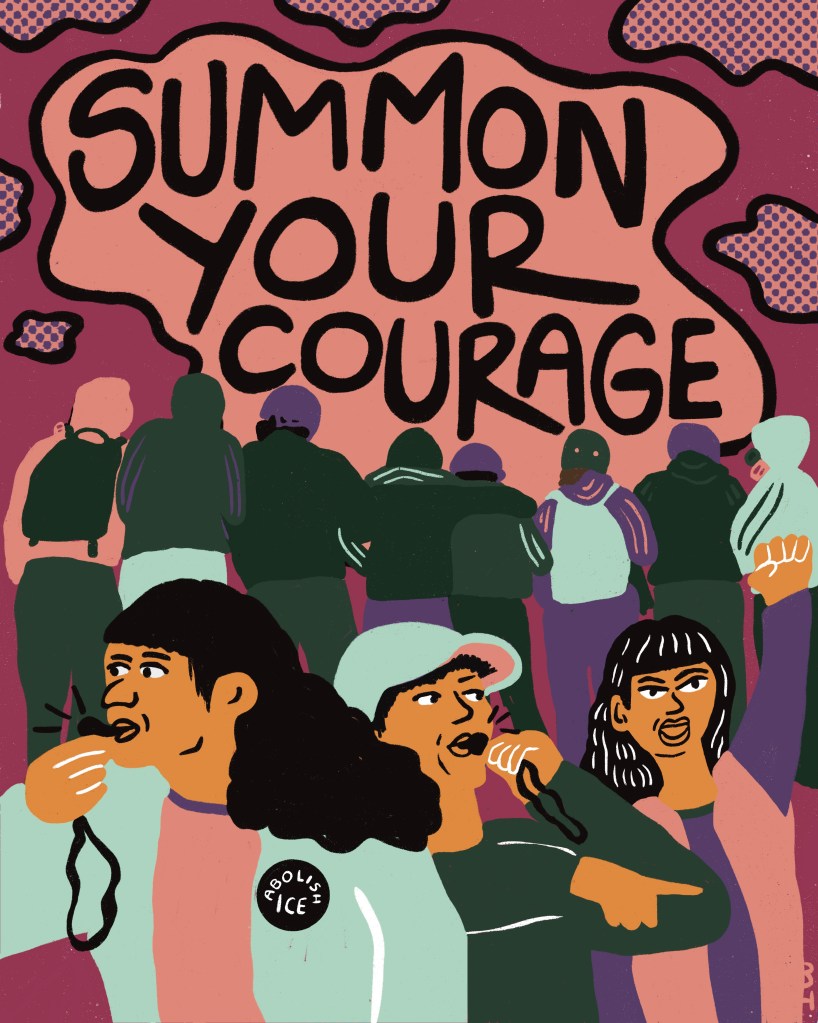
A brightly colored piece of art depicts a line of people linking arms under the words "Summon Your Courage." In the foreground, 2 people with light brown skin and feminine features blow whistles while a third raises their fist. One wears a pin that says "Abolish ICE."
Credit: Monica Trinidad. Instagram: @itsmonicatrinidad. Image available from Justseeds.

Repression of Palestine Solidarity on Campus Enabled Anti-Migrant Escalation

Photos of Palestine solidarity encampments have disappeared from the news, replaced by pictures of immigration agents kidnapping university students and community members, but the campus-based battle to force universities to divest from Israel and weapons manufacturing is still underway.

This a long-term, smoldering battle. “The campuses are definitely as active as they were a year ago from my purview,” says Akin Olla, communications director for the anti-militarist youth organization Dissenters. But, he adds, “The actions look different and are generally less media-friendly.”

While this struggle continues, its shape has shifted, as students who were initially on the front lines of pro-Palestine activism experience additional vulnerability due to the Trump administration’s attacks. Many of these students are Muslim immigrants or from immigrant families, while others are queer or trans and confronting a different series of attacks. As a result of these changes, the shape of the work has changed. For one thing, faculty who spoke to Truthout said that campus student groups are working more in coalition to provide some shielding to targeted students, like Students for Justice in Palestine or Muslim student associations.

Faculty across the United States continue to organize: They’re supporting students and their movements; organizing their own events; building aboveground and underground safety networks in response to the presence of immigration police on campus; and pushing their own unions and scholarly associations to take political positions.


I found it so healing to talk to folks on campuses all over who are creating new networks of solidarity and who see the clear connection between Palestine and other attacks on campus. I am not alone, you are not alone. There are many of us.

Read the full story at Truthout: https://truthout.org/articles/repression-of-palestine-solidarity-on-campus-enabled-anti-migrant-escalation/

And consider signing up as part of the Sanctuary Campus Network: https://www.sanctuarycampus.org/

Harvard Dominates Headlines, But Other Schools Are Quietly Battling Trump

Closed-door committees are forming to investigate whether public universities in North Carolina have fully eliminated diversity practices. Campuses in Utah are being held to neutrality pledges. Accreditation is changing across the Southeast as university systems join a new state-run scheme spearheaded by Florida Governor Ron DeSantis. A major political struggle is being waged on university campuses, and faculty are struggling to keep up.

Higher education has been in the news regularly since the emergence of mass pro-Palestine protests on campuses after October 7, 2023, but much of the coverage has been dominated by the likes of elite private schools such as Harvard and Columbia. Right-wing attacks, however, have rocked campuses across the country, escalating with the Trump administration’s executive orders banning diversity, equity, and inclusion (DEI) practices. These orders have been followed by Department of Justice or Department of Education investigations into whether there are any lingering practices of inclusivity. The playbook has been used at institution after institution as a form of pressure to withhold funds and secure concessions.


In the midst of everything going on right now, universities are facing attacks coming fast and furious. It was an honor to talk to colleagues organizing in many cases under really inhospitable conditions and finding a way to fight for a better future, and I’ve got another article coming out in a few weeks that focuses more on faculty and staff movements to support immigrant and international students and a free Palestine.

Read the full article at Truthout here: https://truthout.org/articles/harvard-dominates-headlines-but-other-schools-are-quietly-battling-trump/

Prisons Allow Private Companies to Cut Off Communication With Loved Ones

Some states’ departments of corrections are outsourcing to private companies their decision-making about who can and who cannot communicate with people in their prisons. These decisions cut families and loved ones off, sometimes permanently.

The Washington State Department of Corrections (DOC) has said it does not maintain any records of who has been blocked from communications with people incarcerated in the state. According to the department, these lists are maintained by the private company Securus, which manages phone, e-messaging and video calls for the state.

In a denial of an open records request submitted by Truthout, the department said: “The records you request from the Securus messaging system are not public records, created, used or maintained by the department and; therefore, are not disclosable under the Public Records Act, RCW 42.56. You may submit your request directly to Securus.” Neither Securus nor its parent company Aventiv responded to any requests from Truthout for further information.

As a private company, Securus is not subject to open records laws in Washington State or anywhere else in the U.S. Prisons are public agencies, and increasing privatization of communications options has contributed to decreased transparency.


My latest piece at Truthout is up now. This is part of my ongoing investigation into how prisons block people (like me!) from communicating with their loved ones. If this has happened to you or anyone you know, please get in touch.

Amid Growing Health Threats, Nurses Are Still Fighting for Basic Protections

Five years since the start of the COVID-19 pandemic caught our health care system unawares, nurses and other health care workers say we are no more prepared for the next threat.

“It’s scary,” says Tatiana Mukhtar, a nurse in New Orleans. The exposure during the initial phase of the COVID-19 pandemic “was horrific, for patients and for health care workers” she says, “and having been there and having experienced that, I feel like we have learned nothing because [health care systems] are still not doing what we need to do.”

Although the emergency feeling of spring 2020 may have faded, the need for public health measures to combat the spread of disease remains urgent. COVID is still circulating widely, and studies show that at least 35 million adults have experienced Long COVID, and that COVID increases the risk of heart disease in both children and adults. This has also been the most dangerous flu season in 15 years, with up to 92,000 people dying of the flu between October 1, 2024 and mid-February this year.

The U.S. also faces a resurgence of both tuberculosis (TB) and measles, the latter of which is one of the most contagious viruses on Earth. Meanwhile, with the threat of a bird flu outbreak among humans also looming on the horizon, the Trump administration is eliminating what Mary Bowman, a nursing assistant professor, refers to as our “already meager public health infrastructure.”

“In truth, what was laid bare by the beginning of COVID was how disinterested capitalism is in people caring for themselves when they’re sick, when they could be sick, when they could get other people sick, when their families are sick, when someone dies,” Bowman told Truthout. “There’s just no space for humanity in it.”


My latest at Truthout is up now. This piece is about the lessons that were learned from COVID that have been forgotten or rolled back, but it’s also about how those lessons — like high quality masking in the hospital — were only ever implemented in the first place because of the hard organizing work of nurses and others. In other words, we have to keep organizing!

They Served Their Time. But They May Still Die in State Custody.

Eliseo Padrón is a 50-year-old Mexican American man from St. Paul, Minnesota. Padrón told The Appeal he grew up surrounded by gang culture. He spent his early adulthood in and out of prison. 

“Living that lifestyle led to me doing a lot of things that I regret,” Padrón says. He was convicted of first-degree criminal sexual conduct in 1995. 

After he violated his parole terms by returning late to the halfway house in 2012, the state sentenced Padrón to the Minnesota Sex Offender Program (MSOP), a “treatment” facility operated by the Department of Human Services. The building shares a campus with the Moose Lake prison, complete with sally ports and razor wire. 

Moose Lake is one of two facilities where Minnesota holds people indefinitely, long after their prison sentences have finished, and often for the rest of their lives. Minnesota, along with 19 other states, the District of Columbia, and the federal government, allows for the civil commitment of people convicted of sex offenses after they’ve completed the terms of their incarceration. 


My first piece published with The Appeal is up now. Sex offense civil commitment is an issue that calls our attention because if some people can be imprisoned for indeterminate amounts of time in order to prevent their future crimes, than we are all subject to the whims of the state. Read the full piece here: https://theappeal.org/sex-offense-civil-commitment/

safety planning and reacting to ICE kidnappings: some concrete steps

In the last two weeks there has been an escalation in the impunity with which state forces can and will kidnap people off the streets in the United States. Of course, arrests are always a kidnapping of someone from their community (a great example here is picking people up with open warrants they may not even know about), but it is also fair to say we are seeing significant escalation in who will be picked up and how little advance notice they have that they are being targeted as we watch noncitizens be snatched by masked cops. Spreading terror is clearly the point here, and it’s effective. Unfortunately, trying to comply is not any better of a strategy than hoping it won’t happen to you or your friends, so our only real choice is to face the fear and work together.

I put together a list of ideas based on my experiences and training related to copwatching, human rights accompaniment, jail support, and anti-stalking safety planning. Some of these make more sense for the people targeted by ICE, while others are more for bystanders who want to try to disrupt these nabbings and the terror they are sowing. None of these are guaranteed to work. The main idea here, taken from human rights accompaniment, is that in a bad situation we can try the slim odds to see if sometimes we can stop the worst from happening.

These are not exhaustive tips, and I’m sure there are things I haven’t thought of. Please feel free to reach out if there’s something you think should be added!

  • Make sure someone knows where you are supposed to be at all times. This is so that people can start making calls and publicizing quickly after you are grabbed.
  • Alter routes and routines as much as you can – this makes it harder for ICE or other state agents to predict where to find you
  • Try not to be alone, especially when in public spaces.
  • Make sure that someone trusted has your birthdate, your A-number, the list of stuff you need taken care of ASAP (childcare, pet care, medication), and your other emergency contacts (like lawyer). This person should be someone who is not likely to be arrested or detained with you, and you should memorize their phone number. (This is jail support protocol.)
  • We should probably ALL get busy making sure we have at least one phone number really memorized that we’d call if we are detained.
  • Make sure you have the phone number of a decent immigration lawyer, who can file a habeas corpus, and that your emergency contact has it. It is likely hard to get set up with a retainer for a lawyer right now, as most are swamped with similar requests, but you can at least get the name and number of a recommended person and give it to your emergency contact. Another idea could be for a group of people to pool resources and engage a lawyer together. A good place to start looking for trusted immigration lawyers is your local National Lawyer’s Guild chapter, or a local agency that does immigration defense (even if you can pay, they may have a referral list).
  • Be ready to call/yell/make a disturbance, especially if you are a bystander. The idea is to disrupt all secrecy.
  • Sometimes it works for targets or witnesses to appeal directly to the humanity of people who are doing the violence.
  • Think of the audience you’re appealing to as international at every point in this process. Public support can create more pressure on the state, but if you do not want your situation, still make sure that a significant number of people know what is going on with you so they are ready to step up.
  • Never talk to the cops! If you are bystanding, you can try talking directly to the person being detained, for example asking “do you consent to this search?”
  • In particular for bystanders, be mindful of not escalating a volatile situation, even as you may be trying to disrupt secrecy.
  • Bystanders may also want to make it clear that you are accompanying the victim, and not just gawking at their terrible moment. I do this by yelling some support or a question, and I also hold my phone visibly in my hand, whether or not I film.
  • It’s also helpful to be clearly marked as who you are, especially if that involves privilege: neighbor, professor, manager, etc.
  • Finally, rehearse these incidents mentally. Go over exactly what you might do, and where this would have to be happening for you to intervene. Rehearse what you will say if you are the one stopped on the street. We experience deep conditioning to go along with authority that kicks in when we’re shocked and confused, and all of us need more practice with disobedience.
Tall, bold text in black is oriented horizontally: “IMMIGRANTS ARE NOT THE ENEMY," created by Kevin Caplicki.
Image by Kevin Caplicki.

Writing about the “pandemic of abandonment”

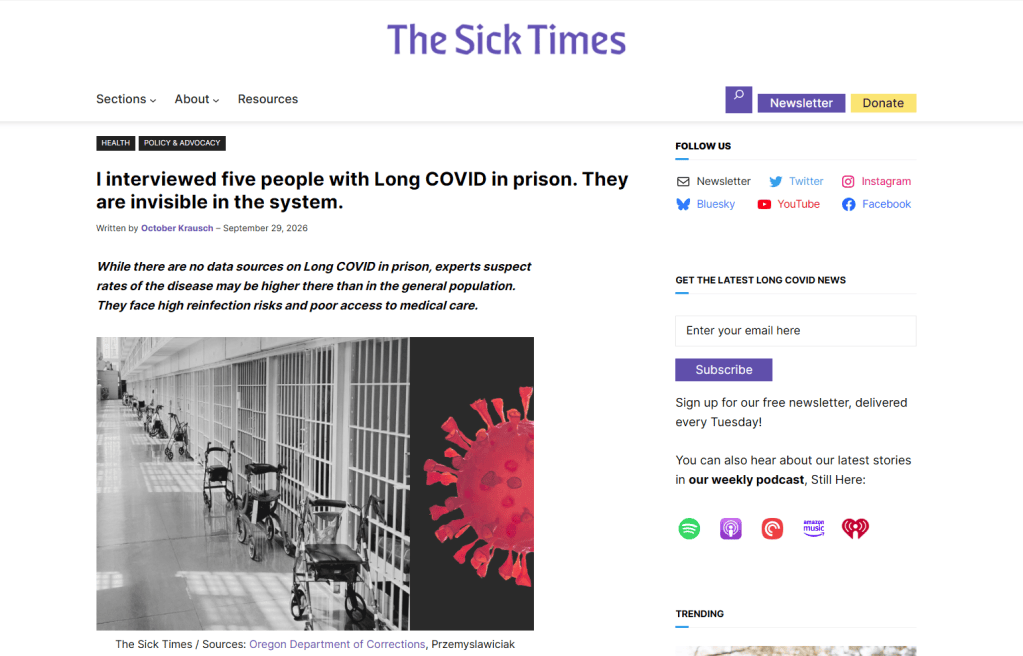
My latest piece, for The Sick Times, is one that was borne out of my own experiences, and especially my frustrations. The five years of the COVID pandemic have been difficult, but it was really 2022 and 2023 that were the most difficult for me. This was the period when so many people I know and love, the same people who were helping me process and keep going throughout the very dark periods of 2020, gave in to the push to “move on.” I have been watching in shock and horror as people close to me have returned to most or even all of their 2019 behaviors, discarding anything we might have learned about protecting each other from infectious disease and making the world a safer place for chronically ill and disabled folks (not to mention preventing more chronic illness and death). These years were also hard because as fewer and fewer people took basic precautions like spacing out risky events or waiting at home when they felt sick to determine if they had a cold or something much more deadly, the world outside got that much riskier. This increased riskiness coincided with my own health getting worse, making me feel that one serious infection could tip me right into disability. In 2020 or 2021 we were working with a shared understanding, but by 2022 all of the burden even in small social settings was shifted on to me if I wanted to be careful, limiting my social world. Suddenly someone not wearing a mask might say “oh yeah, I’m feeling sick, I’m not sure what’s up with me,” as if that didn’t have any bearing on the people around them. I had to start assuming that someone with an active case of COVID was in almost every social setting, drastically reducing my own range of action.

I think regularly about what I did not know, or more precisely, what I did not accept and commit to, prior to the pandemic. I had certainly heard that the flu kills some people every year, but it honestly never occurred to me that the corollary was that I should do everything in my power not spread the flu. This was wrong, and honestly, I’m pretty sure it was rooted in some eugenic thinking that is the status quo. People that might die from the flu, I thought, are people that are vulnerable to all kinds of stuff and something will get them anyway. I’m not proud of this, and I’m not advocating this line of thinking, but I also do not think this is uncommon. I didn’t specifically have this thought consciously, but I felt entitled to a certain range of motion in the world and it didn’t make sense to me to limit that for a small minority. My view on this is changed, dramatically. It is possible to do so much more for each other and to create a world where the flu and COVID and other infections kill so many fewer people each year. Huge institutional change is needed to make this a reality – like paid sick leave and supports for child care beyond the nuclear family – but that’s no different from a range of other social justice issues where I believe fervently that it’s important to fight for institutional change AND to act and live within my values as much as possible. (I want to add, too, that this growth is part of living an examined life. In the future I will probably look back on something I do now and regret the harm I caused, maybe even something comrades are already doing around me.)

Feeling this dissonance with friends and comrades over COVID practices has generated a lot of grief, as it has for thousands of others. This article, which draws on a survey that was responded to by more than 2,500 people, helped me work through that grief. It is helpful (and hopeful) to know that I am not alone, that none of us are alone. That it matters to keep pushing in the direction my values compel me. And it helps to try to make sense of why these deep gulfs have arisen between me and so many people I know rather than remain stuck in the frustration, anger, and grief.

I know the article has been useful to a lot of people who are in a similar situation as me: the COVID-avoidant who are feeling discarded. But I also hope folks who have had their differences with me over COVID practices will find some understanding of how our relationships have changed and why.


The “pandemic of abandonment”: Navigating friendships five years into COVID-19

Over the last five years of the ongoing COVID-19 pandemic, many people have experienced significant changes and ruptures to their personal relationships. People with Long COVID and people taking COVID-19 precautions have lost many friends as they are not able or willing to return to “pre-pandemic” behaviors.

This significant grief has received very little public attention, but the extraordinary response to a The Sick Times survey indicates a strong urge for people to talk about this experience. 

Of 2,586 people who responded to the survey, 81% reported having lost friends.

One woman told The Sick Times, “I don’t see friends often because I hate feeling like the bad guy or like a burden, telling them they have to mask to hang out with me.” Another respondent called this “the pandemic of abandonment.” 

Read the rest here: https://thesicktimes.org/2025/01/30/the-pandemic-of-abandonment-navigating-friendships-five-years-into-covid-19/

After Writing About Prison Censorship, I Got Blocked From Messaging My Sources

Afew months ago, I logged into my online Securus account to send an electronic message to a friend in a Washington State prison. To my shock, I found the word “blocked” on my account and I was not able to send any messages. The block came just a few weeks after I had published an article with Truthout on censorship inside of prisons and had sent the finished article to some of my sources over the e-messaging system. It’s hard to know for sure, but the block is either the result of my journalism, or it is a result of facilitating a book club that connects people inside with those on the outside. Since my Truthout article was about how difficult prisons make it to access information, especially for LGBTQ+ people, the block seems ironic, to say the least.

People in prison do not have direct access to the internet or to any standard email services, nor can they generally receive phone calls. Instead, any communication other than paper mail (which is increasingly rare) takes place over services managed by for-profit companies like Aventiv, ViaPath and IC Solutions. If one of these services chooses to implement a block on an account, as in my case, an outside user cannot send e-messages, put money on a loved one’s books or pay for phone calls — for anyone who lives in a prison, anywhere in the United States, that uses the service that has implemented the block.

The only remedy for this is apparently to appeal to the state Department of Corrections (DOC), but unsurprisingly, there is no obvious method for such an appeal available to an outside family member or friend. Figuring out how to appeal required several calls and emails, and in the end, did not yield any change to my situation. This block is inhibiting my ability to do my work, and more than that, it’s isolating my friends in prison from contact with the outside world.


My last article of the year was this op-ed for Truthout, about a problem I’ve been dealing with for the second half of 2024. Make sure you take your blood pressure pills before reading, because the prison system is shameless in its cruelty and the results are enraging. Read the rest of the story here: https://truthout.org/articles/after-writing-about-prison-censorship-i-got-blocked-from-messaging-my-sources/