Eulogy for UWS

I did not plan to be a college professor when I entered my PhD program in sociology. I was interested in more directly community engaged work and writing. I fell in love with teaching during my fieldwork at a movement run high school for adults in Buenos Aires, where I co-taught social sciences in a classroom populated primarily by young women who lived in the neighboring shantytown. But even so, I was highly suspicious that this experience could be replicated inside of a bureaucratic institution of higher education in any meaningful way.

It was only toward the end of my tenure as a graduate student when I saw one particular job listing that I decided to look for jobs teaching at the university level. The job was at the University of Michigan-Flint, a regional comprehensive university where my mom had graduated when I was a kid.

Looking at the posting brought back a flood of memories of attending classes the few times she didn’t have childcare, and had to take me to classes with her. These days are burned into my memory, because the visual inspection, behavior talk, and overall prep was intense! I must have been in about second grade, and I can remember my mom talking me into wearing my best clothes by telling me this is what all the “college girls” would be wearing. I know I was much more dressed up than I usually got just to go to my own school. Now I can see that my mom was worried about being embarrassed by having me or us look too poor, since having to bring your kid to class is already a bad way to stick out at college. Once I can remember getting a new toy doll just in order to go to class to be sure that I wouldn’t become restless during the lecture. Although I was generally a pretty good kid, I still remember the very serious talk I got before going to those classes about how essential it was that I be absolutely good.

I have told this story to more than one student at UWS, because I wanted these students to feel welcome in my classes and on our campus. And I always tell them their kids are welcome in my classes, because I know they will behave. After all, I know exactly the serious talk they got before coming to the class. I have wanted to be part of expanding these students’ access to education, their access to big ideas, and part of expanding their world. My mom’s life circumstance forced her to leave high school but her child is a college professor, in no small part because of my exposure to the importance of College, capital C, through her and her persistence in completing it.

I didn’t get the job at U of M-Flint, but after I saw that listing I knew that I wanted to teach students like my mom. Not just students with kids, but nontraditional students; students who never thought they’d find themselves in a university for a variety of reasons including race and social class; students who are afraid that if something goes wrong, someone will figure this out, and they won’t be let back in. UW-Superior has provided a tremendous environment for doing this, because it is open enrollment, has small class sizes, has a public liberal arts college mission, and my department is very supportive of deeper methods of teaching and learning. All of this is unsustainable with the loss of any faculty voice in the running of the campus, the partnership with for-profit companies who will put pressure on the campus to develop easier curricula for faster degrees regardless of what is being learned (if they haven’t already started), and the elimination of nearly all the liberal arts disciplines on campus. There is no longer any institutional support for these experiences.

I have been able to be a part of amazing transformations in my few short years at UWS that are considered impossible in most educational environments, and I will be grateful for that experience. But I will mourn the tremendous loss for all of us in the region at the abandonment of that mission, and I will not participate in the charade that it has not been abandoned. This is no longer the UWS where I hoped to spend the next twenty five years teaching.
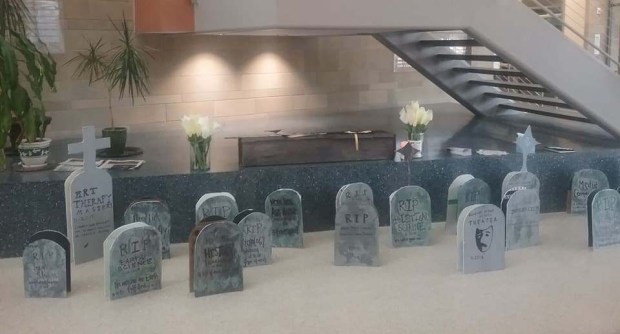
picture is of 25 handmade headstones with the names of academic programs set out in a univeristy building. in the background is a cardboard casket flanked by paper flowers.

Headstones for each cut major and minor program and a casket for the University of Wisconsin-Superior we knew and loved. The funeral was held Saturday, April 14, 2018. Photo Credit: Trudy Fredericks.

a meditation on tools

In the United States, the squeaky wheel gets the grease.

In Japan, the nail that sticks out gets hammered in.

Audre Lorde famously admonished white feminists at a conference in 1979 that “the master’s tools will never dismantle the master’s house.”

Black and white line image of a hammer, screwdriver, and wrench.

If you are neither the wheel or the nail, you might start to wonder about your commitments to justice.

It might not be an honor to be the last one standing.

Does that make you a tool?


lazy professor up at night

Last fall my university made the very sudden announcement to close the sociology program as well 24 others. Part of this experience as a faculty member is being told that it’s our fault, constantly. We are implicitly and explicitly blamed for not doing enough before this point. Chancellor Wachter has said over and over again that the “students voted with their feet,” which is just a way of saying if I/we had been offering worthwhile classes, I/we wouldn’t be in this situation (among other problematic implications of this phrase she loves so much). And yet here I am, literally awake at night, either still thinking (uselessly) about what I could do to try to stop these cuts from happening, or about what I could do make our program better, or about how I could recruit more students. The other night I lied in bed with a new idea for bringing back successful graduates (which is most) to meet our current students. I had pretty much fully developed the idea before I realized the entire thing is moot. There is no sociology program to recruit anybody in to. There is no reason to ease anybody’s fears about majoring or even minoring in sociology. In fact, perhaps students have good reason to be afraid of these majors and minors. Perhaps they should be afraid the administration will eliminate them, or the faculty time and resources need to sustain them. Working to recruit more students at this point would just be more time I’d spent on something that wouldn’t be valued, and if successful, I’m afraid it would ultimately place more students in the path of destruction.

But thinking about such solutions has become almost like a reflex for me, so that even six months later it’s still hard to stop. So I still haven’t been able to stop. And I don’t know when I will be able to, because ultimately I love(d) what I do. And I wasn’t coming up with ideas to recruit students to the major just to satisfy some bureaucrat or looking for ways to assuage student fears about what it would mean to major in sociology to bolster our numbers, but I was doing it because I wanted to teach. Because I thought that majoring in sociology would actually be meaningful for students, and because I know our graduates are actually out in the world happy with their work and I’d love to see more people doing that. It’s hard for me to turn that off, because it’s hard to accept the destruction of that possibility.

I see the same difficulty turning this impulse off in my colleagues too. We keep trying to do our jobs as if the old things mattered, although we have been pretty much told over and over again by our bosses that none of what we do matters, or at least not a lot of it. But old habits die hard, and it’s precisely because we believed passionately in those old habits. Because we weren’t and still aren’t the people we’re accused of being. And that’s one of the most painful bits. We’re accused of being these lazy arrogant out of touch people who don’t care at all for our students by people who actually seem to be all of those things.

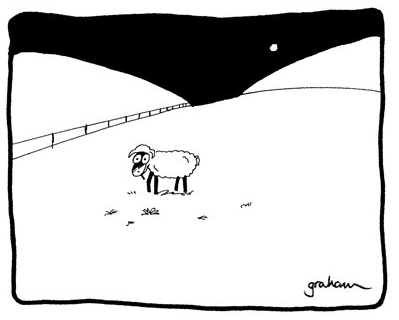
Sheep alone awake in a field at night.

Cartoon by Graham Licence

I’m left with a few hanging sociological questions for another day about the myth of the lazy professor: Who does the myth connect with? Who believes it? Anyone? Our students’ parents? Do the administrators and politicians who deploy it, or is it used totally cynically? (I don’t think the administrators believe it; I suspect they know it’s untrue and that’s why it will offend us so much.) Why does it hurt me so much if I’m not sure who believes it?

Losing the University

The university was never meant to be a place for liberation and social justice, but from its start was built for straight, white, able-bodied, cis-male elites. Rod Ferguson reminds us in his work We Demand that the fact that many of us associate universities with something else – with diversity, with the possibility for envisionining anticapitalist politics, with social justice movements – is in many ways the product of student struggles. Universities themselves have resisted these associations. Ferguson recalls for us that in 1970, four students were killed at Kent State University by the National Guard. Ten days later, police shot approximately 400 bullets into a women’s dorm at Jackson State University, killing two students. The reaction to these murders by dozens of college presidents was to “petition their state legislators not to curtail but to augment police powers on their campuses”(15-16).

The point is that I know the university is not nor has it ever been this romantic perfect place. I remind myself of that fact constantly. I was never planning on making a life here in academia in the first place; I didn’t feel like it was my life’s mission to teach undergraduate students and I have always felt like there are much better and more direct ways to make social change than education. This makes it easier to remember that the university has always been flawed, it wasn’t meant for anyone other than straight white male elites, and if some of the rest of us have managed to increasingly arrive in the past 100 years, especially the last 50 years, it has been for the most part, an anomaly. And it has been the fruits of our struggle. They didn’t want us here in the past and they don’t want us here now. They have never wanted us here. Ferguson says

For university and political elites, then, the social categories ‘tolerance’ and ‘diversity’ were never meant to inspire appreciation for the student movements, movements that might shed light on social inequalities and recommendations for transcending them. “Tolerance” and “diversity” were instead ways of saying “Society must be defended”—that is, protected from the student, who was understood to be a criminal from the start. (2017: 23)

In other words, it is not necessarily a tragedy to lose this place because there are and have always been other ways of doing this. Marginalized communities have always found ways to educate themselves, and those ways, being designed by and for liberation, have more liberatory potential than any institution which has always fought to keep us out.

But knowing all of that doesn’t seem to be helping me feel less sad right now. It doesn’t seem to be helping me much at all. The fact is that I feel I’ve benefitted enormously from my time in and around universities and it seems like many of my most marginalized students have done so as well. While these other forms of learning and education, free schools and free universities and popular educational models which I’ve been a part of, can be much more liberatory in the end, I’m afraid they will still be much more limited in their reach than the good ol’ public university in its heyday was. (Because was is really starting to seem like the operative concept here.)

Ironically, I mean, I wouldn’t even know about free schools without my exposure to the university… that’s certainly not true for everybody. And it needn’t be true. But I think it points to why I feel hope lacking in this moment. I feel a light going out. And sure, that light was really dysfunctional in the first place but it was granting wide access and possibility and acting as a funnel, at least for many students, to something much better, to much more critical ideas and action. How many of us were radicalized in the university? Of course there are other sites, other methods, other ways, but undeniably, this sucks.

The loss of access to critical thinking, to liberal arts, to social justice oriented classes throughout Wisconsin (and probably eventually elsewhere), is without a doubt, a loss of something, for some folks, who were in fact benefitting. Even if we do succeed in creating liberatory alternatives, it’s hard for me to imagine they will have the same reach and impact as the public university in its heyday. But I could be wrong. Perhaps I just need to dream bigger. I hope so. Perhaps I just need to get started on the experiment.

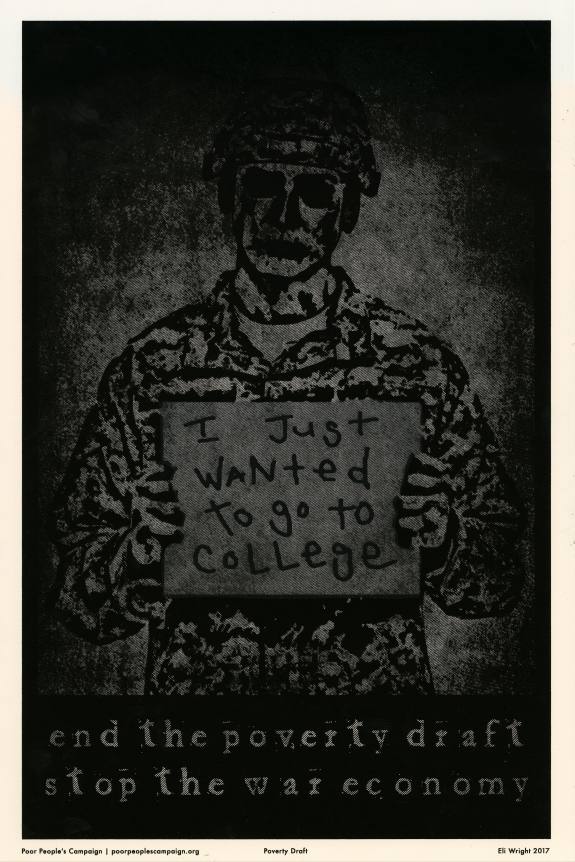
Black and white screenprinted poster of a soldier holding a sign that says "I just wanted to go to college." Text at bottom of poster says "End the poverty draft. Stop the war economy."

Image created by Eli Wright at Justseeds Collective for the new Poor People’s Campaign.

Stop Telling Me I’m Brave: On Courage and Being Set Apart

As feminists we know it’s important for us to have each other’s backs in a shitty heterosexist world. We have often done this by reassuring each other that we are strong and brave people. The thing is, after the year I’ve had, I’m not sure telling our friends over and over that they’re brave works the way it’s supposed to.

When you call someone brave you pretty much mean to say that they’re doing something that you’re not sure you would do in their situation. And that’s a compliment, but it also pushes that person away from you by making them different. When I spoke out openly about my experience as a stalking survivor and the incredible failures of the institutions that were supposed to protect me, it started to feel less like “brave” was about having my back and more like no one else was “brave” enough to have my back.

It started when I was doing things that did not feel like they even involved a choice, let alone courage. What I learned in surviving stalking is that even if you think you don’t want to go on, you pretty much do because there just aren’t that many other choices available. With the exception of suicidal depression (which I’m not minimizing, but I didn’t have), you will have to get out of bed sometime. I missed more days of work than ever before, but still I couldn’t just stop going altogether. I wasn’t so out of it that I couldn’t calculate those risks. I kept putting one foot in front of the other and showing up. Surviving.

My acts are not what I would characterize as “brave” necessarily. They are acts of resilience, like the acts that human beings who have survived worse things before me like intimate partner stalking, colonial wars, and daily racist police violence. Human beings are, at the end of the day, apparently pretty good at surviving some pretty terrible things, but that doesn’t make us all brave, and being called brave, when I was busy just surviving stalking, was almost like salt in the wound. Because all I felt, all the time, was fear.

I advocated, loudly, for my safety in my campus workplace. And, because I am a feminist activist, I did this in a way that I hoped would benefit future stalking victims and tried to point out how inevitable it is that this problem would happen again. I published my story with a major web outlet clarifying why I thought we needed better procedures on our campus not just for myself but for all of us, and called out my campus for their shameful disregard of the safety of my body and their refusal to “set a precedent.” I went forward with this story publicly even after I was issued an ultimatum insisting that it needed to be published anonymously or it could not be published. In each case, I was told by my friends and colleagues that my actions were very brave but in each case, I felt like I was simply doing the only right thing.

When my friends were calling me brave, it really felt like they were just letting themselves off the hook for not taking actions that were similar to mine or, worse, for not joining me in solidarity in the ways that they might have been implicated. I do not think my friends consciously meant anything negative when they told me I was brave. I think they really meant it. But what it usually means to say someone is brave is – what I heard–was, “oh wow, you have so much courage. I could never dare to do that.” What I needed to hear was: “man that situation sucks! Let me join you in this struggle.”

As a feminist method of support, bravery seems to work okay when we assign the label to ourselves. The women who wrote the groundbreaking All the Women Are White, All the Blacks Are Men, But Some of Us Are Brave obviously got a lot out of it. There were times when I liked the idea too, but only when I decided on my own to do something that I felt was brave. When the idea of bravery backfired, it was when someone else called me brave. Like a lot of terms, there’s a big difference between applying it to yourself and having it applied to you by someone else.

The concept of bravery though is one that always sets people apart. It’s an idea that’s usually associated with extraordinary individuals. Extra-ordinary. And maybe that’s why it hurt me so much, because I was already feeling so isolated. Bravery just seemed to set me even further apart from the pack.

But there are other reasons to avoid setting people apart, even when they haven’t necessarily survived something traumatic. If we want to build social movements that will change the world, we will need groups of people, not a few extraordinary individuals. I don’t dispute that to do this work we will have to be brave, but maybe we need to stop calling each other brave. Instead we have to find ways to be brave together. The first step to doing this will mean not holding each other up on pedestals too tall to reach but alternatively trying to learn how we can better support and understand each other’s necessary and chosen risks. Here in the United States the cliché is that one person can change the world but the reality is that it takes many people to change the world. Dr. Martin Luther King, Jr., did not boycott those buses on his own. Assata Shakur didn’t break herself out of jail. Although in the course of history we’ve exalted only these single individuals, their names would mean little without the movements full of other people around them. If they had been set apart in their own time as singularly brave individuals, as merely exceptional people, we wouldn’t even know who they were today because nothing would have been accomplished.

I know by telling me how brave my actions were that my feminist friends were trying to be nice and supportive. I can see that I was moving from surviving to advocating and that people wanted to pat me on the back for that forward movement. But what I want is to change the world, and for that I need my friends to join me, not laud me. I want my acts, just like my feminist ideals, to become ordinary, not extraordinary.

solidarity is our weapon

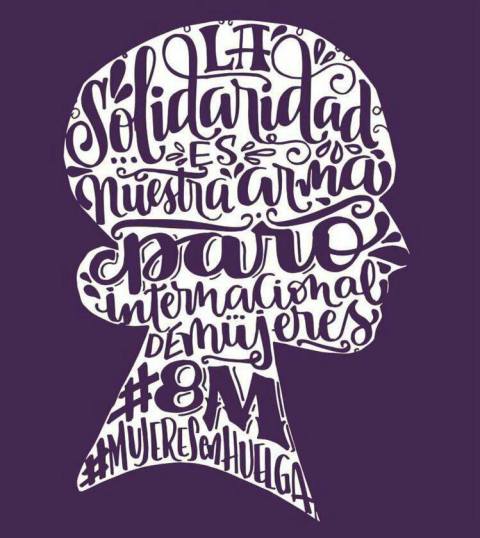
“Solidarity Is Our Weapon. International Women’s Strike.”