Saturday Rec: Fiction I Read in 2018

To celebrate the end of the year I’m recommending a whole slew of things to read! This is a non-exhaustive list of the novels I read this past year that I loved and would love for you to read. Why read fiction, you ask? Please watch the fabulous (and dearly departed) Ursula K LeGuin at the National Book Awards in 2014 explain that it is in part because we “need writers who can remember freedom” (transcript here).

  • LaRose – Louise Erdrich
    • I’ve read several of Erdrich’s books and I plan on eventually reading all of her work – but slowly, so I don’t run out of it.
  • The Killing Moon and the Shadowed Sun (The Dreamblood Duology) – NK Jemisin
  • She Would Be King – Wayétu Moore
    • A magical realist tale of the founding of Liberia. I actually recommend not reading any more summary than that.
  • Troubling Love – Elena Ferrante
    • A painful but beautiful novel about the sudden disappearance and loss of the narrator’s mother in Ferrante’s signature style. I think I have now finished Ferrante’s catalog and I feel a bit lost.
  • Pachinko – Min Jin Lee
    • A book about four generations of a Korean family from before the two Koreas and their migration to Japan. A great transnational novel on race, identity, and migration.
  • Unsheltered – Barbara Kingsolver
    • I’ve read and loved all of Kingsolver’s work and this is her newest.
  • The Ministry of Utmost Happiness – Arundhati Roy
    • A very beautiful and surprising novel about nonbinary genders and the militant struggle in Kashmir.

If Ursula K Le Guin did not convince you, my favorite academic advice columnist has also recommended reading fiction among many other wonderful suggestions for those experiencing “outrage fatigue.” Here’s to imagining (and building) a different world in 2019.

leguinbookawards

Ursula K Le Guin at the National Book Awards in 2014.

a spell for writing

Some days I have so much to say that I can’t find a way to say anything.

Other days I run so dry of words that I have to read a book.

Learning to tell the difference feels like magical self-awareness, but it is a simple spell.

  1. Breathe deeply and know that both will pass quickly.
  2. Spend a few minutes letting it all out on the page.
  3. If nothing comes out, spend a longer time letting the ideas flow in.

Saturday Recommendation: When They Call You a Terrorist

When They Call You a Terrorist: A Black Lives Matter Memoir – Patrisse Khan-Cullors and asha bandele

I do not think I have ever met anyone who could not somehow benefit by reading this book. White people, middle class people, and anyone who experiences the privilege of not being Black in the US will find a lot illuminating in Khan-Cullors powerfully told story of growing up in a culture which simply does not value your life or those of your loved ones. The honesty and vulnerability with which this contemporary story is told means that there is a lot to be learned even for those who feel that they have done a lot of listening, learning, and studying; there are new nuances here that are important. This same emotional heft means that the book has value (at least, I imagine so) for those who do share her experiences because it is validating. Its intersectional dimensionality – careful attention is paid here not only to gender but to sexuality, trans visibility, and more, including how communities and movements have succeeded and failed in organizing at certain moments because it is always a struggle—mean that there are opportunities for everyone to learn. Organizers and activists will also find Khan-Cullors’ words inspiring , validating, and simply nourishing. Those who are not activists will find the book helpful for understanding why others, such as the three women who founded Black Lives Matter, do what they do.

Two short passages that occur near the end of the book:

 “…now it was late, maybe 1:00 in the morning, and I was heading back to my cottage where Mark Anthony was supposed to be sleeping but instead was standing outside our home, barefoot, in pajamas and with his hands cuffed behind his back. … They were able to gain entry to our home because in St. Elmo’s, before this, we never locked the doors. But on this night, the police entered through the back door. They said he fit the description of a guy who’d done some robberies in the area. They offered no further explanation. … Later when I hear others dismissing our voices, our protest for equity, by saying All Lives Matter or Blue Lives Matter, I will wonder how many white Americans are dragged out of their beds in the middle of the night because they might fit a vague description offered up by God knows who. How many skinny, short, blond men were rounded up when Dylann Roof massacred people in prayer? How many brown-haired white men were snatched out of bed when Bundy was killing women for sport? … Mark Anthony’s cuffs are finally removed, but the police do not leave my home for another two hours, taking down all kinds of information about him, running his license, hoping to find any reason to take him away, this man they yanked out of his own bed in the middle of the night in the house where he lives in a community where he is loved” (pp. 193-195).

And then, a discussion about the formation of the BLM:

“We agree that there is something that happens inside of a person, a people, a community when you think you will not live, that the people around you will not live. We talk about how you develop an attitude, one that dismisses hope, that discards dreams” (p 199).

This book is a record of life in Van Nuys. This book is a record of a movement. This book is a record of state terrorism. This book is a record of a dream.

sadness and struggle

I’ve been trying and failing to finish a lot of writing over the last few weeks. I have felt overwhelmed, with a lot to say, but at the same time not quite able to edit and polish and publish what I’ve got.

Today, after once again writing about 1,500 words without finishing a post, I finally picked up Cindy Milstein’s Rebellious Mourning and read the first essay, Benji Hart’s “Feeling Is Not Weakness.” In it, Hart talks about how sad and depressing it is to connect the dots on the systemic violent oppression of black and brown people. Hart says they feel guilty for being sad, because Hart knows one of the functions of the system is to create demoralization. Sadness makes it feel like this campaign of demoralization is working. In Hart’s words:

“I feel guilty for being demoralized. I should be angry. I should be fiery with unquenchable passion. I should be as relentless as the state. If I am sad, the state has won. If I am sad, the fight is over”(p. 20).

I too feel sad. And I had not realized until just at this moment that I have had writer’s block because I didn’t want to write anything out of my sadness. I didn’t want to let Husky, or city council, or Walker, or Trump, or whoever control my life and my successes and make me sad. I didn’t want the state or capital to win. But feeling sadness when confronted with tragic realities is what makes me human. It is what makes me strong. Hart puts it like this:

“Experiencing hurt around the realities my people and I face is more than understandable; it shows that I have not given in, not accepted the current, violent reality as inevitable, not forfeited belief in my own right to life.”(p. 21)

A compañera of mine put it another way:

“We’re in the heart of the Empire,” I said.
“You’re wrong,” she said, “the Empire has no heart.”

My sadness does not mean the battle is lost. It means I’ve refused to lose what’s at the core of struggle and what we struggle for: my dignity and humanity. My belief that better worlds are possible. My compassion for others. My willingness to see and face systemic injustice. My meaningful connections to people living precarious lives of all kinds. My hope that people can be better people, and that they can find the will and courage to stop enacting their power over others. It’s only when I become so cynical that I lose these things that the fight is over. Sadness is not the sign the battle is lost but the sign that it is still raging, and the sign that I am still willing to fight it.

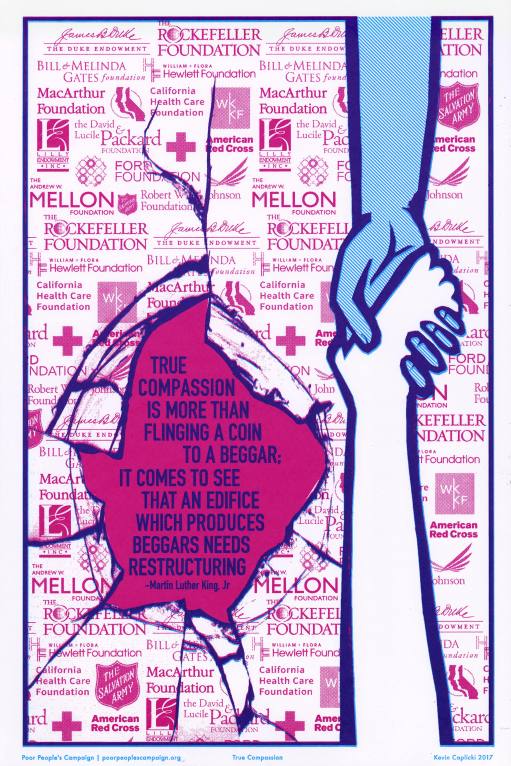
a blue arm and a white arm hold hands across a paper background with foundation and charity names. the paper is torn to reveal the words "True Compassion is more than flinging a coin to a beggar; it comes to see that an edifice which produces beggars needs restructuring." - Martin Luther King, Jr

Art by Kevin Caplicki for the Poor People’s Campaign, available at Just Seeds Collective.