I interviewed five people with Long COVID in prison. They are invisible in the system.

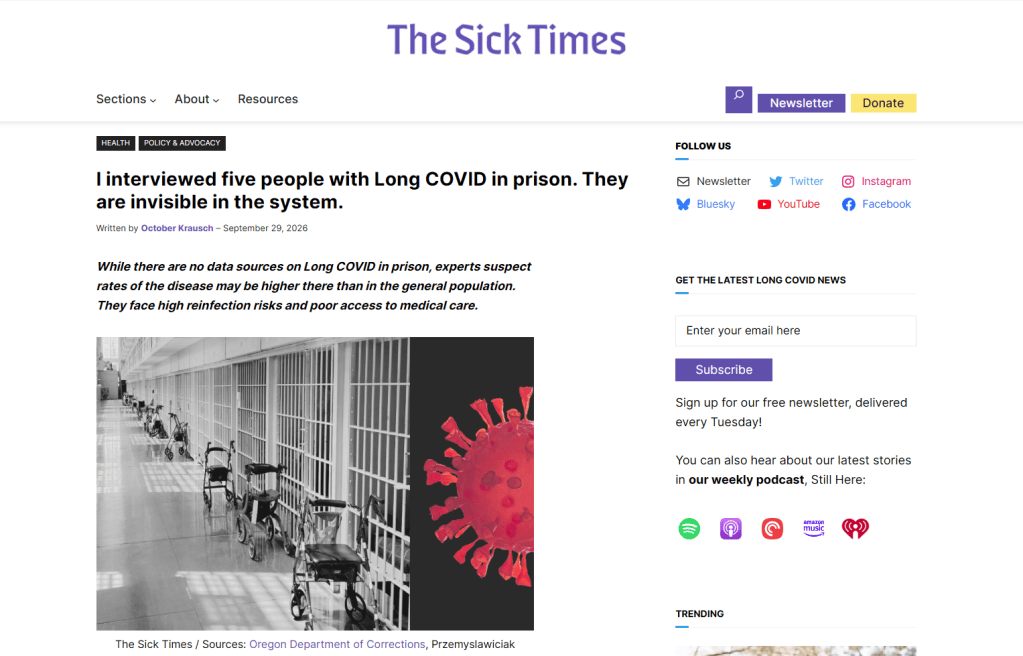
A screenshot of the front page of the Sick Times website featuring this article.

Since he had a stroke during his case of COVID-19 in November 2020, 72-year-old Richard Grape sleeps for 12 to 18 hours a day and uses a wheelchair. Grape says he lacks the energy to do much of anything at all, even play games on the PlayStation he bought for himself. Like a lot of people with Long COVID, he doesn’t have a formal diagnosis. 

Grape has spent the last 31 years imprisoned by the Colorado Department of Corrections (DOC). An army veteran who treasures his travel memories, Grape told The Sick Times what it’s like to be in prison with Long COVID. “I think it’s actually getting worse, to be honest with you,” he said. “I do not have a lot of drive or motivation to do hardly anything.” Nonetheless, Grape still needs to get up any time guards want to do a shakedown (a surprise search) of his cell or count heads. 

Prison is a notoriously bad place for anyone with chronic illness because of the difficult living conditions and inadequate medical care. There are no reliable data on how many people in prison across the country have Long COVID, or, critically, what kind of care they are receiving. 

John Richard Green, who is imprisoned in Texas, wrote that, with Long COVID, his health is “more messed up than the floor of a New York cab.” He has chronic diarrhea, cataracts in both eyes, incontinence, fatigue, and nerve pain. Green is a fan of the band Emerson, Lake & Palmer, and like Grape, is an aging man who has been in prison for decades.

“Now I am bedbound, sick, and all alone,” he wrote. “And waiting for parole to a nursing facility because I have nowhere to parole to.” Green recently lost his aunt, who managed his finances. Like many people entering their “golden years” in prison, Green has little surviving support on the outside. Yet, he wrote, “I’m hanging on, because I promised my aunt I wouldn’t give up.”  

For this story, The Sick Times spoke with experts in prison health data and lawyers handling prison-related litigation, and circulated a call among prison newsletters. After several months, we interviewed five people in prison in four states who have Long COVID symptoms but found no sources of systematic data.

Speaking with sources in prison is challenging. All forms of external communication are difficult from inside the prison. Calls are limited to 30 minutes or less, depending on the state, and in Colorado and Oregon, an opaque process of approval took several weeks before these calls were permitted. Additionally, e-messages require the purchase of “stamps,” which is a hardship for those without financial support from the outside.

Once in contact, sources reported no interest from medical staff in Long COVID and varying levels of accommodations for their symptoms. Grape and Green are each living in quasi-retirement within the prison, but others are simply struggling through daily life as best as they can. Wayland Scott, who is living with Long COVID in an Oregon prison, said that it’s hard enough to find a decent job and requesting any work accommodations or restrictions would be of no benefit. “You’d screw yourself.”

All those who spoke to The Sick Times lacked Long COVID–informed medical care, but more than that, they lacked access to basic information about the disease.

Read the rest here: https://thesicktimes.org/2026/09/29/i-interviewed-five-people-with-long-covid-in-prison-they-are-invisible-in-the-system/


This article, the product of a months-long investigation, is up now at The Sick Times. Although this article is a rough read, I hope people will not feel hopeless after reading it. There is a lot we can do to ease the suffering of people in prison that is discussed at the end of the piece (and please reach out if you want any ideas or support with that!). And, as I have often, often argued on this blog, doing even something small about a social problem in a consistent way is the path both to rejecting despondency and to tearing down the awful world we have to bring about something new.

Writing about the “pandemic of abandonment”

My latest piece, for The Sick Times, is one that was borne out of my own experiences, and especially my frustrations. The five years of the COVID pandemic have been difficult, but it was really 2022 and 2023 that were the most difficult for me. This was the period when so many people I know and love, the same people who were helping me process and keep going throughout the very dark periods of 2020, gave in to the push to “move on.” I have been watching in shock and horror as people close to me have returned to most or even all of their 2019 behaviors, discarding anything we might have learned about protecting each other from infectious disease and making the world a safer place for chronically ill and disabled folks (not to mention preventing more chronic illness and death). These years were also hard because as fewer and fewer people took basic precautions like spacing out risky events or waiting at home when they felt sick to determine if they had a cold or something much more deadly, the world outside got that much riskier. This increased riskiness coincided with my own health getting worse, making me feel that one serious infection could tip me right into disability. In 2020 or 2021 we were working with a shared understanding, but by 2022 all of the burden even in small social settings was shifted on to me if I wanted to be careful, limiting my social world. Suddenly someone not wearing a mask might say “oh yeah, I’m feeling sick, I’m not sure what’s up with me,” as if that didn’t have any bearing on the people around them. I had to start assuming that someone with an active case of COVID was in almost every social setting, drastically reducing my own range of action.

I think regularly about what I did not know, or more precisely, what I did not accept and commit to, prior to the pandemic. I had certainly heard that the flu kills some people every year, but it honestly never occurred to me that the corollary was that I should do everything in my power not spread the flu. This was wrong, and honestly, I’m pretty sure it was rooted in some eugenic thinking that is the status quo. People that might die from the flu, I thought, are people that are vulnerable to all kinds of stuff and something will get them anyway. I’m not proud of this, and I’m not advocating this line of thinking, but I also do not think this is uncommon. I didn’t specifically have this thought consciously, but I felt entitled to a certain range of motion in the world and it didn’t make sense to me to limit that for a small minority. My view on this is changed, dramatically. It is possible to do so much more for each other and to create a world where the flu and COVID and other infections kill so many fewer people each year. Huge institutional change is needed to make this a reality – like paid sick leave and supports for child care beyond the nuclear family – but that’s no different from a range of other social justice issues where I believe fervently that it’s important to fight for institutional change AND to act and live within my values as much as possible. (I want to add, too, that this growth is part of living an examined life. In the future I will probably look back on something I do now and regret the harm I caused, maybe even something comrades are already doing around me.)

Feeling this dissonance with friends and comrades over COVID practices has generated a lot of grief, as it has for thousands of others. This article, which draws on a survey that was responded to by more than 2,500 people, helped me work through that grief. It is helpful (and hopeful) to know that I am not alone, that none of us are alone. That it matters to keep pushing in the direction my values compel me. And it helps to try to make sense of why these deep gulfs have arisen between me and so many people I know rather than remain stuck in the frustration, anger, and grief.

I know the article has been useful to a lot of people who are in a similar situation as me: the COVID-avoidant who are feeling discarded. But I also hope folks who have had their differences with me over COVID practices will find some understanding of how our relationships have changed and why.


The “pandemic of abandonment”: Navigating friendships five years into COVID-19

Over the last five years of the ongoing COVID-19 pandemic, many people have experienced significant changes and ruptures to their personal relationships. People with Long COVID and people taking COVID-19 precautions have lost many friends as they are not able or willing to return to “pre-pandemic” behaviors.

This significant grief has received very little public attention, but the extraordinary response to a The Sick Times survey indicates a strong urge for people to talk about this experience. 

Of 2,586 people who responded to the survey, 81% reported having lost friends.

One woman told The Sick Times, “I don’t see friends often because I hate feeling like the bad guy or like a burden, telling them they have to mask to hang out with me.” Another respondent called this “the pandemic of abandonment.” 

Read the rest here: https://thesicktimes.org/2025/01/30/the-pandemic-of-abandonment-navigating-friendships-five-years-into-covid-19/