What if Renee Good had been a jerk? (guest post)

Below is a message from a migrant and scholar of migration. She has restrained from publicly speaking her mind on the horrors that are happening to the migrant community in this country and the anxiety that she lives with day to day because she is keenly aware of the risk in doing so under a regime that does not recognize her humanity. 

Yet she also understands that the fear she feels is a carefully calibrated tool to keep her silent and isolated and that her silence will not protect her (or anyone). So in a desperate attempt to encourage herself to exorcise the fear out of her body, she requested that I share the following words on her behalf. She hopes that if each small drop of anger can find one another and become a raging torrent, it may tear open the dark reality and bring a ray of light.


I have seen so many posts going around highlighting what kind of a person Renee Good was. She was kind, a mother, a daughter, a U.S. citizen, and (unspoken but probably most importantly) white. In other words, she is, or is made to be, a perfect victim. Having studied media discourse surrounding immigration, I recognize and understand this pattern—it’s an effort to “humanize” the victim and make her more “relatable” so more will rally behind her and take action. 

But I cannot stop wondering: what part of “being shot multiple times in the face right next to your partner and in front of your dog” is not condemnable enough that we need to add qualifiers to the deceased so we can dare to act and demand actions? What if she had not been kind? Had no children? Weren’t white or citizen? Would her murder not be worthy of grief or outrage? Why do we have to humanize a human being with adjectives that exclude other humans? 

Maybe we all can and should relate to Renee Good not because how amazing and white she was but because she once lived and was murdered by a state yielding violence granted by its citizenry.

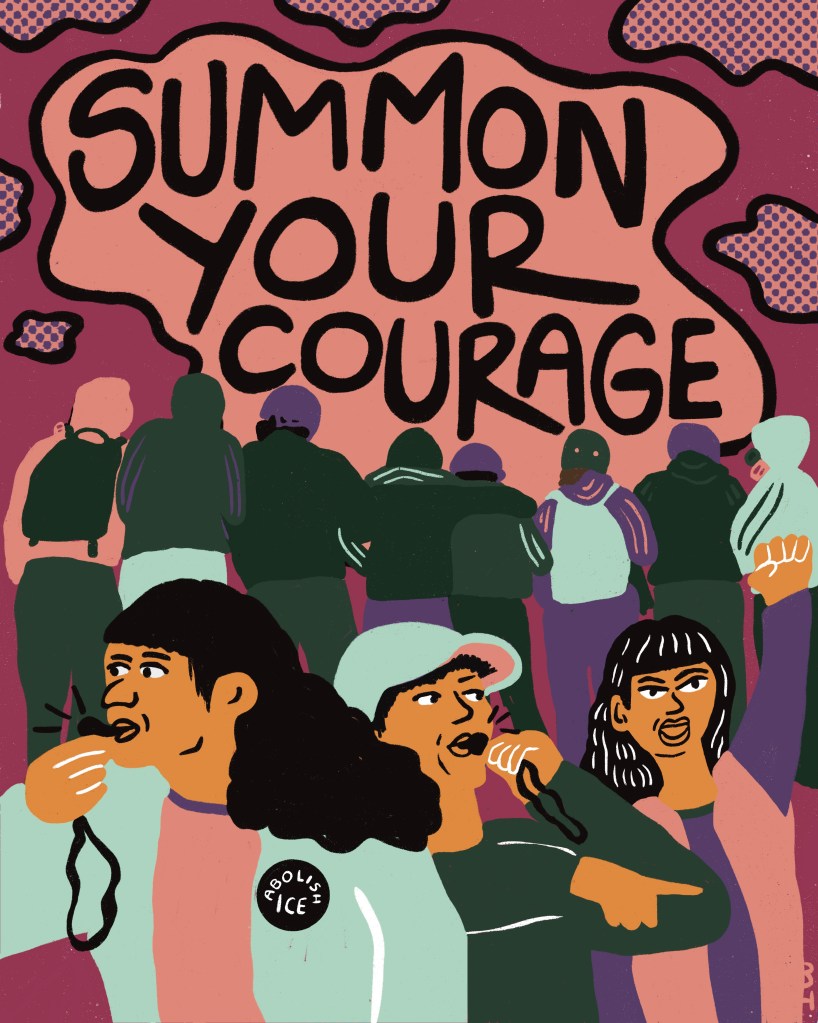
A brightly colored piece of art depicts a line of people linking arms under the words "Summon Your Courage." In the foreground, 2 people with light brown skin and feminine features blow whistles while a third raises their fist. One wears a pin that says "Abolish ICE."
Credit: Monica Trinidad. Instagram: @itsmonicatrinidad. Image available from Justseeds.

Writing about the “pandemic of abandonment”

My latest piece, for The Sick Times, is one that was borne out of my own experiences, and especially my frustrations. The five years of the COVID pandemic have been difficult, but it was really 2022 and 2023 that were the most difficult for me. This was the period when so many people I know and love, the same people who were helping me process and keep going throughout the very dark periods of 2020, gave in to the push to “move on.” I have been watching in shock and horror as people close to me have returned to most or even all of their 2019 behaviors, discarding anything we might have learned about protecting each other from infectious disease and making the world a safer place for chronically ill and disabled folks (not to mention preventing more chronic illness and death). These years were also hard because as fewer and fewer people took basic precautions like spacing out risky events or waiting at home when they felt sick to determine if they had a cold or something much more deadly, the world outside got that much riskier. This increased riskiness coincided with my own health getting worse, making me feel that one serious infection could tip me right into disability. In 2020 or 2021 we were working with a shared understanding, but by 2022 all of the burden even in small social settings was shifted on to me if I wanted to be careful, limiting my social world. Suddenly someone not wearing a mask might say “oh yeah, I’m feeling sick, I’m not sure what’s up with me,” as if that didn’t have any bearing on the people around them. I had to start assuming that someone with an active case of COVID was in almost every social setting, drastically reducing my own range of action.

I think regularly about what I did not know, or more precisely, what I did not accept and commit to, prior to the pandemic. I had certainly heard that the flu kills some people every year, but it honestly never occurred to me that the corollary was that I should do everything in my power not spread the flu. This was wrong, and honestly, I’m pretty sure it was rooted in some eugenic thinking that is the status quo. People that might die from the flu, I thought, are people that are vulnerable to all kinds of stuff and something will get them anyway. I’m not proud of this, and I’m not advocating this line of thinking, but I also do not think this is uncommon. I didn’t specifically have this thought consciously, but I felt entitled to a certain range of motion in the world and it didn’t make sense to me to limit that for a small minority. My view on this is changed, dramatically. It is possible to do so much more for each other and to create a world where the flu and COVID and other infections kill so many fewer people each year. Huge institutional change is needed to make this a reality – like paid sick leave and supports for child care beyond the nuclear family – but that’s no different from a range of other social justice issues where I believe fervently that it’s important to fight for institutional change AND to act and live within my values as much as possible. (I want to add, too, that this growth is part of living an examined life. In the future I will probably look back on something I do now and regret the harm I caused, maybe even something comrades are already doing around me.)

Feeling this dissonance with friends and comrades over COVID practices has generated a lot of grief, as it has for thousands of others. This article, which draws on a survey that was responded to by more than 2,500 people, helped me work through that grief. It is helpful (and hopeful) to know that I am not alone, that none of us are alone. That it matters to keep pushing in the direction my values compel me. And it helps to try to make sense of why these deep gulfs have arisen between me and so many people I know rather than remain stuck in the frustration, anger, and grief.

I know the article has been useful to a lot of people who are in a similar situation as me: the COVID-avoidant who are feeling discarded. But I also hope folks who have had their differences with me over COVID practices will find some understanding of how our relationships have changed and why.


The “pandemic of abandonment”: Navigating friendships five years into COVID-19

Over the last five years of the ongoing COVID-19 pandemic, many people have experienced significant changes and ruptures to their personal relationships. People with Long COVID and people taking COVID-19 precautions have lost many friends as they are not able or willing to return to “pre-pandemic” behaviors.

This significant grief has received very little public attention, but the extraordinary response to a The Sick Times survey indicates a strong urge for people to talk about this experience. 

Of 2,586 people who responded to the survey, 81% reported having lost friends.

One woman told The Sick Times, “I don’t see friends often because I hate feeling like the bad guy or like a burden, telling them they have to mask to hang out with me.” Another respondent called this “the pandemic of abandonment.” 

Read the rest here: https://thesicktimes.org/2025/01/30/the-pandemic-of-abandonment-navigating-friendships-five-years-into-covid-19/

really facing the climate crisis

Recently I heard Dean Spade on the podcast Death Panel talking about an article he wrote for In These Times. The article was about two recent pieces of “cli fi” (climate fiction), and in part inspired by his essay, I went looking for more literature representing more realistic views of the climate crisis we are facing (and already experiencing). (I’m also looking for helpful representations of pandemics or specifically the coronavirus pandemic in literature, so if anyone has recommendations, please do point me to them.)

Spade argues, in part, that even among the left we retain some liberal fantasies when it comes to climate, believing that climate is somehow too big for our actions to impact and that ultimately only state intervention will be meaningful, or worse, that we hope that state intervention or actions of some kind will save us. Spade writes, “avoidance and denial perpetuate and stem from people’s hope for state-based solutions and the belief that states or corporations are the only actors that can ultimately implement solutions to these problems. The (often suppressed) awareness that the very entities that got us into this mess are not going to get us out of it — much less contribute to building a society where people have what we need — can, of course, cause our overwhelm and immobilization if we believe they are the only answer.” Spade continues, writing about Peter Gelderloos’ book The Solutions Are Already Here, “It is so helpful to remember that no matter what fictions are used to justify domination, we did not design or consent to these arrangements of extraction, and people lived for tens of thousands of years without them. To resist and survive the current crisis to whatever limited extent is still possible, we have to work against states, not inside them.”

What I ended up finding in my own search for fiction to help me think about this was The Light Pirate, written by Lily Brooks-Dalton, a book I liked a surprising amount given that it is a book about the climate that is also part of Oprah’s book club. In fact, I really liked the book and found that it really helped me tackle some of the things that Spade mentioned in his interview and article, specifically my own denial and avoidance.

[mild spoiler alert] In the Light Pirate, people in Florida are abandoned by the state. This happens in sudden, but realistic feeling ways. Our already frustrating, impersonal, uncaring local, state, and federal government systems – one where elected representatives never even bother to answer their phone lines – are tipped over the edge by the collapse of their tax base as people flee.

I liked too, Brooks-Dalton’s portrayal of how everyday people react, and especially her portrayal of the failure to notice the crisis until it is already too late to do much, perhaps even too late to survive. People in the book engage in acts of trying not to recognize what some part of them knows in a way that makes it easier to understand the total avoidance that most people in the U.S. engage in when it comes to climate crisis.

Listening to Spade talk about our difficulty facing the grief, anguish, and hopelessness we feel, and how that relates to our inability to really face the reality of the situation, really made me reflect on the silences in my own thinking. Up to now, I thought that I was facing this in a pretty clear-eyed way. I talk about climate crisis and the future I expect from it much more than the average person and more than almost anyone else I know, and preparing myself for this crisis is a specific part of the way I think about arranging my life. A lot of my thinking about COVID, and the ways that I have made permanent shifts in my life in response to COVID, are driven by the knowledge that COVID is very likely only the first such illness and pandemic I will face as the Earth warms. I do not expect to find a house or a career or a life that I can stay put in for decades because I do not expect that to be a real possibility for me among the varying levels of collapse. Even so, as I listened to Spade, I realized that there are a lot of aspects of the climate crisis that I have not thought about in specific detail.

By taking a hyperlocal perspective rather than a global one, The Light Pirate encouraged me to think in specific concrete terms about what the next few decades are likely to bring exactly where I live. For me, this is obviously not to disregard what will happen elsewhere; it is critical to expand our nets of solidarity as wide as we can so that more people can survive. But if I’m honest with myself, I have allowed myself to consider this a global phenomenon and thus more abstract or harder to conceive of, and to leave the concrete realities of what will likely happen to me, right where I live, out of my thinking. It’s as if a wall goes up when I try to think more about that and my mind just switches topics. Reading this book helped me see how essential developing that understanding (and facing it) is to any kind of preparation, whether mutual or individual. There are knowable things that I can learn, like understanding the ecosystem that I’m in and how it is most likely to change, that will increase my chances of adapting and, crucially, of supporting others.

One of the Light Pirate’s main messages is one of adaptation, an evolutionary message of adapt or die. The book also really helped me understand why this kind of adaptation is so difficult for us. Through the character’s eyes, I have a better sense of why so many refuse to see what is happening to our environment and our living conditions right in front us. I found the portrayal of a world where people in Chicago are still taking vacations to Europe and attending graduate school while people in Florida are literally being swept away by hurricanes and a rising water table to be realistic. After all, we are already in that world where we go about our daily lives in ways that reflect that the problems suffered by people in other parts of the world do not have urgency and are not our own. Why would it be dramatically different as the zone of “not here” gets larger and the zone of “stability” gets ever smaller? Recently I had a really good conversation with an old friend about COVID. We were talking about the feeling and meaning of being “early adopters” when it comes to making permanent shifts to our lives as a result of COVID, and in preparation for the other pandemics that are likely coming. Being an early adopter is a lonely thing, and by definition it means doing something or conforming to an idea that is not widely held. Personally, it can be hard for me not to question my actions or understanding when it seems so contrary to everyone around me. I think the Light Pirate really helped me grapple a bit more with that. After reading it, I feel affirmed in my early adoption preparing for the next pandemic, and in refusing to go back to a normal that has now vanished and instead working as hard as I can to prepare for what’s to come.

A green sign carried a protest reads "Make Detroit the engine of a Green New Deal". The sign is laying on a plain floor.

grieving what was never good

Right now, I am swimming in a sea of grief more days than not.

The other day my driving route took me through a small, vibrant downtown. I found myself kind of interested in the shops, scoping out the coffeeshops, and wondering if the multiple new Asian fusion restaurants were good or trying too hard and awful. I found myself laughing a little at what it would be like to go to the out-of-date gym, and wondering who goes there now. But looking at the businesses and the people, I mostly felt like I was visiting the past. I struggled to believe that I was in the moment.

I have been lucky, and I have experienced the privilege of class and race over the last two years, and so my grief is more for places, things, and ways of living forever gone to me than people lost. In the astonishing number of souls lost directly and indirectly to covid-19 in the last two years, I have lost surprisingly few people close to me. I have experienced this enormous loss more as a diminishing collective light, as a resounding lack of elders to guide us through these troubling times, as the pain I see and feel around me in the grieving of others, and as the first echo of what is coming when we talk about the end of the Anthropocene.

Sometimes it is hard to make a proper place for the grief of the loss of things and concepts when so many that I know and love are grieving the loss of dear ones. And yet another part of me knows that grief is grief. It will have its due whether I make space for it or not.

I know I am also grieving the life I believed I would have, the one that I was, finally, very excited for. It included arranging my work schedule permanently so that I could travel regularly both for pleasure and work, and do international work that was important to me. In fact, I believe I have grieved this and for the most part let it go, but I have not found something to replace it. And I have not found a way to do international work and I am scared that I will not see my friends and comrades outside the US again, some of whom were once some of my closest people. That part really scares me and it makes me really sad.

Though it’s hard to admit, even to myself, I am grieving the life I had, the one where I ate at a restaurant every week and went to the movies. Or where I traveled for pleasure, or did a thousand dumb things more easily than now. I am an anti-capitalist and it’s not true to say that I want to rebuild that lifestyle for myself or anyone else. There are many ways that I am glad to have ripped the band-aid off and to have reduced my dependency on the underpaid labor of others in a lot of ways in my life (I am interested in finding more pleasurable and constructive ways to do similar things together without that!). But the brilliant adrienne maree brown has recently reminded us both that grief is complex in that we can grieve people and things we had complicated feelings about to start with, and that capitalism is quite tricky in how it feeds us empty calories to make us think we are enjoying it even when it is not really satisfying us.

I have hesitated – for two entire years! – to write much about this because this grief feels selfish. There are clearly more urgent issues to address, and because it is not that I want most of the things I miss to come back. But this grief is also lonely. Deeply, hollowly, empty lonely. And finally, I thought perhaps I am not alone with this feeling.

Disenfranchised grief” is grief not recognized socially. It can be harder to move through. Perhaps, I hope, there will be a reason to talk to each other in this grief and to connect over it as humans. Perhaps that is the way through, because the capitalist trap is to continue to hide or even subvert our feelings, and to try to do things by ourselves—although doing things “ourselves” almost always means relying on the paid or coerced labor of others.

I know better than to think that just because others have lost more, that my grief is not real. Although it can be really hard, we need to make space for everyone to feel and express their grief, large and small. We do not need to equate those losses, but we can create appropriate spaces for each other to acknowledge that they happened. So many of us are grieving, still forced to move through the world of the past, unsure (and afraid) of what the future will actually be.

speaking and seeking the truth about covid

I have been trying to write something about covid for over a year, and have almost finished several short essays, but have not quite been able to work it out. I have so many thoughts and ideas that need writing down, that I need to work through and share in this way, and yet I am scared to do so. A lot of what I’m going to say here is going to be partial, incomplete, not quite right, and maybe just wrong. But I’m so hungry for this conversation and dialogue that I’m going to take this plunge.

Covid seems to me to be a new avenue or axis of political struggle, analysis, and terrain, and with that come all the same difficult conversations and rending in the fabric of relationships precisely when we need them most. I have lost a couple of my closest and longest friendships in the last two years, and other friendships seem to be teetering on the brink. I haven’t handled everything the best and I know most of us are struggling in various ways. So, although I have started writing several times, I haven’t been brave enough to finish a lot of it. But there is so much gaslighting and half-truths about what’s really going on out there that it remains critical to my own survival, and I believe that of a lot of other people, to keep trying to talk out loud about what’s real and what actions, solutions, campaigns, and types of care are needed.

For me, covid has been a moment of absolute rupture. That doesn’t mean that a lot of these things were not happening before – the nexus of infectious disease, global inequality, disability, and climate crisis is not new. But at least for me, this global pandemic and the climate events that have occurred during it and which have perhaps driven it have been a major alarm bell. I cannot imagine my life ever being the same again.

Although one person’s individual actions can’t change the tide and don’t cause the problem, neither are actions neutral. I spent significant time, perhaps a full year, mourning and grieving the end of life as I knew it. It is sad to let that life go, but I do not think I will be returning to it given the embodied knowledge about the intertwining disasters of climate collapse and contagious disease that I have gained in the past two years.

In fact I have spent a lot of time grieving my life, my old life, and all the dreams and plans I had for the future. Many of those plans and ideas seem almost laughable now, and unthinkably selfish. It could be that I will not keep feeling this way – perhaps there will come a time when 6,500 people per day are not dying from covid (or another infectious disease) and I will feel very differently. We seem to live in very turbulent and changing times and that calls for a lot of flexibility and patience with ourselves as well as with each other.

I think however that this kind of turbulence and rapid change calls very much for mourning and acknowledging the changes. For me it has been personally critical to make the decision that there is no “going back to before” and that my old life (including my hopes for the future) has vanished. This is not all sad; the last two years have also been a time of growth, discovering skills I wasn’t sure I had, and working on some other abilities that need strengthening.

Without romanticizing the first two pandemic years, where millions have died and millions more have lots their loved ones and their health, it’s also important to remember there were also some gains made in the last two years. We should not want to go along with “getting back.” “Getting back” strikes me as an inherently conservative idea that also takes us back to a world without eviction moratoriums; where you owe the government interest payments on your education; where the government does not offer you unqualified payments so you can eat; and where more public money goes to the police for the purpose of advertising their effectiveness and arming themselves against us rather than for education, water, or anything that serves the purpose of life.  It is in the interest of elites – the rich, the politicians, and the media that they control – that we all “get back” to how things were. And it looks as if other people, namely middle-class white people, are most focused on getting themselves isolated from covid or its more serious effects, rather than working to protect everyone. Maybe this is obvious or predictable, but it is nonetheless sad, infuriating, frustrating, and enraging.

Of the many things that I am working actively on, I am struggling with how to do all of the following at once: hold on to principled forms of action and ethics for myself in difficult circumstances, how to remain in movement and community, how to keep punching up instead of down or across, not be judgmental, and think about helpful structures of accountability when something has social consequences. I am not great at this and none of it is easy. For me, one of the more isolating aspects of covid has been the inability to have these conversations and the seeming collective amnesia as the US has moved through different phases. It feels like lessons are not being collectively carried forward. Even if this pandemic is an unpleasant experience (of course it is), there have been some critical public health and other lessons! I am left with big questions like: why haven’t more people learned to take (or give) sick days yet? why aren’t we taking better care of ourselves and each other after two years of this? why aren’t more of us re-thinking the implications of travel in more fundamental ways, beyond just the current travel regulations or even covid?

I write this as an attempt to find or re-connect with folks who want to have these conversations. I believe now, as I have for a long time, that we need honesty and that we need each other.
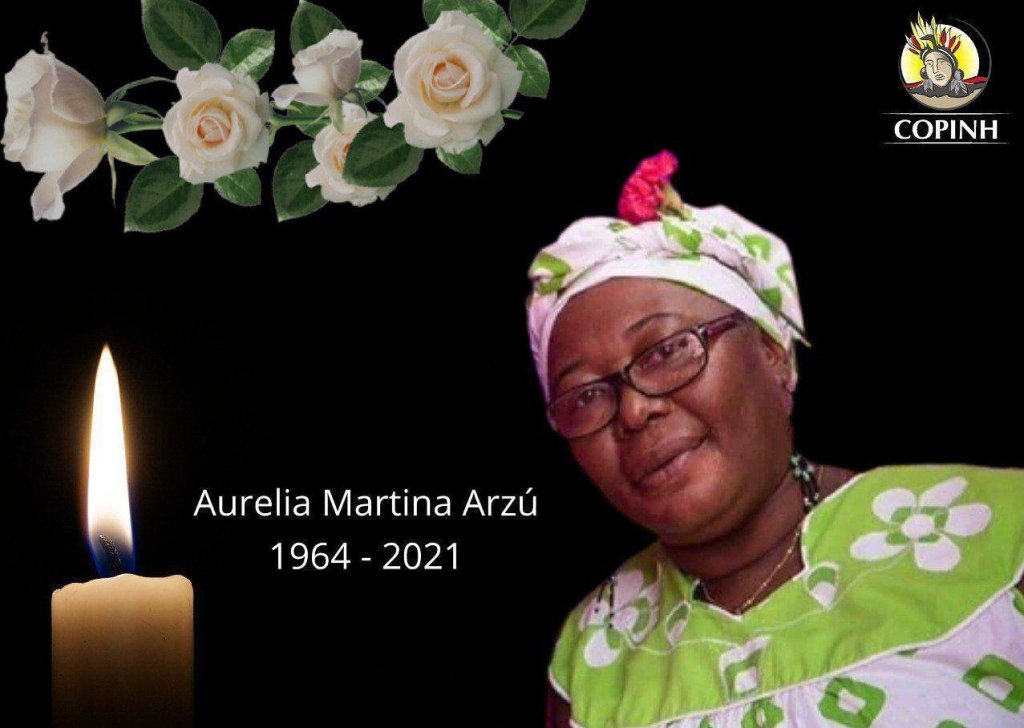
en el fallecimiento de Aurelia Arzú

(English below)

Ya basta de abrir mi cuenta de Facebook y enterar de otra compañera/o/e fallecida en Honduras por la narcodictadura apoyado de mi gobierno, por la falta de sistema de salud, saqueado por el partido nacional, por los asesinatos de defensoras/es, acelerado por el robo de las tierras, por la precariedad ante huracanes y cambio climático, por la desigualdad, por los múltiples desastres, y por la oscuridad de vivir así.

El mundo ha perdido la compañera Aurelia Arzú. Yo solo tuve una oportunidad de hablar con ella, hace poco más de un año, para aprender sobre las condiciones durante covid en las comunidades organizado con OFRANEH. Sus palabras y su sabia en esta pequeña entrevista me tocaron profundamente.

Unos meses después de que publiqué la entrevista, intenté servir como un puente para una oportunidad para difundir las palabras de la compañera Aurelia en inglés. Pero al final fue imposible por la situación que viven en esta parte de Honduras, por los dos huracanes que hicieron ya más imposible la comunicación hacia afuera.

La compañera Aurelia fue conocida como Patrona, y fue una lideresa importante de OFRANEH por muchos años. Me hubiera gustado conocerla en persona, y me hubiera gustado escuchar más de sus palabras. Pero ya no puedo. Eso me llena de dolor, y de rabia también. No me imagino como se sientan las personas que la conocieron. Les ofrezco a sus seres queridos mi más sentido pésame. Entiendo que su vida fue una vida de luz, de lucha, de fuerza, y de mucho amor, y que eso sería su legado.

I’m tired of opening Facebook and finding out about another compañera/o/e in Honduras who has died because of the narcodictatorship supported by my government; because of the lack of health system, looted by the National Party; by the assassination of human rights and land defenders, accelerated by the theft of lands; by the precarity of hurricanes and climate change; because of the multiple disasters; by the darkness that comes with living with all of this.

The world has lost Aurelia Arzú. I only had an opportunity to speak with her once, a little over a year ago, to learn about the conditions under covid of the communities that are organizing with OFRANEH. Her words and her wisdom in that small encounter touched me deeply.

A few months after I published the interview, I tried to serve as a bridge to an opportunity to publish compañera Aurelia’s words more widely in English. But in the end it turned out to be impossible because of the situation that people are in in that part of Honduras, because of the two hurricanes that made communicating with the outside world even more impossible.

Compañera Aurelia was known was Patrona, and she was an important leader of OFRANEH for many years. I would have liked to meet her in person, and I would have liked to hear more of her words. But now I cannot, and this fills me with sadness, and also anger. I cannot imagine the way people who knew her feel. I offer my deepest condolences to her loved ones. I understand that her life was one of light, struggle, strength, and much love, and that this will be her legacy.

why write? an incomplete list

when I have my ideas and thoughts out of my head on the page I can examine them and work through them and move forward with them and develop.

then they are out there and ideally they can become a way to have a broader conversation with other people.

the writing can become a tool for other people to use. it’s also a tool for me.

once a piece is done, it’s like being able to complete a thought. 

a sense of completion and accomplishment for an idea, and a way for me to hold on to it as I put it into practice.

a clear way for me to develop an idea or concept as I put it into practice.

a way for me to send it into the world, in hopes that someone else may find it useful.

a way for me to send something to the world as a question, with the idea that I may get a response.

a way to be known.

releasing the burning words from my mouth.

encouraging people to read the things that I believe are better than what I’m saying.

sometimes I want to establish the common ground for conversations I’m having.

sometimes I just want to share my joy in reading or watching something good.

a way occasionally to meet others.

to provoke.

a way to act as the wind carrying the words and work of others.

to counter hegemony.

to introduce people to the work of others or their words.

so people will like me and think I’m smart.

a way to process.

a time to practice freedom.

A young white woman sits at a typewriter in an office in France in the late 1940s. She is pictured from the side, with a desk and another box with a blurry red cross on it a bit blurry in the foreground as she types.
Image from National Archives, identifier 19999025

What Does It Mean to Feel Hopeful Right Now?

Mariame Kaba says “hope is a discipline,” and of course, as in most things, she is completely right. What makes me so devastated is that right now I see so many people (ahem white liberals! but others too) digging for and grasping at false hope. Yes, we absolutely must have some hope for better times ahead in order to get through tough situations, like the coronavirus pandemic we’re living through right now. But to me it is critically important to distinguish “hope” in the generic sense from the kind of hope that Mariame Kaba is talking about, or the kind that I embrace as I face the world anew every day. Irrational hope that things will just get better on their own; the mistaken but common belief that massive, systemic problems will resolve themselves through the simple passage of time (“history moves forward”); and false hope in bad solutions or ones that simply sidestep issues and create new and different systems of inequality – I can only see this hope leading to more cynicism, depression, anxiety, and hopelessness. Hope in *anything* just for the sake of *having some hope* doesn’t really seem like hope to me at all.

I do not feel any hope in a vaccination roll out that continues right down the genocidal and imperialist path we are already walking down. Seeing and hearing people more focused on how quickly we can fulfill our own desires than on how they can work with others to leave fewer people behind fills me with despair, not hope.

Hope, for me, comes from the visionary organizing of disabled people who have fought for priority access to the vaccine. Hope, for me, comes from learning how to design solutions to this pandemic that would actually work for most or all of the population by working collectively in struggle with the groups that are most affected by it, not by listening to some blowhard politicians that actually do not give a shit if people die. Actually what I mean is some politicians that are interested in killing people so they can profit off of it or, best case scenario, would not bother to help us even if they had the chance to cast a winning vote.

Hope comes to me in letters from prison and in messages from Honduras and in emails from long-lost friends. It says “they tried to separate us but they could not.” It says “they tried to kill our visions but they could not.” It whispers “they tried to tell us the sun would not rise unless we gave up everything that meant anything to us but they were wrong.” It reassures me “They tried to make us afraid to live with dignity but I’m not afraid if we do it together.” Turning to the discipline of hope, I can tell myself that there are many things that I might want to make my life more comfortable/relaxing/fun right now, but I can sit down, take a deep breath, and reach within my network and my imagination to find how can I meet that need in another way without leaving someone else behind. I have hope that my sacrifices are actually saving and improving lives, and that my work matters to someone.

I am deeply, deeply angry – I am in a rage a lot of the time. But I have a lot of hope too. I am inspired by the brave and visionary people all around me, and I learn constantly how to do a better job working to create a different and better world together with those people. This hope is not always easy. It requires work. But it is built on my real experiences and relationships, not lies. It is hard to let go of the easy, shiny promises and false hopes being hawked but I know I am not alone and I know these hopes are solid. I know that the only way to a future I want a part of is one that I take an active part in creating and understanding and in that, there is also hope.

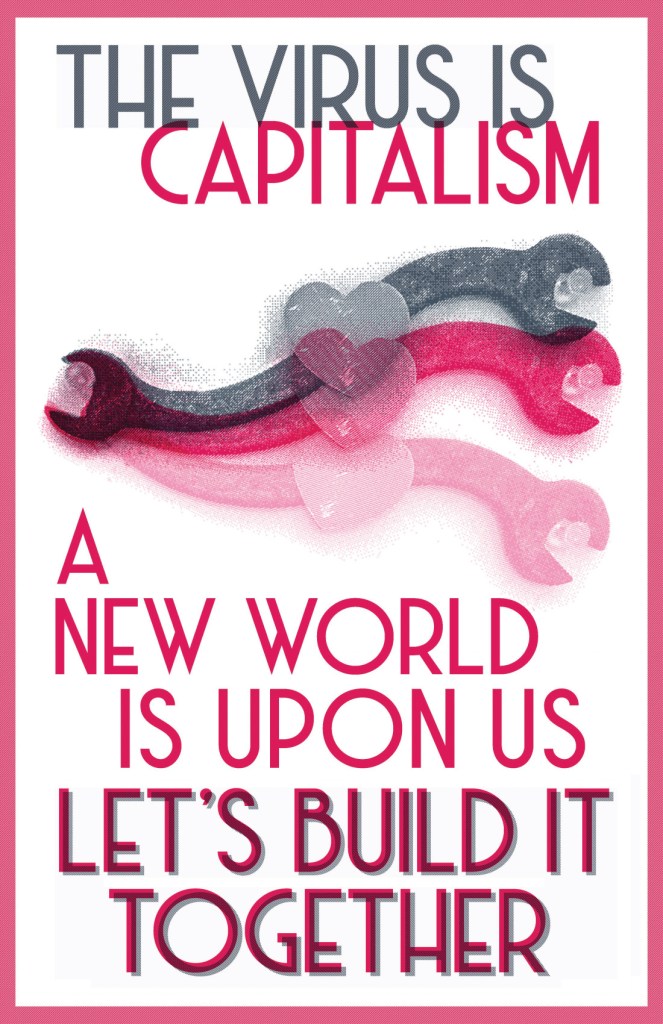
Pink and gray images of a wrench with a heart in the middle. Text says "The virus is capitalism. A new world is upon us. Let's build it together."
art by Christeen Francis @ Justseeds Collective

a lot of us are struggling, but this is a social problem

Over the last few weeks governors in almost every state have called for a “reopening” after the spring COVID19 shelter-in-place orders. During this time, in response to debates about whether returning to circulation in public again en masse is safe or not, I have repeatedly heard the answer given as some variation of “everyone has to decide for themselves what they think is best.”

like everyone else Like many of us, I am not sure what to do and am just trying to figure it out. This is a terrifying time. I think often of another pandemic, another plague, where people died in hospital hallways. This plague also seemed concentrated in certain cities (the same ones that loom large today – New York and San Francisco) and to affect a specific segment of the population. Unlike the Spanish flu, the majority of the population alive today remembers that plague. And maybe in some ways this is the more relevant lesson, because the majority of the population alive today actually doesn’t recall that plague with much specificity, although in some communities whole networks of people were dying by the month and even the week.

During that plague, it seemed that it was easy for a majority of people in the United States to ignore or feel unaffected by what was going on because they believed it was only affecting specific groups of people to whom they already did not feel connected. And once they had done that, they could simply ignore the crisis, the tens of thousands of deaths, and even laugh at jokes about it.

M0001845 John Haygarth. Line engraving by W. Cooke, 1827, after J. H. Credit: Wellcome Library, London. Wellcome Images images@wellcome.ac.uk http://wellcomeimages.org John Haygarth. Line engraving by W. Cooke, 1827, after J. H. Bell. Line engraving Gent\’s magazine Published: 1827 Copyrighted work available under Creative Commons Attribution only licence CC BY 4.0 http://creativecommons.org/licenses/by/4.0/

Then too it was easy to fall into debates about what behavior was the right behavior to prevent oneself or one’s beloved community members from getting sick. But the real culprits, the villains, the murderers, were the politicians and institutions that refused to recognize the crisis or do anything to solve it, and the social structures that sustain systems of inequality making specific groups of people so much more vulnerable to illness.

In fact, it is the same communities who are still being affected. African Americans, imprisoned people, drug users, queer and trans people – these groups are all still dealing with the HIV epidemic that did not go away, and they are the same groups at much higher risk from COVID19.

And it was easier for the pandemic to keep raging when a majority of people felt no urge to apply pressure, when they did not feel personally affected, when they did not feel that their communities would continue to feel the reverberations forever.

Like many others, I am struggling to figure out how to negotiate this situation. I do not understand all the biological science involved. But I do understand that an inherently social problem is going to call for a social solution, and better yet, many of the aspects of the problems that we face here in the US with COVID19 are political problems that require collective action. We have much we can learn from previous struggles.

That means the answer, in an inherently social situation with a contagious disease, is ANYTHING BUT “everyone should do what they feel most comfortable with.”


Some ideas for collective action:

  • The Poor People’s Campaign has launched a “moral non-cooperation campaign” called Stay in Place! Stay Alive! Organize! with actions you can take coordinated with others to push for a healthier plan for your community.
  • Now is a great time to find or start an existing mutual aid network. Create and share the resources people need together in your community to be safe based on community members’ own assessments, instead of saying “some people will have to go to make the tough choice to go to work,” which is another way of saying some of us need to decide between dying from hunger or dying at work.
  • Find ways to support the many workers who are striking right now (e.g., respect their picket lines, donate to their strike funds, amplify their demands).

How We Can Help Each Other in a Pandemic

Like many other activists, I am not exactly sure how to organize in this moment. I like the phrase physical distance and social solidarity, but I find that I’m not totally sure how to put it into practice. This post is my imperfect attempt to share some ideas of what folks can do to help each other. I more than welcome suggestions, critiques, and additions. We are all learning how to do this together, and that is one example itself of social solidarity.

I first want to lay out that although we are all scared right now, we need to try to remain focused on centering the needs of the most vulnerable. We cannot get so wrapped up in our own needs, in securing ourselves and our families, that we leave behind everyone else. If we make sure our most vulnerable are secured, it’s pretty likely we will have created a network that can sustain everyone. Lead from generosity and love, not fear and scarcity. (Trust me, I know this is easier said than done; that’s why I think it has to actually be said. I am telling myself the same thing like a mantra as a way to work out of my own fear-based reactions.)

If your income has not been affected, PLEASE consider donating as much money as you can spare to one or more of the funds below. Even relatively small amounts of money will go a long way toward assisting extremely vulnerable folks, and donations are tight for everyone right now as unemployment is raging. These are fairly Detroit-centric, because I live here, but also because it looks like Detroit is going to be one of the hardest hit places.

  • We the People of Detroit is giving out water to the 5,000 homes in Detroit without running water (there have been severe delays in getting the water turned back on). They are facing more need, higher prices, and difficulties distributing this water:
    https://www.wethepeopleofdetroit.com/get-involved
  • ABISA – an org assisting Black/African immigrants and refugees in the Detroit area. Your donation will assist undocuBlack immigrants keep the lights on, put food on the table, fill the gas tank, turn on water, preserve a home:
  • Movimiento Cosecha – Undocumented Worker Fund – this fund will go directly to assist undocumented families in need. I have recently been organizing with Cosecha Detroit:
    https://secure.actblue.com/donate/cosechamutualaid
  • Witness for Peace Solidarity Collective – The Solidarity Collective has been extremely hard hit by the fact that we have needed to cancel delegations, speakers’ tours, and other aspects of our work on short notice. In fact, if we are not able to raise several thousand dollars quickly, we will not be able to continue our international solidarity work and accompaniment beyond April. Communities in Honduras, Cuba, and Colombia, and our partners specifically, are facing great risks from COVID-19 and our international solidarity and vigilance on US foreign policy remains critical.
  • Brightmoor Connection Food Pantry –Food pantry in Detroit that works with We the People, Detroit People’s Platform, and advocates a “shopper’s choice model”:  https://brightmoorconnection.org/
  • Forgotten Harvest – metro Detroit food bank that redistributes surplus food:
    https://forgottenharvest.giv.sh/03a6

Beyond Donations

The vast majority of suggestions I have seen are calls for donations. If you, like me, are person whose income has been affected or who cannot afford to spare (much), it seems a little harder to figure out how you can work in solidarity with others right now, but I made a short list. Most of you are probably doing some of these, but it’s worth reminding us that they are important examples of solidarity:

  • Check on your neighbors, regularly.  Check on your loved ones, family and friends, emotionally, and see if anyone needs anything.
  • Consider buying gift certificates to any local businesses you can’t patronize now to help them stay afloat.
  • If you have space, grow or make something that you can share with your neighborhood either from afar or in a safe way.
  • I am also working on putting together a central way to distribute action items such as phone calls (phone zaps) to make on a given day.

I hope I will hear suggestions and ideas from people, in any possible mode. 

Here’s what else I’m trying to focus on right now:

We are connected. We can listen to the wisdom of people who have survived terrible events. We can continue reach beyond our own household and beyond ourselves. We can prioritize the needs of the most vulnerable and marginalized. And that will still be the key to something better.

Consider supporting artist Meredith Stern of JustSeeds Collective here.