I have a favorite story that helps me understand and explain
a fundamental aspect of how power works.
Of course power is complex, and of course there are
countless major social theories about its operation in the world. But like
other complex and rich social phenomena, it isn’t as if we understand nothing
without knowing the words of these theories. We have a rooted sense in our
bodies and minds of how power from our own experiences with it, either from
having power enacted upon us, enacting it upon others, or watching it play out
around us. When I taught Intro to Sociology every semester, I actually used to
introduce this conversation by showing an episode of the Office, which lead to
a conversation about Weberian authority. Important for us today: no one has
authority unless the people below see them as legitimate i.e. bestow them some
kind of authority. But I digress, because that is not exactly the example I
want to talk about.
The real point I want to make here is the related idea that
when you really think about it no one can actually make you do anything. Human
beings always have some kind of agency. They may have a very limited (or
constrained) agency, when faced with a very bad set of options, for example: do
something or be killed. But they can always choose to refuse and be killed. You
have not actually “made” the person do anything. You have given them a crappy choice.
This difference is more than semantic.
Here is my favorite example to illuminate that further.
In the fall of 1969, Bobby Seale, at the time the National
Chairman of the Black Panther Party, was on trial in Chicago. Seale was being
tried in the aftermath of the 1968 convention in Chicago. The charge was using
interstate transportation to incite a riot.
Originally Seale was the only African American on trial
alongside seven others, a group that included Abbie Hoffman. The
trial was a circus, which was to some extent intentional on the part of the defiant,
countercultural defendants. Apparently one day two defendants wore judge’s
robes to court and then wiped their feet on them. Eventually Seale’s case was
severed from the other seven.
Bobby Seale and his lawyer asked for a delay for his portion
of the case because his lawyer was sick and couldn’t represent him, but Judge
Hoffman refused, saying that Seale could just be represented by the defense
lawyer representing some of the others. Seale insisted on his right to
represent himself in that case.
It would seem that this violation of his right to a lawyer
outraged Bobby Seale and he continued to complain about it in an attempt to
stop the trial from going forward without him being represented by his own
choice of counsel. The judge, in turn, wanted to stop Seale’s outbursts and to
keep the trial moving.
Of course in the United States due process requires that defendants
must be present in order for them to be tried. What generally happens in this
situation is that judges threaten to hold defendants in contempt of court, a
crime which can include significant fines or jail time. Dear reader, you may
have already gotten there: this does not actually solve the problem unless the
defendant chooses to change their behavior to avoid further penalty because the
defendant must still be in the courtroom for the case to go on.
Bobby Seale was a trained revolutionary, who did not expect
justice to be issued in a US court because he sat quietly and waited for it. He
was not moved by being held in contempt of court.
In this case, an extraordinary (and horrific) measure was
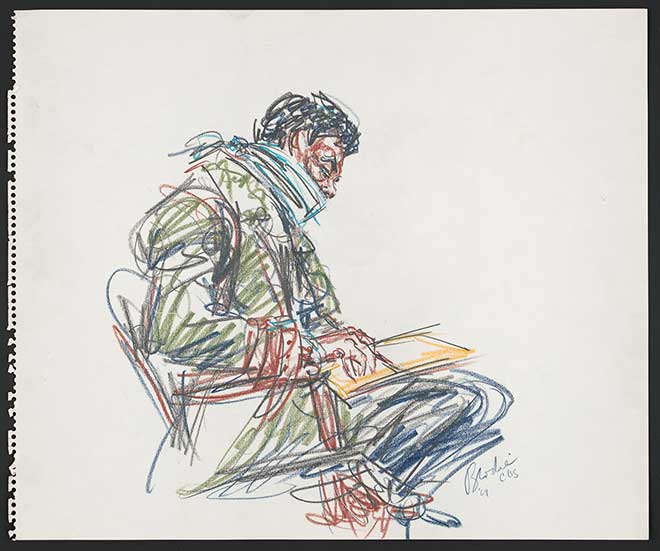
taken. Judge Hoffman ordered that Seale be bound and gagged inside the
courtroom. Even more extraordinarily however, this act could not quiet Bobby Seale. Even bound and gagged he
found a way to use his voice to disrupt the unjust proceedings. The UPI
headline read “Bound,
gagged Bobby Seale still manages wild scuffle in court.”
They could not silence Bobby Seale, because no one can
actually make another person do anything. Power must be consented to in some
way, shape, or form for it to work. It can be difficult to risk, but we do have
the choice to try it, especially when we can get together with others and train
ourselves to do so. The judge could not make him be quiet, even using significant
force.
Bobby Seale is still alive and free to tell the tale. Do not consent if you do not believe it is the right thing to do. Power is not power without legitimacy and consent from those subject to its will. Whenever it feels like I have no choice, I think of Bobby Seale.
IF you got to this post after watching The Trial of the Chicago 7, I highly recommend reading this review by Charlotte Rosen which corrects some of the historical inaccuracies and problems with that film (including the portrayal of this incident).
 Dr. October Krausch