On Thursday morning I was in my upstairs office, writing. My house shook around 10 am. I called downstairs to my partner, who ran upstairs. We both thought the other would know what had happened. Had I dropped something really big on the floor? Had a really giant truck passed by? Neither of these seemed to explain why our windows and doors would shake, but we didn’t hear any sirens and nothing else happened, so mildly unsettled, we went back about our business.
I keep thinking about the part of Wormwood where Eric Olson describes Seymour Hirsch walking into the family’s house and announcing, “You must be the most uncurious family in America.”
At 11:30 I received an email from campus with a link to a news story with the first description of the explosion that had taken place at 10 am. The first news reports listed 20 “casualties,” (later revised to 16 injuries), and I immediately noticed that no one on the hours of news coverage or during the press conferences, was using the word Enbridge or mentioning the pipelines which lead to the plant. In fact, like many other people in town, I thought right up until Thursday that Enbridge owned that refinery, based on my impression from driving on the road next to the site. Apparently, Enbridge owns the tanks right across the street which somehow did not appear in any of the coverage.
I got ready to head to campus for my afternoon classes, simultaneously watching TV and checking social media for updates. I was already seeing several people commenting on the good news that no one had died, which seemed far too early to me. There had not yet been a report that they had accounted for all the workers, people had been taken to the hospital with an unknown severity of injuries, and the fire was still going. Soon after there were more explosions, and it was clear the fire was not out.
I arrived to campus a little after 12:30 and the mood was surreal. Apparently on campus the buildings had not shook and most people I talked to had the sense that it was not that serious. At 11:43 AM, the campus alert system sent the following message: “Explosion at the Husky Refinery. Law enforcement has stated that the fire is out. Campus will resume under normal operations,” which must have contributed to this mood.
I found myself wondering how people in Chernobyl had behaved (and also worrying that I was overreacting). I wondered why we weren’t a little more prepared for what to do. I worried that people were so quick to move on and not at all cautious about the air quality. Walking to my 1 pm class I received a text from my partner indicating that talk of evacuations had begun.
When I got to class, I did my job as a professor of sociology and cautioned my students about some of the dangers of happy talk. We discussed the fact that the refinery disaster perhaps concerned us more than we thought. An athlete told us that they had been asked to go in from the soccer field earlier that morning. I tried to find the line between pretending everything was hunky dory, and creating panic. I trusted that if we were evacuated we would certainly know it. We had just been in that classroom during a tornado drill a few weeks earlier, after all, and every device in the room began making alerts, not to mention that human monitors went room to room to make sure everyone had left. I thought if the computer was on in the room it would show an alert, and we all turned our phones face up. I was sure an evacuation of this level would be announced over the loud speaker as well, and I assured my students of this fact.
I cannot now say whether or not I am ashamed of this rather minimal trust I had in the institution to inform us of what was happening. I feel like a fool who should have known better, but on the other hand, these situations for good reason cannot be left up to individual faculty members to decide. We do not have all the information and should not need to gather it. We were put in an awful position. I heard from several faculty who said they held class because they were worried that if they didn’t their students wouldn’t have anywhere else to go. That’s the problem when institutions do not provide the support we need in an appropriate time frame — they leave us all to make decisions on our own and none of them seem like the right one.
We went on with our class business until about 1:45. Someone noticed they had a lot of messages on their phone first, and then we all looked down and saw that we had a lot of messages from family members and from the university alert system. Our family members wanted us to evacuate or to know if we were OK. The university alert system messages we had received since our class began said:
1:10 PM Info UWS Office of Public Safety has received is that the UWS campus is NOT under an evacuation order. Continuing to monitor and update as needed.
1:41 PM SAFE ALERT: UW-Superior is NOT within the evacuation zone. There has been some misinformation in the media about the evacuation zone.
Authorities state the evacuation zone is 10 miles south of the refinery, 3 miles east and west of the refinery and 1 mile north of the refinery, which is 28th street. We are closely monitoring the situation. If you do choose to leave campus, please use caution and avoid the impacted area.
These strangely defensive alerts were our only source of information for what to do on campus. Several of my students live in a dorm which was .3 mi outside the evacuation zone at that time, and they wondered where they should go instead of home. No one knew. Another student confirmed that WITC, a campus located spatially within our campus, had closed for the day. Still another student who shares caregiving responsibilities for small children began to worry. She checked her phone, and found that the schools had indeed closed and evacuated, but the children’s mother wasn’t sure at that point exactly where the kids were because the school had not activated their alert system. This was the point where the class began to collectively panic and feel that we were not being told what we needed to know and where to go. A resourceful student made a few phone calls and determined that unofficially students who were unable to go home were gathering in the student union. Here’s what the view was like from campus at that point:

Picture taken from UW-Superior campus while classes were still taking place during the Husky Refinery disaster, April 26, 2018.
If the plan was not to cancel classes in order to stop a traffic jam and to complete a more orderly evacuation, why not send email with more guidance for faculty letting us know to bring people to the student union as things escalated? Why not give us a few resources to help us keep things calm? Leaving us with no plans and suggesting that we somehow hold class while students are not sure if they can return home and their children are being evacuated to unknown locations does not make any sense. This was at 1:45. The next set of classes on Thursdays begin at 2:30 and classes were not officially canceled until 3:10. By 4:13, UWS was declaring itself to be in the evacuation zone as well.
I had no idea what to do or where to tell anyone to go. I did not know how to help the students evacuate, although we practice tornado drills every year (tornadoes are exceedingly rare in our region). Our university is located under 3 miles from a refinery; this is a known quantity. There is no reason not to practice or disseminate information about what to do in the event of this kind of disaster other than perhaps the desire to make us feel safe about some things (like pipelines and oil production, who are large donors to the university) and direct our focus on worrying about other things.
After my class dissolved early, I canceled my next class. Then I went home, packed my things, and evacuated myself to Duluth. On the way out of town I received the notice that classes had finally been canceled. Once in Duluth, I went to some stores and tried to do something relaxing for a while. I took this picture from the malt shop, as a sad comparison to so many beautiful pictures I’ve taken of the most amazing lake in the world:
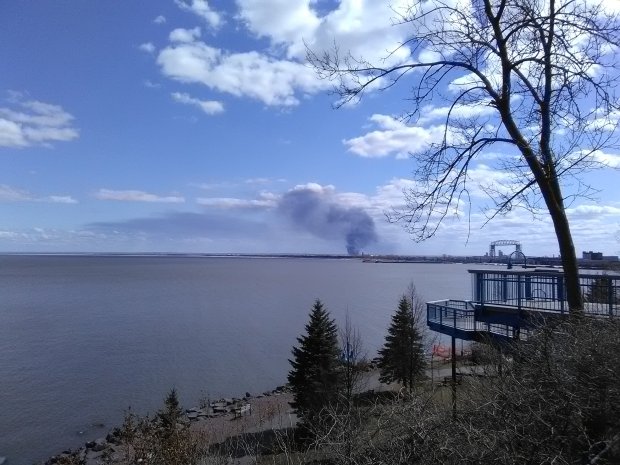
Picture of the Husky Refinery disaster from the Duluth shore of Lake Superior on the afternoon of April 26, 2018.
I got to my friends’ house and ate dinner. We watched the news on and off, but tired of the coverage. The last we had heard, the fire might rage for days, even weeks. Around 7 pm, someone came home and said, “Didn’t you hear? The fire’s out.” We turned on the news, and sure enough, we saw that the fire had been declared out, and Superior residents were told we could come home as early as 9 pm. An information number was given out, which we wrote down. We turned off the coverage again, since we’d been watching it for hours at that point, and we spent time with our friends.
At about 11:30 pm Thursday night we headed out the door to come home to Superior. At the door our friend said, “Oh! we never thought to double check if it was OK to go back.” “It’s OK,” we said, “we’ll call or something in the car.” We listened for news in the car but couldn’t find any local coverage on the radio. On the bridge I called the information line that had been given out only 5 hours before. It rang a bunch of times, then someone picked it up and hung up on me.
I do not know if I was just tired, or if wishful thinking got the best of me. But we went ahead and continued on home to Superior, since the phone call was just a double check and the evacuation seemed like it had already been called off. Imagine my horror when I was already in my house, checked the internet, and realized that the evacuation had been more or less called back on. This is the real risk of rushing to give people good news. It puts people in danger. It put me in danger.
That night and the next day I found that for some reason between 6:30 pm and 11:30 pm, some of the most critical hours for sharing information during the evacuation, when people like me were away from our homes and our usual sources of information and routines, the city and county announced two numbers for residents to call and then quickly closed these numbers. Instead, they directed people to call a hotline run by the Husky Refinery itself. They also announced that “The fire is extinguished. Residents in the evacuation area are asked to remain away from homes for at least another 2 hours (21:00 CST)” then announced at 21:20 CST that the evacuation order was still in place. It’s true that it doesn’t exactly say you can go back at 9 pm. But common sense dictates that an update was needed before 9 pm, not after, so I imagine that was an oversight that encouraged others to return too quickly as well. A press conference and update was announced for 10 am Friday, then it was announced that everyone could return at 6 am. I couldn’t figure out where everyone was even getting this news from. It turned out I was out of the loop in part because I wasn’t following the correct Facebook account. I follow the City of Superior on Facebook, not “Jim Paine, Mayor of Superior.” I only wish I were joking.
I spent the next day feeling as if I was in a freefall. It makes you feel insane when everyone is telling you everything is fine but there are clearly chemical gases being spilled nearby. When you are supposed to hold class with a giant black cloud looming on the horizon and the hospital is being evacuated, it’s hard to know what’s real. When most of the talk you hear is about what a good job everyone did but your experience was terrible (and dangerous), it is literally maddening. I heard a terrible story about what happened to the patients at the VA in Superior. I know other people who came home on Thursday night only to find out belatedly they shouldn’t have. Other people’s homes shook so violently that pilot lights went out, and it took them a few days to notice the gas leak in their empty homes. The air of finality of the pronouncements from the mayor’s office and the lack of questions on all sides contribute to my fear that none of these problems will be dealt with in due course. The last updates were Friday at noon, stating that the “I am in Superior and returning to the refinery site now, breathing the air myself. We will continue monitoring the air but the source of the danger has passed,” indicating no future investigation toward any of the long term health and environmental problems we face.
We know now that the major risk was hydrofluoric acid. We did not know that in my classroom at 1 pm while that fire was raging in the distance. Perhaps it is wise public policy to keep people where they are since we cannot all get out of town on two bridges fast enough when a toxic gas explodes; most of us would have died in our cars in traffic no matter what. Does that mean though that we should have so little plan and so little training that most of us run to our windows when we hear an explosion? Does that mean we should call people back to town before the fire is really out? There were many risks to be managed on Thursday and Friday in addition to all of the health and environmental risks that remain to be managed. Some of those were handled well. The HF tank did not explode. No workers died. These are, in fact, very good things. But some things were handled poorly and they were in fact foreseeable things. There’s no reason the city of Superior can’t operate its own helpline, or at least have a voicemail message giving the most current update and directing people to the proper information and emergency numbers. These things should not be handled by the company, who does not have our community best interest at heart.
There’s no reason we can’t speak critically about what did and didn’t go well and work to keep doing better. We need to know what happened in order to be better prepared for the future. Perhaps people would not panic in emergencies if we were not lulled into complacency in the first place. For me the first step is no more HF in my community. I don’t want to live in a “kill zone” any longer.


 Dr. October Krausch