What if Renee Good had been a jerk? (guest post)

Below is a message from a migrant and scholar of migration. She has restrained from publicly speaking her mind on the horrors that are happening to the migrant community in this country and the anxiety that she lives with day to day because she is keenly aware of the risk in doing so under a regime that does not recognize her humanity. 

Yet she also understands that the fear she feels is a carefully calibrated tool to keep her silent and isolated and that her silence will not protect her (or anyone). So in a desperate attempt to encourage herself to exorcise the fear out of her body, she requested that I share the following words on her behalf. She hopes that if each small drop of anger can find one another and become a raging torrent, it may tear open the dark reality and bring a ray of light.


I have seen so many posts going around highlighting what kind of a person Renee Good was. She was kind, a mother, a daughter, a U.S. citizen, and (unspoken but probably most importantly) white. In other words, she is, or is made to be, a perfect victim. Having studied media discourse surrounding immigration, I recognize and understand this pattern—it’s an effort to “humanize” the victim and make her more “relatable” so more will rally behind her and take action. 

But I cannot stop wondering: what part of “being shot multiple times in the face right next to your partner and in front of your dog” is not condemnable enough that we need to add qualifiers to the deceased so we can dare to act and demand actions? What if she had not been kind? Had no children? Weren’t white or citizen? Would her murder not be worthy of grief or outrage? Why do we have to humanize a human being with adjectives that exclude other humans? 

Maybe we all can and should relate to Renee Good not because how amazing and white she was but because she once lived and was murdered by a state yielding violence granted by its citizenry.

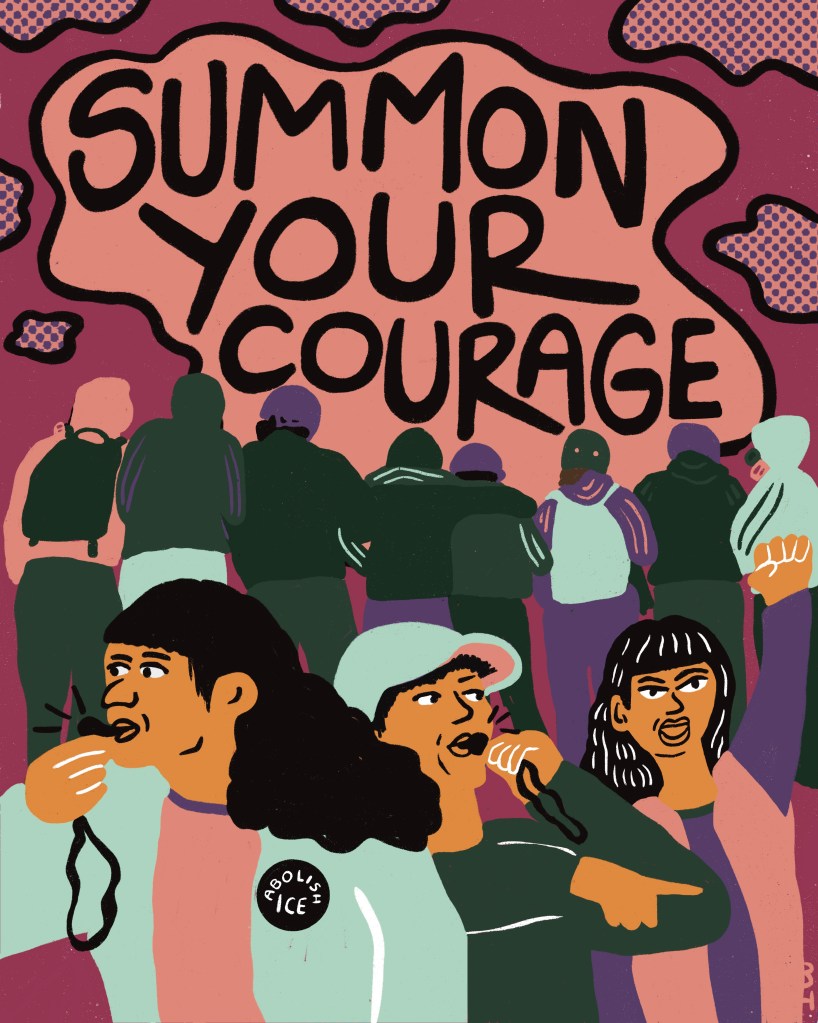
A brightly colored piece of art depicts a line of people linking arms under the words "Summon Your Courage." In the foreground, 2 people with light brown skin and feminine features blow whistles while a third raises their fist. One wears a pin that says "Abolish ICE."
Credit: Monica Trinidad. Instagram: @itsmonicatrinidad. Image available from Justseeds.

Repression of Palestine Solidarity on Campus Enabled Anti-Migrant Escalation

Photos of Palestine solidarity encampments have disappeared from the news, replaced by pictures of immigration agents kidnapping university students and community members, but the campus-based battle to force universities to divest from Israel and weapons manufacturing is still underway.

This a long-term, smoldering battle. “The campuses are definitely as active as they were a year ago from my purview,” says Akin Olla, communications director for the anti-militarist youth organization Dissenters. But, he adds, “The actions look different and are generally less media-friendly.”

While this struggle continues, its shape has shifted, as students who were initially on the front lines of pro-Palestine activism experience additional vulnerability due to the Trump administration’s attacks. Many of these students are Muslim immigrants or from immigrant families, while others are queer or trans and confronting a different series of attacks. As a result of these changes, the shape of the work has changed. For one thing, faculty who spoke to Truthout said that campus student groups are working more in coalition to provide some shielding to targeted students, like Students for Justice in Palestine or Muslim student associations.

Faculty across the United States continue to organize: They’re supporting students and their movements; organizing their own events; building aboveground and underground safety networks in response to the presence of immigration police on campus; and pushing their own unions and scholarly associations to take political positions.


I found it so healing to talk to folks on campuses all over who are creating new networks of solidarity and who see the clear connection between Palestine and other attacks on campus. I am not alone, you are not alone. There are many of us.

Read the full story at Truthout: https://truthout.org/articles/repression-of-palestine-solidarity-on-campus-enabled-anti-migrant-escalation/

And consider signing up as part of the Sanctuary Campus Network: https://www.sanctuarycampus.org/

safety planning and reacting to ICE kidnappings: some concrete steps

In the last two weeks there has been an escalation in the impunity with which state forces can and will kidnap people off the streets in the United States. Of course, arrests are always a kidnapping of someone from their community (a great example here is picking people up with open warrants they may not even know about), but it is also fair to say we are seeing significant escalation in who will be picked up and how little advance notice they have that they are being targeted as we watch noncitizens be snatched by masked cops. Spreading terror is clearly the point here, and it’s effective. Unfortunately, trying to comply is not any better of a strategy than hoping it won’t happen to you or your friends, so our only real choice is to face the fear and work together.

I put together a list of ideas based on my experiences and training related to copwatching, human rights accompaniment, jail support, and anti-stalking safety planning. Some of these make more sense for the people targeted by ICE, while others are more for bystanders who want to try to disrupt these nabbings and the terror they are sowing. None of these are guaranteed to work. The main idea here, taken from human rights accompaniment, is that in a bad situation we can try the slim odds to see if sometimes we can stop the worst from happening.

These are not exhaustive tips, and I’m sure there are things I haven’t thought of. Please feel free to reach out if there’s something you think should be added!

  • Make sure someone knows where you are supposed to be at all times. This is so that people can start making calls and publicizing quickly after you are grabbed.
  • Alter routes and routines as much as you can – this makes it harder for ICE or other state agents to predict where to find you
  • Try not to be alone, especially when in public spaces.
  • Make sure that someone trusted has your birthdate, your A-number, the list of stuff you need taken care of ASAP (childcare, pet care, medication), and your other emergency contacts (like lawyer). This person should be someone who is not likely to be arrested or detained with you, and you should memorize their phone number. (This is jail support protocol.)
  • We should probably ALL get busy making sure we have at least one phone number really memorized that we’d call if we are detained.
  • Make sure you have the phone number of a decent immigration lawyer, who can file a habeas corpus, and that your emergency contact has it. It is likely hard to get set up with a retainer for a lawyer right now, as most are swamped with similar requests, but you can at least get the name and number of a recommended person and give it to your emergency contact. Another idea could be for a group of people to pool resources and engage a lawyer together. A good place to start looking for trusted immigration lawyers is your local National Lawyer’s Guild chapter, or a local agency that does immigration defense (even if you can pay, they may have a referral list).
  • Be ready to call/yell/make a disturbance, especially if you are a bystander. The idea is to disrupt all secrecy.
  • Sometimes it works for targets or witnesses to appeal directly to the humanity of people who are doing the violence.
  • Think of the audience you’re appealing to as international at every point in this process. Public support can create more pressure on the state, but if you do not want your situation, still make sure that a significant number of people know what is going on with you so they are ready to step up.
  • Never talk to the cops! If you are bystanding, you can try talking directly to the person being detained, for example asking “do you consent to this search?”
  • In particular for bystanders, be mindful of not escalating a volatile situation, even as you may be trying to disrupt secrecy.
  • Bystanders may also want to make it clear that you are accompanying the victim, and not just gawking at their terrible moment. I do this by yelling some support or a question, and I also hold my phone visibly in my hand, whether or not I film.
  • It’s also helpful to be clearly marked as who you are, especially if that involves privilege: neighbor, professor, manager, etc.
  • Finally, rehearse these incidents mentally. Go over exactly what you might do, and where this would have to be happening for you to intervene. Rehearse what you will say if you are the one stopped on the street. We experience deep conditioning to go along with authority that kicks in when we’re shocked and confused, and all of us need more practice with disobedience.
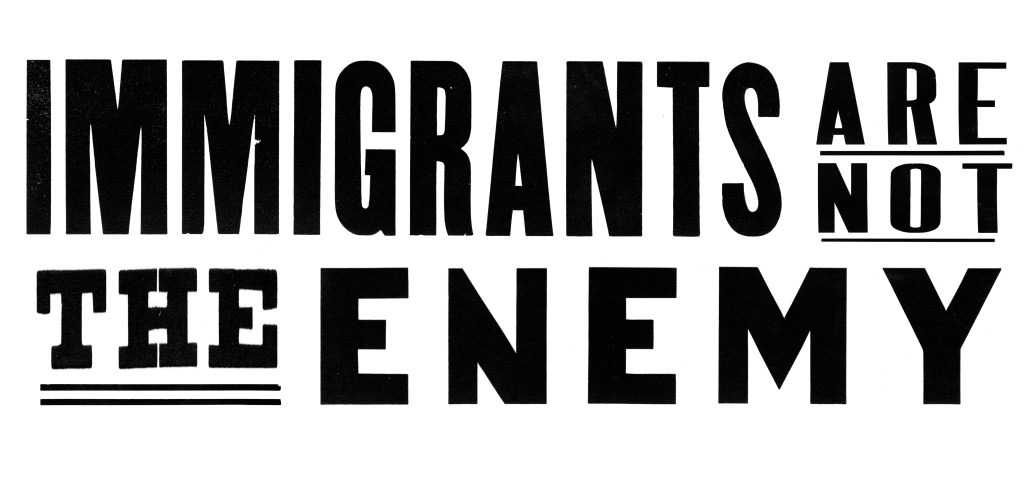
Tall, bold text in black is oriented horizontally: “IMMIGRANTS ARE NOT THE ENEMY," created by Kevin Caplicki.
Image by Kevin Caplicki.

my interview with Harsha Walia at the Socialism Conference

The left in the United States faces a series of urgent questions: How do we stop a genocide in Palestine funded by our own tax dollars? How do we engage with or confront electoral politics? How can we get beyond the insularity of our own context to learn from each other?

Truthout caught up with Harsha Walia at this year’s Socialism Conference, a yearly convergence of over 2,000 people on the left hosted by Haymarket Books in Chicago, to discuss some of these questions. Walia is an organizer, anti-violence worker, and the award-winning author of Border and Rule and Undoing Border Imperialism. She lives in British Columbia, Canada, where she is involved in migrant justice as well as feminist, anti-capitalist, abolitionist and anti-imperialist movements.

In this exclusive interview, Walia discusses building supportive containers for new organizers in this moment of heightened mobilization for Palestine, celebrity culture and the U.S. presidential election, and what we can all learn from international struggles.

You, Kelly Hayes and Robyn Maynard designed a session for the Socialism Conference called “World Building Workshop: Abolition, Solidarity, and Decolonization.” At it, you invited participants to discuss the infrastructure our movements need, any recent wins or stumbles, how we can connect across struggles and how we can manage principled disagreements. Can you talk a little bit about why you decided to do that session?


Read the interview, “Harsha Walia: Democratic Party Laid Groundwork for Anti-Migrant Border Policy,” at Truthout here: https://truthout.org/articles/harsha-walia-democratic-party-laid-groundwork-for-anti-migrant-border-policy/

“Nos Están Matando Uno a Uno Nuestro Líderes”

This article first appeared online in English on The Progressive’s website

Mientras mueren lxs defensorxs de los bosques hondureños, en Nueva York se abre el juicio de narcotráfico para el hermano del presidente del país, Juan Antonio Hernández.

Por: Meghan Krausch

“Nos están matando uno a uno nuestros líderes” dijo el mensaje de texto reenviado. El mensaje venía de alguien de la comunidad indígena Tolupán de El Portillo, en la zona rural de Honduras.

La semana anterior, yo había propuesto un artículo sobre nueve personas indígenas en HondurasAlisson Pineda, Wendy Pineda, José María Pineda, Ángela Murillo, Celso Cabrera, Óscar Cabrera, Óscar Vieda, Sergio Ávila, and Ramón Matute, quienes se enfrentan cargos penales por defender su territorio ancestral.

Antes de que pudiera terminar de escribir el ensayo, otro miembro de la familia había sido asesinado.

El 27 de septiembre de 2019, Milgen Idán Soto Ávila fue encontrado asesinado en el mismo lugar donde INMARE, una empresa maderera privada que actualmente está procesando a sus familiares por protestar contra la tala, trabajaba.

Milgen era un joven platicador e inquisitivo de veintinueve años, tenía una presencia constante en el Campamento Digno en Defensa del Territorio Ancestral, establecido por miembrxs de la comunidad que trabajan con el Movimiento Amplio por la Dignidad y Justicia (o MADJ). El objetivo del campamento es parar la tala de la empresa en el bosque de pinos que ha pertenecido a la tribu Tolupán desde que fueron reasentados en esta área, San Francisco de Locomapa, en el departamento de Yoro, en 1864.

Recuerdo bien a Milgen Soto, no solo porque tuvimos una larga conversación, sino también porque cada vez que estoy en Honduras miro con atención a todxs y me preocupo por quién podría estar ausente la próxima vez que regrese. Milgen era un compañero comprometido con grandes ideas sobre cómo crear una sociedad mejor, y compartimos una animada conversación sobre la política global y las contradicciones de sus experiencias en la pobreza extrema a pesar de su derecho histórico a la tierra.

En mayo, escribí sobre Ramón Matute y la ceremonia de levantamiento de los espíritus de su hermano y su padre, asesinados a principios de este año. Poco después de la publicación de este artículo, Ramón y otros ocho miembrxs de la comunidad fueron arrestados y ahora enfrentan cargos penales. ¿Su crimen? “Obstaculazición del plan de manejo forestal.”

A nivel internacional, más de 100 organizaciones firmaron una carta de solidaridad con los defensores de la tierra “condenando la criminalización de las acciones legítimas de protesta”. Aunque Milgen no fue arrestado, fue denunciado formalmente por la empresa maderera.

El 29 de septiembre, antes de haber asimilado completamente la realidad de la muerte de Milgen, recibí noticias del asesinato de otro líder Tolupán. Según los informes, individuos desconocidos le dispararon a Adolfo Redondo. Al principio, esta información fue difícil de confirmar porque, como lo expresó el mensaje de texto de El Portillo, “estamos incomunicados. No hay energía en la zona, no hay Internet”.

Milgen fue la tercera persona asesinada en la misma pequeña comunidad contando sólo este año, y la novena asesinada en el conflicto por la tala desde 2013. Sin embargo, el estado hondureño no ha ofrecido las protecciones requeridas por el derecho internacional, ni tampoco ha seguido procedimientos judiciales penales básicos.

Salomón y Samael Matute fueron asesinados en febrero, pero “no hay ningún avance sustancial en la investigación”, dice Mario Iraheta, representante de las y los Tolupánes en el proceso de medidas cautelares y miembro del equipo legal de MADJ. “Los autores materiales [del crimen] siguen libres en la zona, sin una orden de aprehensión”.

En cambio, los recursos del gobierno se están utilizando para criminalizar a los propios defensores de la tierra, que son todos beneficiarios de medidas cautelares de la Comisión Interamericana de Derechos Humanos.


Si bien es un tema muy mediático, Brasil no es el único país donde los bosques están en llamas. En una visita a San Francisco de Locomapa en abril, el humo de los incendios forestales fue tan grave, que todo un grupo de observadores internacionales del Colectivo de Solidaridad de Acción Permanente por la Paz, incluyéndome, se sintieron enfermos después de una sola tarde allí.

No está claro exactamente quién está prendiendo los incendios, que siempre parecen estar furiosos, pero la salud del bosque y de las y los Tolupánes está sufriendo. Los miembros de la comunidad dicen que sufren de una variedad de enfermedades respiratorias.

Una comunicación de 30 de septiembre lanzado por MADJ preguntaba: “¿Quiénes son los asesinos del pueblo Tolupán?”

“Invitamos a la población hondureña organizada y no organizada a identificar los actores intelectuales de la dictadura, de la violencia, de la desigualdad, del empobrecimiento, de quienes despojan y asesinan,” dice la comunicación. “Y a superar la clásica pregunta que busca ubicar a los autores materiales y a transformarla en ¿quién o quiénes ordenaron y consintieron sus asesinatos?” 

Los cargos contra los miembros del Movimiento no son un caso aislado. Los defensores del medio ambiente de Guapinol han estado detenidos en prisión preventiva durante un mes debido a su oposición a un proyecto minero.

“Los procesos judiciales, junto con la represión activa por parte de las fuerzas de seguridad del gobierno revelan el compromiso de proteger los intereses corporativos en vez de los derechos humanos en Honduras”, dicen en una entrevista por correo electrónico Corie Welch y Alejandra Rincón, las coordinadoras del Programa de Honduras del Colectivo de Solidaridad de Acción Permanente por la Paz. “Bajo el régimen que llegó al poder en 2009, hemos visto una colaboración entre las élites poderosas y el gobierno de Honduras, ampliando las concesiones para la extracción y utilizando la policía y el ejército para hacer cumplir la construcción de estos proyectos”.

La ironía es indiscutible. Antonio “Tony” Hernández, hermano del presidente Juan Orlando Hernández, se enfrenta a un juicio en el Tribunal de Distrito Federal de Manhattan, acusado por el Departamento de Justicia de los Estados Unidos de narcotráfico, lavado de dinero y la coordinación de asesinato. El juicio comienza el 2 de octubre y el presidente Hernández es identificado como “co conspirador 4” junto con el ex presidente hondureño Porfirio “Pepe” Lobo.

Ambos, los dos únicos presidentes que han realizado campañas desde el golpe de estado de 2009 en Honduras, se ha alegado en documentos judiciales haber utilizado fondos de narcotráfico para sus campañas, aunque ninguno de los dos ha sido acusado en Estados Unidos.

Honduras no es simplemente un “estado fallido“; está activamente deformado por intereses empresariales e internacionales. El propio gobierno, enjuiciado por corrupción y narcotráfico, está lanzando cargos criminales contra algunos de sus más precarios ciudadanos por protestar en defensa de su propio bosque. Mientras tanto, los Estados Unidos mantiene una relación fuerte con la administración hondureña.

Los hondureños se movilizan dentro de Honduras. Pero la realidad del imperialismo en Centroamérica significa que el problema de los hondureños sea global. Cambiar la realidad política en su país requerirá un fuerte movimiento de solidaridad en los Estados Unidos. Mientras el gobierno de los Estados Unidos y otros regímenes internacionales otorguen legitimidad a Juan Orlando Hernández, puede permanecer en el poder. El caso criminal actual de su hermano es una prueba de esa legitimidad.

José María, un compañero mayor de la comunidad de San Francisco de Locomapa, tiene un dicho favorito: “La sangre de los mártires es la semilla de la libertad”.
story from the protest

The cop came over to express concern.

About me getting run over by a car

While handing out flyers to stop the concentration camps

From the sidewalk.

Then he walked me through moving traffic back to safety.

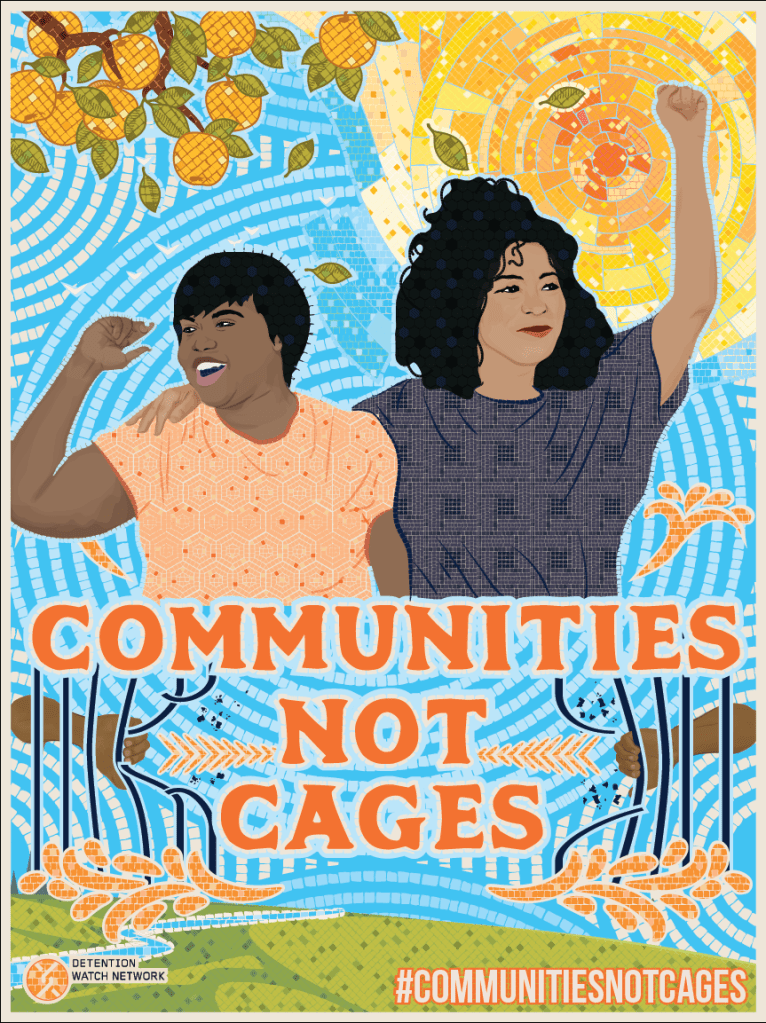
Two people standing together in front of the sun. Poster says "Communities not Cages"
Art by: Rommy Sobrado-Torrico

What Terror Looks Like

More than one year after the post electoral crisis, the terror created by the murders of protestors is still palpable here. Many readers of this blog will be familiar with these killings because you participated last year in an open letter to the families of the victims.

A few days ago Karen Spring wrote this excellent essay on the continued impunity for the killings.

As I mentioned in a previous post, the events of December 2017 & January 2018 are hardly in the past for many Hondurans. These killings were mentioned to me without prompting at some of our site visits, and my general impression both from these weeks on the ground and following social media is of a people where terror has genuinely taken root. I keep thinking of the many histories I’ve read or watched about societies existing under terroristic regimes, and realizing that in this moment I’m visiting one of those societies. And knowing that my friends and others live in it every day.

Nor are these impressions and facts far removed from the United States. Impunity for murdering protestors and the terror it spreads is creating an exodus of people arriving everyday at our border. To say nothing of the direct and indirect support for this terror provided by the US government itself. One example: the US provides funding, training, and “vetting” for various police and military forces implicated in human rights abuses including murder. We are funding terror.

The Songs of the Grandmothers

On Saturday I had the honor of hearing the songs of the grandmothers of COFAMIPRO, the Committee of Families of Disappeared Migrants of El Progreso. These women told us the stories of looking for their lost daughters and sons, who have been lost along the dangerous migrant trail between the US and Honduras or who lost contact with their families once arriving in the US. Rosa Nelly Santos told us about the heartbreaking work of repatriating remains, and how since 2000 she has walked with other mothers along the path wearing pictures of their children and asking around, hoping to find clues of where they were last seen. About the caravans, Rosa Nelly told us that they do not celebrate or agree with the migrant exodus because they would prefer to have people be able to stay in Honduras, but the most important thing is that no one disappears on an exodus. They may still die; but they will not disappear .

The women sang two songs they have written themselves: one for standing outside public offices demanding rights and recognition, and the second for when a person is found. It said “we don’t get tired of waiting.”

Together in a small circle, our Witness for Peace Solidarity Collective delegation cried with these women. We saw their pain, and held it with them for a few moments . We left them reluctantly in a flurry of hugs and smiles, always promising to share their stories.

Regular People Are Deporting Each Other – Or Not

Last weekend I read about immigration lawyers and journalists with US and EU citizenships being denied entry to Mexico. Interpol alerts were placed on their passports because they were involved in assisting the masses of asylum seekers on the US-Mexico border.

We live in times of terror.

There are a lot of people who have to be involved to make a system of terror like this run and keep running. According to the LA Times, it’s highly likely that judges needed to approve the “alerts” be placed on these peoples’ passports. Judges who needed to somehow find it OK to refuse people the right to move across borders because they were assisting others with their human rights; judges who swore to uphold the first amendment and then flagged the passports of journalists. They did not need to participate in this. But that means there were also attorneys who presented the government’s case to the judge. There were people in the courtrooms at the time who have said nothing about this happening, regular people like perhaps a stenographer who have participated in keeping their mouths shut rather than whistle blowing. Even when something happens in judges’ chambers, documents go through a lot of hands.

There are the immigration officers who carried out the orders.

I haven’t even started on the folks carrying out all of this when it comes to the actual asylees, the adults and children who we know have been suffering on our border. I’m talking about the ones participating in the asylum interview bottleneck. The ones turning the locks on the cages. The ones building the cages. The ones actually making money on the cages. There are actually hundreds of thousands of participants in this. It isn’t just Jeff Sessions and Donald Trump, who I think readers of this blog will probably find to be beyond any sense of shame.

I keep thinking of Eichmann organizing those train schedules to make sure all the trains could move everyone around Nazi Germany, and of everyone else involved in running the train system. Bureaucracies are made up in part by individual people and their individual actions, and they are a necessary part of these systems. And while it’s easy to forget, bureaucracies are not faceless.

But I try—I try, because it’s hard–to also think about the forgotten and even intentionally concealed history of everyday resistance that so many people have taken part in throughout history too. I try to hold out hope that we can again find and cultivate those memories, at least among some of ourselves.

Shaun Slifer_Sabot

“Slow It All Down” Shaun Slifer – Text and Image from Justseeds: “As an icon of working class history, the story goes that sabots were thrown into early industrial machinery when workers’ demands weren’t met. The term saboter, however, originally referred to the noisy footsteps of clog-clad rural workers, and thus their low-rung, unskilled labor within newly mechanized industrial factories. The word evolved from there to mean the slowing or bungling of a job on purpose: work stoppage.”

What You Need to Know about the Coup in Venezuela

The U.S. is again attempting a foreign coup in Venezuela. This is not the first time, and if it doesn’t succeed, it will not be the last time. For those of us who are United States citizens, we have a tremendous responsibility to inform ourselves about what our government is doing and to not perpetuate the real and devastating harm that is being caused.

Imagine for a moment that another country declared our elections fraudulent because so many of us are unhappy with Trump, or because the person who wins the popular vote does not become the president. Imagine that country has several nearby military bases. In fact, can you imagine another country having a military base in or near the US?

For example, did you know about the role the United States has played in making sure that “socialism isn’t working” in Venezuela and causing a devastating economic crisis? From this interview with two scholars who have both written multiple books on Venezuela (some of which I’ve read and used in my classes):

Juan Gonzalez: “Citgo, the huge American-based subsidiary of the Venezuelan oil industry, which has not been allowed to remit back any of the money that it’s making here in the United States back to Venezuela.”

Steve Ellner: “The sanction that prohibits Citgo from remitting profits to Venezuela is a very important measure. It means that the Venezuelan government is being deprived of approximately $1 billion a year.”

“But, Juan, in addition to that, there is a major impact in terms of discouraging commercial and financial interests throughout the world from any kind of transaction with Venezuela. There is a list of 70—approximately 70 Venezuelan officials who are being sanctioned. And that translates into a situation in which the U.S. government, and specifically Steven Mnuchin, the secretary of the treasury, has undertaken different investigations, workshops with representatives of Japan, Europe, Latin America, in order to find out where the shell companies are. In other words, he has created a situation in which commercial interests throughout the world are afraid to have anything to do with Venezuela. That amounts to virtually a block—an economic blockade.”

Did you know Mike Pence made an announcement to the Venezuelan people declaring someone else the president before Juan Guaidó even declared himself the president? Did you know our ambassadors and VPs made videos to people in other countries for social media? Can you imagine getting a message on FB from Angela Merkel telling us who our president “really” was?

soa latin america

Original image source: School of the Americas Watch

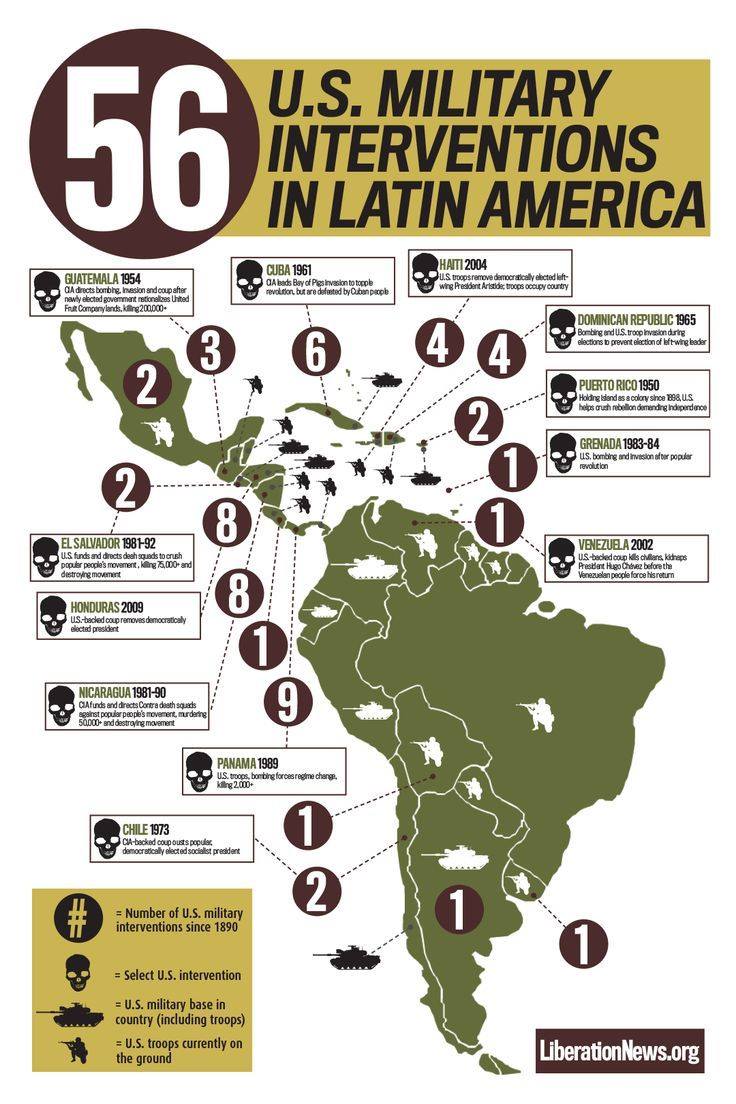
The coup attempt in Venezuela takes place within a history of constant violent military intervention throughout Latin America. These interventions happen regardless of Democratic or Republican administration; the most recent and obvious example is the coup in Honduras which was supported and ratified by Secretary of State Hilary Clinton and President Obama in 2009. There seems to be no sense of irony to the calls of “lack of democracy” in Venezuela while an explicitly, clearly illegitimate and fraudulent president sits in office in Honduras with the full support of Washington.

Furthermore, in the US we are basically never exposed to how or why anyone would support Chavismo at the grassroots. What do you know, for example about the deeply democratic comunas? Now this environment has changed, but it is still essential to consider, and to wonder critically what accounts are being left out now?

Democracy Now! and NACLA are good places to get reliable coverage of what’s happening in Venezuela.

When we are ill-informed or when we turn away, or worse, when we perpetuate the idea that Maduro is a dictator, that there is another legitimate president, that a coup is legitimate, or any of the other lies our government is peddling to us, we put real people’s lives in danger.

military interventions map