Photos of Palestine solidarity encampments have disappeared from the news, replaced by pictures of immigration agents kidnapping university students and community members, but the campus-based battle to force universities to divest from Israel and weapons manufacturing is still underway.
This a long-term, smoldering battle. “The campuses are definitely as active as they were a year ago from my purview,” says Akin Olla, communications director for the anti-militarist youth organization Dissenters. But, he adds, “The actions look different and are generally less media-friendly.”
While this struggle continues, its shape has shifted, as students who were initially on the front lines of pro-Palestine activism experience additional vulnerability due to the Trump administration’s attacks. Many of these students are Muslim immigrants or from immigrant families, while others are queer or trans and confronting a different series of attacks. As a result of these changes, the shape of the work has changed. For one thing, faculty who spoke to Truthout said that campus student groups are working more in coalition to provide some shielding to targeted students, like Students for Justice in Palestine or Muslim student associations.
Faculty across the United States continue to organize: They’re supporting students and their movements; organizing their own events; building aboveground and underground safety networks in response to the presence of immigration police on campus; and pushing their own unions and scholarly associations to take political positions.
I found it so healing to talk to folks on campuses all over who are creating new networks of solidarity and who see the clear connection between Palestine and other attacks on campus. I am not alone, you are not alone. There are many of us.
Closed-door committees are forming to investigate whether public universities in North Carolina have fully eliminated diversity practices. Campuses in Utah are being held to neutrality pledges. Accreditation is changing across the Southeast as university systems join a new state-run scheme spearheaded by Florida Governor Ron DeSantis. A major political struggle is being waged on university campuses, and faculty are struggling to keep up.
Higher education has been in the news regularly since the emergence of mass pro-Palestine protests on campuses after October 7, 2023, but much of the coverage has been dominated by the likes of elite private schools such as Harvard and Columbia. Right-wing attacks, however, have rocked campuses across the country, escalating with the Trump administration’s executive orders banning diversity, equity, and inclusion (DEI) practices. These orders have been followed by Department of Justice or Department of Education investigations into whether there are any lingering practices of inclusivity. The playbook has been used at institution after institution as a form of pressure to withhold funds and secure concessions.
In the midst of everything going on right now, universities are facing attacks coming fast and furious. It was an honor to talk to colleagues organizing in many cases under really inhospitable conditions and finding a way to fight for a better future, and I’ve got another article coming out in a few weeks that focuses more on faculty and staff movements to support immigrant and international students and a free Palestine.
The left in the United States faces a series of urgent questions: How do we stop a genocide in Palestine funded by our own tax dollars? How do we engage with or confront electoral politics? How can we get beyond the insularity of our own context to learn from each other?
Truthout caught up with Harsha Walia at this year’s Socialism Conference, a yearly convergence of over 2,000 people on the left hosted by Haymarket Books in Chicago, to discuss some of these questions. Walia is an organizer, anti-violence worker, and the award-winning author of Border and Rule and Undoing Border Imperialism. She lives in British Columbia, Canada, where she is involved in migrant justice as well as feminist, anti-capitalist, abolitionist and anti-imperialist movements.
In this exclusive interview, Walia discusses building supportive containers for new organizers in this moment of heightened mobilization for Palestine, celebrity culture and the U.S. presidential election, and what we can all learn from international struggles.
You, Kelly Hayes and Robyn Maynard designed a session for the Socialism Conference called “World Building Workshop: Abolition, Solidarity, and Decolonization.” At it, you invited participants to discuss the infrastructure our movements need, any recent wins or stumbles, how we can connect across struggles and how we can manage principled disagreements. Can you talk a little bit about why you decided to do that session?
Recently I heard Dean Spade on the podcast Death Panel talking about an article he wrote for In These Times. The article was about two recent pieces of “cli fi” (climate fiction), and in part inspired by his essay, I went looking for more literature representing more realistic views of the climate crisis we are facing (and already experiencing). (I’m also looking for helpful representations of pandemics or specifically the coronavirus pandemic in literature, so if anyone has recommendations, please do point me to them.)
Spade argues, in part, that even among the left we retain some liberal fantasies when it comes to climate, believing that climate is somehow too big for our actions to impact and that ultimately only state intervention will be meaningful, or worse, that we hope that state intervention or actions of some kind will save us. Spade writes, “avoidance and denial perpetuate and stem from people’s hope for state-based solutions and the belief that states or corporations are the only actors that can ultimately implement solutions to these problems. The (often suppressed) awareness that the very entities that got us into this mess are not going to get us out of it — much less contribute to building a society where people have what we need — can, of course, cause our overwhelm and immobilization if we believe they are the only answer.” Spade continues, writing about Peter Gelderloos’ book The Solutions Are Already Here, “It is so helpful to remember that no matter what fictions are used to justify domination, we did not design or consent to these arrangements of extraction, and people lived for tens of thousands of years without them. To resist and survive the current crisis to whatever limited extent is still possible, we have to work against states, not inside them.”
What I ended up finding in my own search for fiction to help me think about this was The Light Pirate, written by Lily Brooks-Dalton, a book I liked a surprising amount given that it is a book about the climate that is also part of Oprah’s book club. In fact, I really liked the book and found that it really helped me tackle some of the things that Spade mentioned in his interview and article, specifically my own denial and avoidance.
[mild spoiler alert] In the Light Pirate, people in Florida are abandoned by the state. This happens in sudden, but realistic feeling ways. Our already frustrating, impersonal, uncaring local, state, and federal government systems – one where elected representatives never even bother to answer their phone lines – are tipped over the edge by the collapse of their tax base as people flee.
I liked too, Brooks-Dalton’s portrayal of how everyday people react, and especially her portrayal of the failure to notice the crisis until it is already too late to do much, perhaps even too late to survive. People in the book engage in acts of trying not to recognize what some part of them knows in a way that makes it easier to understand the total avoidance that most people in the U.S. engage in when it comes to climate crisis.
Listening to Spade talk about our difficulty facing the grief, anguish, and hopelessness we feel, and how that relates to our inability to really face the reality of the situation, really made me reflect on the silences in my own thinking. Up to now, I thought that I was facing this in a pretty clear-eyed way. I talk about climate crisis and the future I expect from it much more than the average person and more than almost anyone else I know, and preparing myself for this crisis is a specific part of the way I think about arranging my life. A lot of my thinking about COVID, and the ways that I have made permanent shifts in my life in response to COVID, are driven by the knowledge that COVID is very likely only the first such illness and pandemic I will face as the Earth warms. I do not expect to find a house or a career or a life that I can stay put in for decades because I do not expect that to be a real possibility for me among the varying levels of collapse. Even so, as I listened to Spade, I realized that there are a lot of aspects of the climate crisis that I have not thought about in specific detail.
By taking a hyperlocal perspective rather than a global one, The Light Pirate encouraged me to think in specific concrete terms about what the next few decades are likely to bring exactly where I live. For me, this is obviously not to disregard what will happen elsewhere; it is critical to expand our nets of solidarity as wide as we can so that more people can survive. But if I’m honest with myself, I have allowed myself to consider this a global phenomenon and thus more abstract or harder to conceive of, and to leave the concrete realities of what will likely happen to me, right where I live, out of my thinking. It’s as if a wall goes up when I try to think more about that and my mind just switches topics. Reading this book helped me see how essential developing that understanding (and facing it) is to any kind of preparation, whether mutual or individual. There are knowable things that I can learn, like understanding the ecosystem that I’m in and how it is most likely to change, that will increase my chances of adapting and, crucially, of supporting others.
One of the Light Pirate’s main messages is one of adaptation, an evolutionary message of adapt or die. The book also really helped me understand why this kind of adaptation is so difficult for us. Through the character’s eyes, I have a better sense of why so many refuse to see what is happening to our environment and our living conditions right in front us. I found the portrayal of a world where people in Chicago are still taking vacations to Europe and attending graduate school while people in Florida are literally being swept away by hurricanes and a rising water table to be realistic. After all, we are already in that world where we go about our daily lives in ways that reflect that the problems suffered by people in other parts of the world do not have urgency and are not our own. Why would it be dramatically different as the zone of “not here” gets larger and the zone of “stability” gets ever smaller? Recently I had a really good conversation with an old friend about COVID. We were talking about the feeling and meaning of being “early adopters” when it comes to making permanent shifts to our lives as a result of COVID, and in preparation for the other pandemics that are likely coming. Being an early adopter is a lonely thing, and by definition it means doing something or conforming to an idea that is not widely held. Personally, it can be hard for me not to question my actions or understanding when it seems so contrary to everyone around me. I think the Light Pirate really helped me grapple a bit more with that. After reading it, I feel affirmed in my early adoption preparing for the next pandemic, and in refusing to go back to a normal that has now vanished and instead working as hard as I can to prepare for what’s to come.
Last fall, I made my first digital zine. I have made a few minizines before (the kind you make from folding a single piece of paper) and have found it a fantastic exercise (plus they’re cool). I like how the process of collage, of looking for images and fonts and other little bits, can unlock my mind. There’s a kind of relaxation in thinking about what you want to say without thinking so directly and insistently about what you’re going to say. And, it’s kind of like a blog in the sense that it can be a less polished version of writing. These intermediary steps of daring to get my ideas out and see what people think of them, before putting in the work to polish the writing, have been so critical for me in developing a much more regular writing practice.
click to open and read the zine
For this reason, a zine was the perfect medium for getting a project started that I’ve really been thinking about for several years now: a book on why social movements matter. But more specifically than that, a book on why it matters when we get together to fight for our collective liberation, even if we don’t win. My hope is that this is a book that can inspire people to take the risk and do something. I know so many people who are clear on the problems they see around them but for whatever reason, are not actively engaged to change the situation. My hunch is that many of us think that it is hopeless to fight against big structures like racism, or the prison industrial complex, or environmental devastation. This is a book about why it should never be hopeless.
The zine I’m sharing here is a first draft of the ideas for the book. The book itself – which I’m putting together now! – is an anthology. In the end, it didn’t make sense for me to write a book about collective struggle by myself. I wanted to include multiple viewpoints and more collective wisdom. So this book, tentatively titled The Struggle Is Always Worth It, includes the writing of a dozen badass organizers and folks engaged in thinking about why we on the left do what we do.
As always, I’d love to hear any reactions and I hope you’ll keep a look out for the forthcoming book.
In Republican-controlled regions across the country, people are engaged in abolitionist organizing: Even though conditions vary, people are organizing for freedom virtually everywhere. This is nothing new. The South, for example, has been a site for abolitionist organizing for centuries, and it continues to be one, despite the attacks on long-settled civil rights being organized by Republican supermajorities in statehouses.
Ash-Lee Woodard Henderson is the first Black woman to codirect the Highlander Research and Education Center, a century-old nexus for abolitionist and labor organizing in Tennessee and beyond. She is also a cofounder of the Movement for Black Lives. Woodard Henderson says that if abolitionists really believe the most impacted and marginalized people are at the heart of the struggle, then red states and counties must be centered in organizing efforts instead of treated as lost causes. She notes that the South in particular is often ceded by national organizations—which, among other problems, makes it hard for organizations working in the region to secure funding from philanthropic foundations.
Resumen: Les activistas* dicen que la medida — implementada como parte de una “guerra contra la extorsión” — en realidad equivale a la criminalización de la pobreza.
Activistas forman un plantón contra el estado de excepción el 14 de enero 2023 en Parque Finlay, Tegucigalpa, Honduras. Foto: Karla Lara.
En Tegucigalpa, Honduras, un grupo de activistas se reune regularmente los sábados por la mañana para oponerse a una de las nuevas políticas populares de la presidenta Xiomara Castro: el estado de emergencia que suspende parcialmente varios derechos constitucionales fundamentales. La medida, también conocida como estado de excepción, pretende ser una parte clave de la “guerra contra la extorsión” de Castro, un problema importante y estructural en Honduras. Les activistas antimilitaristas, sin embargo, dicen que no se puede avanzar con más militarización y que el estado de excepción equivale a la criminalización de la pobreza.
Al igual que sus contrapartes abolicionistas en los Estados Unidos, estes activistas antimilitaristas a menudo son atacades en las redes sociales cuando invitan a la gente a sus actividades. Les comentaristas les acusan de apoyar la extorsión o incluso de ser mareres. Criticar al nuevo gobierno conlleva el riesgo de ser tachade de derechista, dijo una miembro del grupo, Sofía (seudónimo), que pidió el anonimato por temor a represalias de la policía. Las medidas son populares, dijo Sofía, a pesar de que “se atropellan los derechos humanos”, porque “la gente quiere venganza”.
“Y es entendible también”, agregó. En Honduras como en los Estados Unidos, la violencia es una respuesta popular para enfrentar la violencia.
Siguiendo los pasos de El Salvador
En enero de 2022, Honduras eligió una nueva presidenta, Xiomara Castro. Castro, cuya campaña fue apoyada por muchos de los movimientos sociales del país, es la primera mujer presidenta del país y la primera en ser elegida por un partido no tradicional (LIBRE). La elección de Castro marcó el fin de la narcodictadura que se impuso después de que su esposo, Mel Zelaya, fuera destituido con fuerza de su cargo en 2009, y representada por Juan Orlando Hernández, quien fue presidente por dos periodos.
El período de 12 años posterior al golpe del 2009 se caracterizó por una mayor militarización, debilitamiento de las instituciones civiles, altos niveles de violencia contra activistas, colusión con los narcotraficantes en los niveles más altos del gobierno y la policía, y el saqueo de fondos públicos. En medio de todo esto, los índices de violencia han sido extraordinariamente altos en Honduras y la gente común, especialmente aquellos que viven en áreas controladas por poderosas pandillas o sindicatos del crimen organizado, se ha visto profundamente afectada.
El control de las pandillas y maras en los vecindarios a veces se extiende hasta el punto de decidir por les residentes dónde pueden y dónde no pueden trabajar (básicamente en lugares controlados por una pandilla rival) y controlan otros comportamientos de la vida diaria. La pena por la desobediencia es a menudo alta y violenta.
Entre los efectos de este nivel de control de las maras están los “impuestos” o “cuotas” que deben pagarse regularmente. Según una encuesta reciente (la extorsión casi nunca se denuncia a la policía), les hondureñes pagan alrededor de US$737 millones en “cuotas” anualmente. Este tipo de extorsión, que afecta en particular a personas que trabajan en el sector del transporte como taxistas, es el principal objetivo por el cual se dio el estado de excepción.
Castro originalmente impuso la medida por 30 días, empezando el 6 de diciembre de 2022, incluyendo a más de 200 barrios y colonias de las dos ciudades más grandes de Honduras. Desde entonces, el estado de excepción ha sido aprobado por el Congreso de Honduras y extendido dos veces (el actual vence el 20 de abril), y ahora incluye 17 de los 18 departamentos del país.
En virtud de la orden, se suspenden seis artículos de la constitución hondureña, lo cuales se refieren a la libertad de circulación, el derecho a la libre asociación y reunión, y la inviolabilidad del domicilio. Igualmente, las fuerzas de seguridad pueden realizar arrestos sin órdenes judiciales o procesos judiciales de causa probable, las personas pueden ser detenidas por períodos más prolongados y sus hogares pueden ser allanados y registrados por la policía sin los mismos controles judiciales de un estado de derecho. Poco menos de 20.000 oficiales de múltiples agencias, incluida la Policía Militar (PMOP) creada por el régimen anterior, se han dedicado a este control.
El medio de comunicación independiente hondureño Contra Corriente destacó que el estado de excepción aumentará drásticamente las tasas de detención en un momento en que el sistema penitenciario de Honduras ya está enjaulando a casi el doble de personas para el cual fue construido para albergar.
La idea del estado de excepción sin duda viene del vecino El Salvador, donde desde hace poco menos de un año se renueva un programa similar implementado por el presidente Nayib Bukele, y los hechos son preocupantes. La evidencia sugiere que la vida cotidiana en El Salvador ha mejorado notablemente, incluso dramáticamente, y los residentes se maravillan de las formas en que ahora pueden circular libremente en público sin obstáculos por la violencia, pero estas mejoras tienen un alto costo. Hasta el momento, 64.000 personas han sido encarceladas, según cifras gubernamentales, más del 2 por ciento de la población total del país, y se ha construido una nueva “mega prisión” para albergar a la masiva población encarcelada.
Un informe de Human Rights Watch afirma que al menos 90 personas detenidas han muerto en El Salvador durante el estado de emergencia, pero el gobierno no ha investigado ninguna de estas muertes y abundan los casos de abusos y detenciones de personas inocentes. Les defensores públicos dicen que, en el entorno político y jurídico actual, es casi imposible lograr la liberación de alguien, sin importar su caso o circunstancias.
El modelo salvadoreño es tan popular en Honduras como lo es en El Salvador. “Es normal que la gente se sienta tranquila cuando puede salir de su colonia porque el estado de excepción ha barrido a la gente, pero ¿qué se ha escondido debajo de la alfombra? Lo que no se ve es que gente inocente ha sido detenida, y algunos de ellos no han salido con vida”, dijo la legisladora Claudia Ortiz al medio independiente El Faro, sobre los cambios en El Salvador. “Es impactante saber que tu tranquilidad o la mía se logró a un precio inaceptable”.
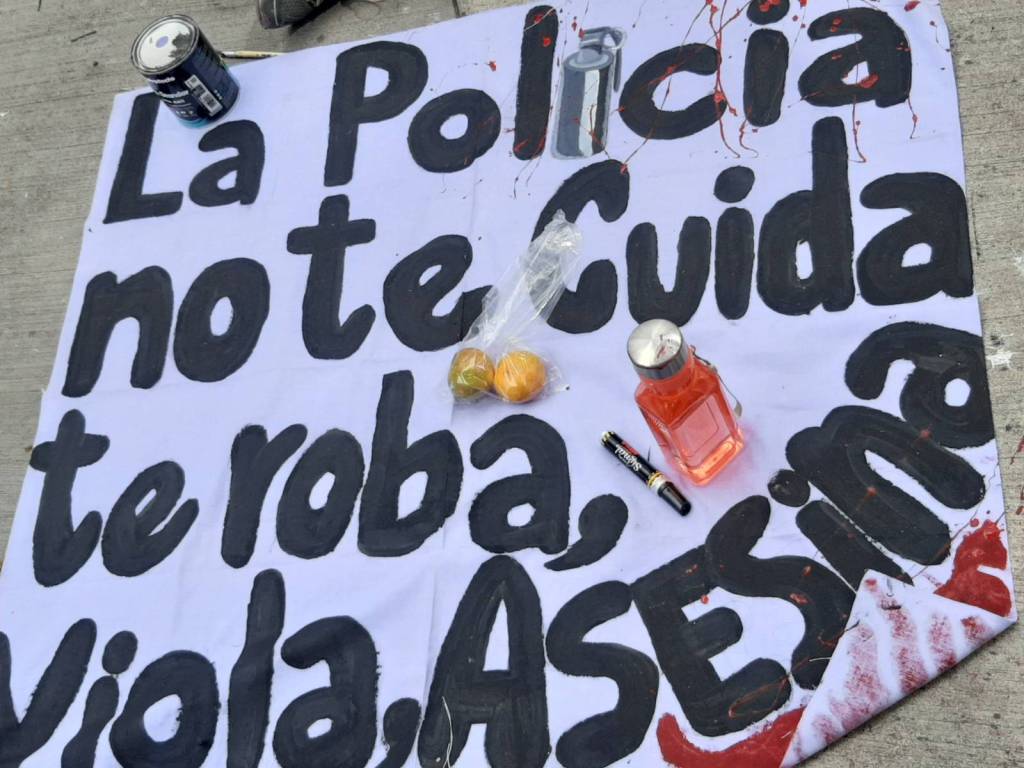
Una manta se seca durante un plantón antimilitarista el 10 de diciembre 2022 en Plaza La Merced, Tegucigalpa, Honduras. Foto: Karla Lara.
Cuestionando la normalización de la violencia
Desde el inicio del estado de excepción en Honduras en diciembre pasado, un grupo autoconvocado de antimilitaristas ha organizado plantones periódicamente en barrios que están afectados por la orden. Su propósito, dijo Sofía, es “visibilizar el carácter clasista del estado de excepción”. Su compañera, Suli Argentina, dijo que también utilizan estos espacios para compartir los testimonios de todas las formas en que las personas han sido afectadas por la militarización, para que la gente vea que, si bien la extorsión daña a la comunidad, la militarización también causa mucho daño.
Estos eventos han tomado diferentes formas, pero todos han sido en un espacio público como una plaza o un parque donde se reúne la gente de la comunidad o donde se puede ver al grupo facilmente. Muchos de los plantones han tenido actividades artísticas colectivas. En el primer evento, que se llevó a cabo el 10 de diciembre del 2022, trabajaron con miembros de la comunidad para pintar mantas, las misma que se utilizan hasta ahora en los plantones.
Una actividad aparentemente simple como pintar una manta colectivamente puede generar un diálogo sobre el militarismo y el patriarcado, dijo la cantautora popular feminista Karla Lara. Por ejemplo, el grupo pintó una manta en honor a Keyla Martínez, una estudiante de enfermería que fue asesinada en la comisaría en febrero de 2021 tras ser detenida por violar un toque de queda decretado por el coronavirus.
Mientras el grupo trabajaba en la manta, intentaban decidir de qué colores pintarla. Lara recordó que una persona sugirió que la manta se pintara de rosa. Otros participantes entablaron un diálogo, preguntando por qué pensaban que el rosa sería efectivo para humillar a la policía, y finalmente llegaron al punto de que el rosa solo “humilla” porque está asociado con la feminidad. En otras palabras, usar rosa para humillar es, en el fondo, una idea misógina.
Otros eventos han incluido presentaciones de música y talleres de grupos como Batucada AntiCistemica (un grupo que afirma la identidad trans que toca los tambores y tiene un juego de palabras con “cisgénero” en su nombre). En otra ocasión, el grupo antimilitarista se instaló en una plaza central con menos tráfico peatonal pero con alto tráfico automovilístico y colgaron las mantas para que pudieran ser vistas por más personas.
Para la gran mayoría, dijeron las activistas, el punto es crear un espacio en los barrios para cuestionar el militarismo como la solución a los problemas que vive la gente. Al mismo tiempo, dijo Sofía, se ejerce mucha cautela en la forma en que se diseñan los eventos debido a la sensibilidad de los temas y el riesgo de ser tachado del Partido Nacional y de la derecha. “Tratamos de hacer actividades lúdicas”, dijo, “para que tampoco provoquen violencia”.
Argentina dice que espera que el grupo pueda ayudar a la gente a ver “por qué la militarización no necesariamente resuelve el problema desde sus raíces, y así para que la gente empiece a entender que no estamos en contra de medidas para garantizar la seguridad de la población, sino mas bien proponemos que se tomen medidas que realmente aseguran la erradicación de este tipo violencia”.
Les activistas antimilitaristas pintan una manta diciendo “los uniformados matan” el 10 de diciembre 2022 en Plaza la Merced, Tegucigalpa, Honduras. Foto: Karla Lara.
Poner fin a la violencia requerirá mayores cambios en la calidad de vida de todos
Los barrios y las colonias bajo el estado de excepción sufren altísimos índices de pobreza y desempleo. A las personas que están en ellos se les ofrecen fuerzas de seguridad; pero no así atención médica, ni abundante comida saludable, ni arte ni escuela. No solo ha aumentado el tamaño de las fuerzas armadas a lo largo de los años de la dictadura, dijo Sofía, sino que este año también aumentó el presupuesto de seguridad con el nuevo gobierno en detrimento de otros servicios públicos.
Los abolicionistas a menudo han enfrentado pedidos de más policía que hacen las propias comunidades afectadas por el sistema policial. En su libro No More Police, las organizadoras sociales y abolicionistas Andrea Ritchie y Mariame Kaba escriben que entienden estos llamados como “respuestas a lo que se percibe como una amenaza de quitar el único recurso que ofrece el estado para responder a una multitud de problemas”. En cambio, argumentan, la abolición se trata de ofrecer a las comunidades tantos recursos como sea posible, en lugar de la violencia policial igual para todos. El sistema policial es el único recurso que ofrece el estado ante el peligro que experimentan estas comunidades en un contexto de abandono organizado, peligro que es creado y sostenido por la desigualdad y las condiciones sociales.
El mismo estado de excepción “está enfocado en los barrios más pobres… donde la falta de recursos es parte del día en día”, dijo Argentina.
Argentina y otros en el grupo de activistas antimilitaristas enfatizan fuertemente la forma racista y clasista del estado de excepción. Dicen que centrarse solo en los barrios históricamente marginados es clasista, ya que el estado de excepción no afecta a todos por igual, y destacan que la extorsión tampoco se limita a estos barrios y colonias. Además, dijo Lara, limitar la medida a dichos barrios es “instalar la idea de que la pobreza es criminal al implicar que los extorsionistas están en estos barrios”.
Al suspender los requisitos como orden judicial antes de detener, registrar o arrestar a las personas, el único criterio que la policía puede usar es quién les parece “sospechoso”. “Es puro prejuicio”, dijo Sofía. Pero el arresto de jóvenes pobres y de clase trabajadora, dijeron les activistas, también estigmatizará la pobreza ya que sus arrestos conducen a la confirmación de la presunción de su culpabilidad.
Las autoridades hondureñas afirman que no había denuncias de derechos humanos durante el estado de excepción. Las entrevistadas por Truthout confirmaron que tenían conocimiento personal de los abusos policiales, incluyendo la detención de personas inocentes, como resultado del decreto. Una contó la historia de una persona que fue recogida por la policía y dejada en un barrio extraño mientras la amenazaban, en lugar de llevarla a una comisaría.
Las personas con las que habló Truthout no se sorprendieron por la falta de denuncias oficiales. No es razonable, dijo Sofía, esperar que la gente va a la misma comisaría de la misma policía que las ha atacado para presentar una denuncia formal de abuso policial, particularmente dentro de una cultura de gran desconfianza hacia la policía que surge desde la dictadura o incluso de antes.
Estes activistas también dijeron que temen represalias por su trabajo de organización contra el estado de excepción. Si bien no han enfrentado ningún ataque físico por parte de la policía hasta el momento, los miembros del grupo son muy conscientes de que cuando critican el militarismo en Honduras, están provocando a las mismas instituciones poderosas que conservan el poder ilimitado para cometer abusos.
El estado de excepción no ha cambiado fundamentalmente la estructura de violencia, extorsión y narcotráfico en Honduras, según estes activistas, en parte porque la policía y el ejército son una parte importante de dicha estructura. A juicio de Lara, “La cultura abusiva de la policía es la de siempre. Por mucho que digan que estos son los policías del gobierno socialista, que ha habido una depuración, que ha cambiado la dirigencia, al final los policías siguen tan violentos como siempre. Diría aún más. Porque el estado de excepción les da impunidad total”. Además, agrega, todos saben quién controla realmente las drogas en el barrio: la policía.
El expresidente Juan Orlando Hernández enfrenta actualmente un juicio en los Estados Unidos por cargos de utilizar su puesto para facilitar el tráfico de más de 500 toneladas de cocaína. Es un asunto de registro público que su gobierno estaba profundamente enmarañado con el narcotráfico, y se ha establecido, en parte a través de la condena de su hermano, que usó millones de dólares del sistema de salud del país, ahora en crisis, para financiar su campaña de reelección, que fue posible como resultado de un golpe judicial que encabezó. Estos años de corrupción, abandono organizado y la desintegración de la mayoría de las instituciones son una parte importante de la historia de las causas profundas de la violencia en las calles de Honduras.
Aunque el estado de emergencia es popular, este grupo de activistas antimilitaristas no es el único que se opone. El Consejo Cívico de Organizaciones Populares e Indígenas de Honduras (COPINH), la organización fundada por la mártir defensora Berta Cáceres, también se ha pronunciado en contra. Su declaración enfatiza que las raíces de la violencia estructural que enfrentan los hondureños no se encuentran en los barrios precarios enumerados en el estado de excepción sino en las instituciones financieras, entre otros actores de élite, y entre las fuerzas de seguridad.
Puede que no haya mejor evidencia de que la estructura subyacente de violencia en Honduras sigue sin ser controlada por el estado de excepción —”que la militarización no sirve para mejorar las condiciones de vida de las personas”, como dijo Argentina— como lo evidencia la racha de asesinatos contra defensores de derechos humanos y de la tierra durante el período de emergencia. Desde fines de diciembre del 2022, asesinaron al menos ocho personas involucradas en movimientos sociales. Además, tres mujeres garífunas fueron asesinadas en enero en Puerto Cortés, zona que se encuentra bajo estado de excepción.
A les hondureños, al igual que para las personas en los EE. UU. y en muchas otras partes del mundo, se les vende un tipo específico de seguridad. Esta seguridad se puede comprar rápidamente poniendo a miles de policías y militares más en las calles, pero requiere aumentar no disminuir el nivel general de violencia, en la medida que la definición de violencia incluya el abuso policial, las redadas y el encarcelamiento.
Kaba y Ritchie escribieron que los abolicionistas deben “confrontar las historias que nos cuentan sobre el sistema policial y la seguridad que no cuadran”, incluida la forma en que “la policía coloniza nuestra imaginación”. Lara menciona, también, que “aprendimos en las series de televisión que la policía hace cosas importantes. Vemos en ‘Chicago Fire’ que además de eso son guapos”. Esto tiene que cambiar, dijo. Pero el trabajo de crear alternativas al sistema policial es lento y no tan fácil de explicar.
Constantemente se vende a la gente soluciones militarizadas y violentas al “crimen”, a través del aumento de las fuerzas policiales y de seguridad en las calles, a través de los programas de televisión y a través de los discursos de los políticos. Muy poco se representan las alternativas complejas, locales, multifacéticas y de cambio de sistema.
“Lo feo [de esta militarización] es que la gente cree que está bien que hagan eso, y que te llevan a creer que está bien eso”, dijo Lara.
Por eso es tan crítico, dicen estes activistas, crear un espacio público para cuestionar la militarización. “Como parte de la comunidad de diversidad sexual y como mujer, tengo muy claro personalmente, que no confío en la policía”. Haciéndose eco de una consigna del movimiento, agregó que la policía “no nos cuida, nos asesina”. Sin embargo, Argentina dijo: “Vamos a seguir luchando por una apuesta por la vida”.
Utilizando un lenguaje inclusivo, he optado por el uso de “e” para eludir las palabras en femenino o masculino.
Every day I get up and I work on my long list of small tasks dedicated to moving us toward liberation, toward the revolution, toward supporting a comrade, toward righting an injustice. In times like these, every night I lie down to sleep and I wonder if I’ve done enough, if my small contribution can possibly be weighed against the thousands of lives lost that day to the combined weight of coronavirus, racism, capitalism, imperialism, settler colonialism, and heteropatriarchy. This is an ugly kind of math, and one that I can never win. How can the phone call I’ve made, the letter I’ve written, even the hours I may have spent or the miles I might have marched measure up to these lives? And yet, it seems to be the only kind of math I know how to do at the moment.
The more relevant kind of math, the one I know from decades of activism, is that change and movements are made for the most part by small, regular, granular level actions. While the scale of what we are organizing against is massive and horrific, what it takes to bring it down, I think, is steady work. Maybe it is wrong to use the term work here – maybe I mean effort. Or steady dedication. Chipping away at. After all, the systems of injustice and oppression are also made up of a series of smaller things: rules, people, policies, particular institutions, attitudes, habits, actions, and so on. They are not singular, enormous horrors but composites of smaller things too.
I know I am not the first to say this; I am not saying this because I think it is news. I am saying this to remind myself and recall myself to this truth. I am writing for myself because I am writing myself back to this truth.
Because in the mode of crisis, it is hard to remember. And these days I feel I live in a crisis. This is no accident but part of both Trumpism’s strategy as well as endemic to capitalism. This week alone there was the tense national election in the US; the hurricane that hit my comrades in a Honduras already devastated and made fragile by narco-dictatorship and neoliberal plundering; and the surge of coronavirus cases in the ongoing pandemic. People close to me need support for other private troubles; the source of these troubles are almost all located in larger systems of structural oppression intensified by certain news cycles. In the crisis mode, it is hard to remember that I’m working together with others for big, long-term changes, and also small gains. It’s hard to remember that I exist in larger communities of talented, visionary, resilient people, and that we want it all – small immediate changes now, and big stuff, and everything in between even as I recognize no change will last forever. I am lucky to exist in communities with these people, I am honored to learn constantly from them, and overjoyed to have the skills and resources to be able to find ways to support their work.
Crisis is the vision of the right wing that does not value Black life, Indigenous life, or life itself; it is their mode. I was reminded by Hoda Katebi that we already have our own, better plans; I was reminded that, as Mariame Kaba says, “hope is a discipline”; I was reminded to listen to all the wisdom right around me insisting that even cracks of light in a dark time are necessary and vital forces.
I will continue to wake up every day and commit to organizing in movement with other people or somehow acting in solidarity with others or supporting my folks. I will continue doing one thing every day to build a better world, and I will know that in doing so, I am building some version of that world. This struggle is long and it will never be done but struggling together is how we get free.
G.F. 1619-2020
by M. L. Graham

Ask
and ask
and then ask
why we can't breathe
why we can't see each other
in 'we'
at least not officially
why whenever we speak of history
it's dotted with caveats
inclusive I's
exclusive we's
narrating our story
while we can't breathe
ask why
grown men holler momma
eighteen months after she's passed
eight minutes before we do, too
which we know thanks to a seventeen
year old --
or so we're told
or so we're shown.
ask why
slave patrols kept their colors
their vicious dogs
their strikes like bloodhounds
unerringly cracking black spines
black kidneys
black arteries
until we can't breathe
Who's in control of the city?
Why we riot whenever we bleed?
Why we get asked to trust
those who've robbed our best,
robbed our breath?
Why black anyways,
isn't that the mark of a slave?
why not call me by my name?
There's nothing black about me
that wasn't left by brutality,
boots, batons, knees,
the hearts of those who refuse to hear my pleas.
ask, and ask why
ask until you hear your voice in
every preacher's cries
ululations, protestations,
hymns
parched and inflected
pitched and hoarse,
ask again
ask why you think riots
are uncalled for
when injustice is ringing
when the police who cleared the
streets
were still writing
false reports in our names
signed by the silent
coauthored by the medic
who backed our killer's tale
before they thought we knew.
I don't want your stores
or their windows
your streets strewn with broken glass
your loot,
we want to breathe,
like Eric Garner, Rodney King,
Philando Castile, Freddy,
Tamir, George, Brianna,
You & Me
Ask why
I had to write this
for 'We the People'
it's not for a cause
it's because 'it' happened again
and again
and again
and I'm not sure what 'we'
means anymore
they want prison for the perps
I want justice for all
they want harsher charges
I want a sweeter liberty
we can't have both
but we can have neither
ask why it seems that's what
we've got.
Ask why you think
peaceful protests are best
we had those three years ago,
at Trump's inauguration
at his appointment of Gorsich,
at the Kavanaugh hearings,
the Mueller findings
the Impeachment proceedings,
and yet Manafort is free,
as is Stone,
Sheriff Arapaio,
Giuliani & Co.,
and of course Trump is
still president
the glory of peaceful protests!
like flowers at a cancelled wedding,
like Floyd's nonresistence.
"Just be calm," he whispered
"I can't breathe," he replied
and peaceful crowds were dispersed
helicopters hovered
tear gas bursting in air
proof through the night
that they don't care.
Burn, New York!
Burn, Baltimore!
Burn, Louisville!
Burn, L.A.!
Burn, Seattle, Minneapolis, St Louis,
Houston, Oakland, Miami,
Burn! Burn! Burn --
with the flame of indignation,
the heat of reprehension,
the fire of compassion,
light up the skyline
with refrains
from Malcolm, Huey,
Angela and Martin
let your silhouettes flicker
to the tune of unrequited memorials
that ask why
through dead black throats
ask why
we can't keep our bowels from releasing
ask why
the EMT can't find our pulse
ask why
when your soul died you took my body
with it
ask why
our eyelids can't lift so we can
stare into the camera,
past the little girl holding it,
into your living room
He killed us!
His stare is still here,
we cannot convict him
he is us
ask why
convicting him is not suicide for you,
for all of you who didn't ask why
just repeated the lies
just retweeted the myths
covered the blows with words
hid the strangle holds behind
other breaking news,
concealed your broken face
behind 'my' facts
ask why
like you've never asked before
so you'll never have to ask again
ask
"Why can't you get in the car, George?"
and ask
"Why won't you be still, George?"
then ask again
"Momma!"
Why can't we breathe
This poem was sent to me to publish by my friend and penpal of 4 years who is currently imprisoned. I am happy to have a space to share with a Black poet, and am honored to call Mr. Graham my friend. Our letters have been a constant source of inspiration, intellectual exchange, and hope over the years. I would say a lot more, in less formal terms, about this poet and our friendship, but for his life being at the mercy of the ever watchful prison.
Over the last few weeks governors in almost every state have called for a “reopening” after the spring COVID19 shelter-in-place orders. During this time, in response to debates about whether returning to circulation in public again en masse is safe or not, I have repeatedly heard the answer given as some variation of “everyone has to decide for themselves what they think is best.”
like everyone else Like many of us, I am not sure what to do and am just trying to figure it out. This is a terrifying time. I think often of another pandemic, another plague, where people died in hospital hallways. This plague also seemed concentrated in certain cities (the same ones that loom large today – New York and San Francisco) and to affect a specific segment of the population. Unlike the Spanish flu, the majority of the population alive today remembers that plague. And maybe in some ways this is the more relevant lesson, because the majority of the population alive today actually doesn’t recall that plague with much specificity, although in some communities whole networks of people were dying by the month and even the week.
During that plague, it seemed that it was easy for a majority of people in the United States to ignore or feel unaffected by what was going on because they believed it was only affecting specific groups of people to whom they already did not feel connected. And once they had done that, they could simply ignore the crisis, the tens of thousands of deaths, and even laugh at jokes about it.
M0001845 John Haygarth. Line engraving by W. Cooke, 1827, after J. H.
Credit: Wellcome Library, London. Wellcome Images
images@wellcome.ac.ukhttp://wellcomeimages.org
John Haygarth. Line engraving by W. Cooke, 1827, after J. H. Bell.
Line engraving
Gent\’s magazine
Published: 1827
Copyrighted work available under Creative Commons Attribution only licence CC BY 4.0 http://creativecommons.org/licenses/by/4.0/
In fact, it is the same communities who are still being affected. African Americans, imprisoned people, drug users, queer and trans people – these groups are all still dealing with the HIV epidemic that did not go away, and they are the same groups at much higher risk from COVID19.
And it was easier for the pandemic to keep raging when a majority of people felt no urge to apply pressure, when they did not feel personally affected, when they did not feel that their communities would continue to feel the reverberations forever.
Like many others, I am struggling to figure out how to negotiate this situation. I do not understand all the biological science involved. But I do understand that an inherently social problem is going to call for a social solution, and better yet, many of the aspects of the problems that we face here in the US with COVID19 are political problems that require collective action. We have much we can learn from previous struggles.
That means the answer, in an inherently social situation with a contagious disease, is ANYTHING BUT “everyone should do what they feel most comfortable with.”
Some ideas for collective action:
The Poor People’s Campaign has launched a “moral non-cooperation campaign” called Stay in Place! Stay Alive! Organize! with actions you can take coordinated with others to push for a healthier plan for your community.
Now is a great time to find or start an existing mutual aid network. Create and share the resources people need together in your community to be safe based on community members’ own assessments, instead of saying “some people will have to go to make the tough choice to go to work,” which is another way of saying some of us need to decide between dying from hunger or dying at work.





 Dr. October Krausch