Since he had a stroke during his case of COVID-19 in November 2020, 72-year-old Richard Grape sleeps for 12 to 18 hours a day and uses a wheelchair. Grape says he lacks the energy to do much of anything at all, even play games on the PlayStation he bought for himself. Like a lot of people with Long COVID, he doesn’t have a formal diagnosis.
Grape has spent the last 31 years imprisoned by the Colorado Department of Corrections (DOC). An army veteran who treasures his travel memories, Grape told The Sick Times what it’s like to be in prison with Long COVID. “I think it’s actually getting worse, to be honest with you,” he said. “I do not have a lot of drive or motivation to do hardly anything.” Nonetheless, Grape still needs to get up any time guards want to do a shakedown (a surprise search) of his cell or count heads.
Prison is a notoriously bad place for anyone with chronic illness because of the difficult living conditions and inadequate medical care. There are no reliable data on how many people in prison across the country have Long COVID, or, critically, what kind of care they are receiving.
John Richard Green, who is imprisoned in Texas, wrote that, with Long COVID, his health is “more messed up than the floor of a New York cab.” He has chronic diarrhea, cataracts in both eyes, incontinence, fatigue, and nerve pain. Green is a fan of the band Emerson, Lake & Palmer, and like Grape, is an aging man who has been in prison for decades.
“Now I am bedbound, sick, and all alone,” he wrote. “And waiting for parole to a nursing facility because I have nowhere to parole to.” Green recently lost his aunt, who managed his finances. Like many people entering their “golden years” in prison, Green has little surviving support on the outside. Yet, he wrote, “I’m hanging on, because I promised my aunt I wouldn’t give up.”
For this story, The Sick Times spoke with experts in prison health data and lawyers handling prison-related litigation, and circulated a call among prison newsletters. After several months, we interviewed five people in prison in four states who have Long COVID symptoms but found no sources of systematic data.
Speaking with sources in prison is challenging. All forms of external communication are difficult from inside the prison. Calls are limited to 30 minutes or less, depending on the state, and in Colorado and Oregon, an opaque process of approval took several weeks before these calls were permitted. Additionally, e-messages require the purchase of “stamps,” which is a hardship for those without financial support from the outside.
Once in contact, sources reported no interest from medical staff in Long COVID and varying levels of accommodations for their symptoms. Grape and Green are each living in quasi-retirement within the prison, but others are simply struggling through daily life as best as they can. Wayland Scott, who is living with Long COVID in an Oregon prison, said that it’s hard enough to find a decent job and requesting any work accommodations or restrictions would be of no benefit. “You’d screw yourself.”
All those who spoke to The Sick Times lacked Long COVID–informed medical care, but more than that, they lacked access to basic information about the disease.
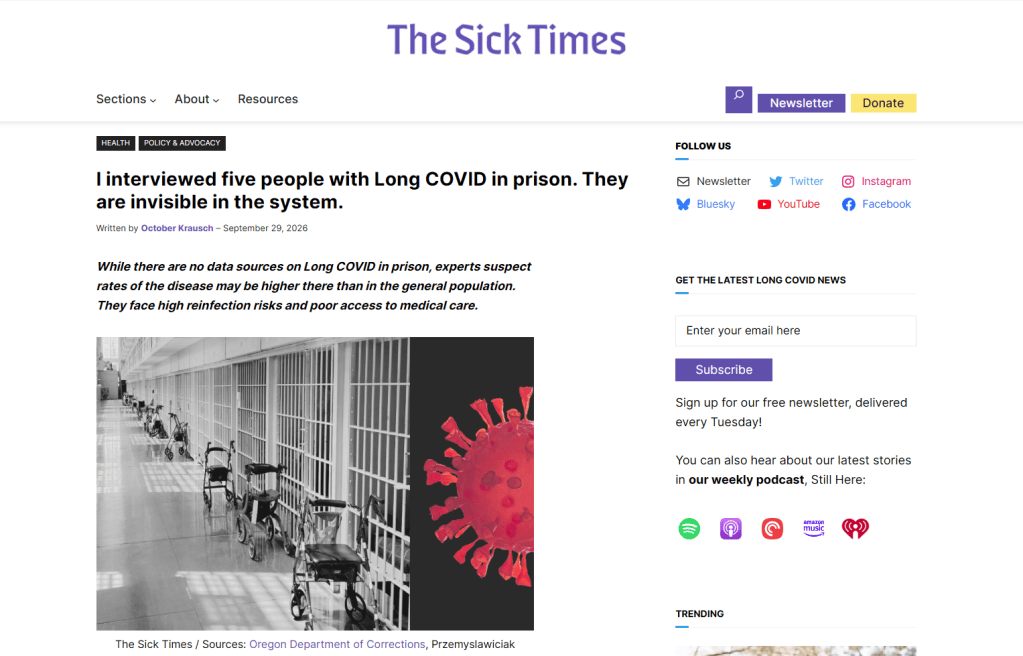
Read the rest here: https://thesicktimes.org/2026/09/29/i-interviewed-five-people-with-long-covid-in-prison-they-are-invisible-in-the-system/
This article, the product of a months-long investigation, is up now at The Sick Times. Although this article is a rough read, I hope people will not feel hopeless after reading it. There is a lot we can do to ease the suffering of people in prison that is discussed at the end of the piece (and please reach out if you want any ideas or support with that!). And, as I have often, often argued on this blog, doing even something small about a social problem in a consistent way is the path both to rejecting despondency and to tearing down the awful world we have to bring about something new.

