Amid Growing Health Threats, Nurses Are Still Fighting for Basic Protections

Five years since the start of the COVID-19 pandemic caught our health care system unawares, nurses and other health care workers say we are no more prepared for the next threat.

“It’s scary,” says Tatiana Mukhtar, a nurse in New Orleans. The exposure during the initial phase of the COVID-19 pandemic “was horrific, for patients and for health care workers” she says, “and having been there and having experienced that, I feel like we have learned nothing because [health care systems] are still not doing what we need to do.”

Although the emergency feeling of spring 2020 may have faded, the need for public health measures to combat the spread of disease remains urgent. COVID is still circulating widely, and studies show that at least 35 million adults have experienced Long COVID, and that COVID increases the risk of heart disease in both children and adults. This has also been the most dangerous flu season in 15 years, with up to 92,000 people dying of the flu between October 1, 2024 and mid-February this year.

The U.S. also faces a resurgence of both tuberculosis (TB) and measles, the latter of which is one of the most contagious viruses on Earth. Meanwhile, with the threat of a bird flu outbreak among humans also looming on the horizon, the Trump administration is eliminating what Mary Bowman, a nursing assistant professor, refers to as our “already meager public health infrastructure.”

“In truth, what was laid bare by the beginning of COVID was how disinterested capitalism is in people caring for themselves when they’re sick, when they could be sick, when they could get other people sick, when their families are sick, when someone dies,” Bowman told Truthout. “There’s just no space for humanity in it.”


My latest at Truthout is up now. This piece is about the lessons that were learned from COVID that have been forgotten or rolled back, but it’s also about how those lessons — like high quality masking in the hospital — were only ever implemented in the first place because of the hard organizing work of nurses and others. In other words, we have to keep organizing!

safety planning and reacting to ICE kidnappings: some concrete steps

In the last two weeks there has been an escalation in the impunity with which state forces can and will kidnap people off the streets in the United States. Of course, arrests are always a kidnapping of someone from their community (a great example here is picking people up with open warrants they may not even know about), but it is also fair to say we are seeing significant escalation in who will be picked up and how little advance notice they have that they are being targeted as we watch noncitizens be snatched by masked cops. Spreading terror is clearly the point here, and it’s effective. Unfortunately, trying to comply is not any better of a strategy than hoping it won’t happen to you or your friends, so our only real choice is to face the fear and work together.

I put together a list of ideas based on my experiences and training related to copwatching, human rights accompaniment, jail support, and anti-stalking safety planning. Some of these make more sense for the people targeted by ICE, while others are more for bystanders who want to try to disrupt these nabbings and the terror they are sowing. None of these are guaranteed to work. The main idea here, taken from human rights accompaniment, is that in a bad situation we can try the slim odds to see if sometimes we can stop the worst from happening.

These are not exhaustive tips, and I’m sure there are things I haven’t thought of. Please feel free to reach out if there’s something you think should be added!

  • Make sure someone knows where you are supposed to be at all times. This is so that people can start making calls and publicizing quickly after you are grabbed.
  • Alter routes and routines as much as you can – this makes it harder for ICE or other state agents to predict where to find you
  • Try not to be alone, especially when in public spaces.
  • Make sure that someone trusted has your birthdate, your A-number, the list of stuff you need taken care of ASAP (childcare, pet care, medication), and your other emergency contacts (like lawyer). This person should be someone who is not likely to be arrested or detained with you, and you should memorize their phone number. (This is jail support protocol.)
  • We should probably ALL get busy making sure we have at least one phone number really memorized that we’d call if we are detained.
  • Make sure you have the phone number of a decent immigration lawyer, who can file a habeas corpus, and that your emergency contact has it. It is likely hard to get set up with a retainer for a lawyer right now, as most are swamped with similar requests, but you can at least get the name and number of a recommended person and give it to your emergency contact. Another idea could be for a group of people to pool resources and engage a lawyer together. A good place to start looking for trusted immigration lawyers is your local National Lawyer’s Guild chapter, or a local agency that does immigration defense (even if you can pay, they may have a referral list).
  • Be ready to call/yell/make a disturbance, especially if you are a bystander. The idea is to disrupt all secrecy.
  • Sometimes it works for targets or witnesses to appeal directly to the humanity of people who are doing the violence.
  • Think of the audience you’re appealing to as international at every point in this process. Public support can create more pressure on the state, but if you do not want your situation, still make sure that a significant number of people know what is going on with you so they are ready to step up.
  • Never talk to the cops! If you are bystanding, you can try talking directly to the person being detained, for example asking “do you consent to this search?”
  • In particular for bystanders, be mindful of not escalating a volatile situation, even as you may be trying to disrupt secrecy.
  • Bystanders may also want to make it clear that you are accompanying the victim, and not just gawking at their terrible moment. I do this by yelling some support or a question, and I also hold my phone visibly in my hand, whether or not I film.
  • It’s also helpful to be clearly marked as who you are, especially if that involves privilege: neighbor, professor, manager, etc.
  • Finally, rehearse these incidents mentally. Go over exactly what you might do, and where this would have to be happening for you to intervene. Rehearse what you will say if you are the one stopped on the street. We experience deep conditioning to go along with authority that kicks in when we’re shocked and confused, and all of us need more practice with disobedience.
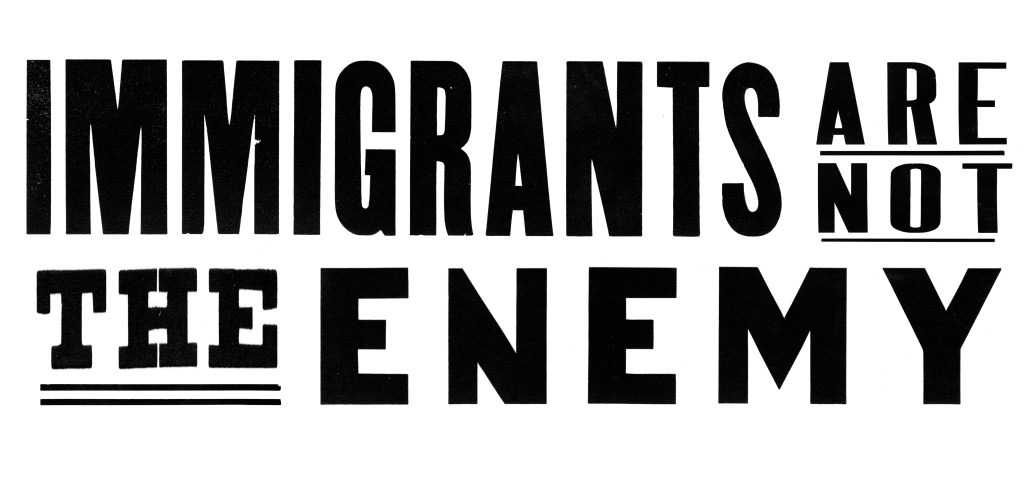
Tall, bold text in black is oriented horizontally: “IMMIGRANTS ARE NOT THE ENEMY," created by Kevin Caplicki.
Image by Kevin Caplicki.

(Don’t get) COVID for the holidays

As we’re facing the next COVID surge (brought on by holiday travel), I thought I might try a different kind of COVID post. You can skip to here for some easy to do tips and tricks you might have missed, or you can read down for my discussion of why this is important.

I have recently been writing and thinking a lot about why so many of my friends and family’s actions on COVID are so different from mine. Namely why so many people I know no longer seem very interested in either preventing themselves from being sick or, importantly, not spreading sickness to anyone else.

In my own case, the experience of staying home to stop the spread in 2020 forced me to strongly reconsider my behavior up to that point. Why had I ever thought it was OK to go to work or ride the subway with the flu, unmasked and taking no precautions, knowing that the flu certainly hospitalizes and kills people each year? Even if the flu was no big deal for my body, my behavior had limited other people—particularly disabled people—from comfortably being in public during flu season. I had knowingly spread around an illness. I radically reconsidered a lot of my behavior, and in particular, 2020 pushed me to focus more specifically on disability justice in my activism. A disability justice framework pushes us beyond thinking about individual access to consider how ableism limits us all from liberation.

Getting back to why this reconsideration didn’t happen on a mass level, understanding disability justice also means understanding that ableism is the current social order. And if it’s the order of the day, like other oppressive ideologies, that means we are all drenched in it and it is impossible to avoid ever doing something ableist. Furthermore, most people are going to act in ableist ways, most of the time. None of this are exempt from this, but not even trying is definitely worse!

I am also well aware that good COVID information is hard to come by, especially if you are not on the regular lookout for it. And if you do go looking for it, it can quickly get overwhelming. So I’d like to offer here a very short, distilled list of things people might have missed since 2020. (I’ve not taken the time to track down citations for all of these things; you’ll have to trust me that I got them from trustworthy sources or you can verify on your own. I’m happy to give more info on any of these too.)

Some of these things are easy enough to do. I’m offering this list because from a “stop the spread” mindset, each specific thing you do is helpful. This list is not meant to be comprehensive, and it’s hopefully not overwhelming. You don’t have to be perfect or avoid COVID 100% of the time or make this part of your identity, but I’d like to ask everyone reading this to take one step up in your mitigations for the holiday season, since this is reliably a time with huge increases in virus transmission. With around a thousand people still dying every week from COVID in the US, you don’t know whose life you may save by being a little more careful.

Masking

This is the biggest bang for your buck, precaution-wise. If it’s hard for you to mask all the time in public, consider masking in places that disabled people really can’t avoid, like the pharmacy, the grocery store, and on public transportation.

I’d also suggest that if masks are uncomfortable, try different kinds of masks! The Aura is my favorite mask – it’s tight to my face so my glasses don’t fog and head straps don’t hurt my ears like ear straps do. Wellbefore sells masks in different sizes and colors, and Armbrust has sampler packs. Just try a bunch and see what works for you!

Finally, know that if at all possible, you should wear an N95 or KN95 mask. This is a change since spring 2020 because the current variants of COVID are more contagious.

Mouthwash

Washing your mouth out with a mouthwash containing CPC (cetylpyridinium chloride) before or after seeing people, or just regularly, will kill some of the virus in your mouth and keep you below the threshold to get sick and/or shed the virus to others. This is a really easy one; CVS brand mouthwash has CPC.

Sip mask

These valves will allow you to drink without breaking the seal of your mask. This is great for airplane travel, crowded conferences, or other risky spaces that you need to be in for an extended amount of time.

Airplane

The most dangerous time on an airplane from a virus transmission standpoint is the time sitting on the runway (because of the way they circulate and filter the air onboard). Even if you don’t mask up during the flight, this is the best time to mask. (And if you do mask, this is the worst time to have a snack or drink – try to keep your mask on for all of this period.)

Space out risky or crowded events

Don’t go to a wedding and a concert in the same weekend! Illness takes 3-5 days to develop after exposure, so give yourself time to know if you got sick from the last thing before potentially spreading that to the next thing.

Air purifiers work!

This is a great one for places that you can’t avoid, like school, work, or daycare. You can make your own Corsi-Rosenthal box, but there’s also a variety of high quality air purifiers you can get for $70-100. You want to make sure it has a HEPA or Merv13+ filter on it, and check how quickly it changes out the air in a room. Since COVID is airborne, there can be COVID in a space even after the person has left it. Setting up air purifiers and/or opening windows until enough air has circulated before you remove your mask is a great way to make a space COVID safer

Test before going to events, even if you don’t feel sick

Rapid tests (the kind you’re used to getting from the government and at the drug store)

False negatives from these are rampant but a positive test reliably means you have COVID. The accuracy of these tests also increases a LOT if you take two of them 48 hours apart.

Better home tests are now available

Metrix and Pluslife are both testers you can buy that offer a similar level of accuracy to a PCR test (that is, very accurate!). These devices are expensive, but so is another COVID infection: think of the missed work, cost of Paxlovid, and potential for Long COVID to keep you down even longer.

It’s a good idea to get an updated vaccine 2x a year too; like the flu shot, these vaccines are updated to try to fend off the particular variants that are circling. Be mindful though that vaccination will not necessarily stop transmission, especially of asymptomatic cases. Handwashing is also good for general prevention, but it doesn’t really stop COVID transmission. In the early days of COVID, researchers guessed that it was spread by physical droplets. That’s why we were instructed to wash our hands and groceries. But now we know that COVID is airborne; it spreads more like cigarette smoke than spit!

Of course, no single thing works perfectly. The best model is still the Swiss cheese model, but that also means each thing you do helps. If you’re reading this, please consider doing *one more thing* to take care of yourselves and others. I love you.
A photograph of a sidewalk display in NYC. Approximately 20 mannequin heads wear a variety of colors of KN95 masks, amidst ball caps and other items for sale. Handwritten signs adorn the table saying things like "On sale KN 95. 1 for $3, 2 for $5."
Photo by Sam Stone. Manhattan, New York, on 6th Avenue somewhere between 20th and 17th Street, 2020. https://hdl.loc.gov/loc.pnp/ppbd.01588

the politics of COVID information

The pandemic isn’t over. Why is it so hard to find accurate information about it?

This week, Nassau County, New York, passed a mask ban. Those wearing face masks will now face the possibility of up to a year in jail or a $1,000 fine. Angry at the power of anti-genocide protests, lawmakers banned one of the most basic forms of disease protection just as the world is experiencing a record surge in COVID cases. While officials insist that the law will not be used against those masking for medical reasons, disabled activists protesting the move say they were intentionally coughed on during the city council meeting where the bill was passed.

In a world of airborne contagious diseases, everyone has a medical reason for masking. So why doesn’t our public health policy recognize that?

In 2020, at the height of the first wave of the COVID-19 pandemic, then-President Donald Trump was excoriated for saying that “when you test, you create more cases.” This statement was met with outcry by journalists and public health professionals and pundits from all major outlets.


Read my most recent article here. In it you will also find a list of places you can stay more informed about COVID, critical during this record-breaking surge.

The response to this article has been tremendous. I was especially honored to be a guest on one of my favorite podcasts, Death Panel, to talk about the piece. If you’re not a paid subscriber, you can check out a preview of the first 20 minutes of the episode here.

Finally, I want to officially announce my name change to October! This has been a long process for me since letting go of the past is not always easy, but I am excited to have a name that better reflects who I am in this part of my life. If you have known me a long time, please feel free to continue calling me Meg, but I will gradually be removing Meg and Meghan from my byline and business information, and may change my email address eventually too.

a birthday request

I want to share here some of the organizing work I’ve been involved with this year. This year I have been enmeshed in two big abolitionist projects in and beyond Detroit. And, in honor of my birthday next week, I’m asking anyone who wants to celebrate with me to make a $43 donation to one of these projects (or whatever you can afford!).

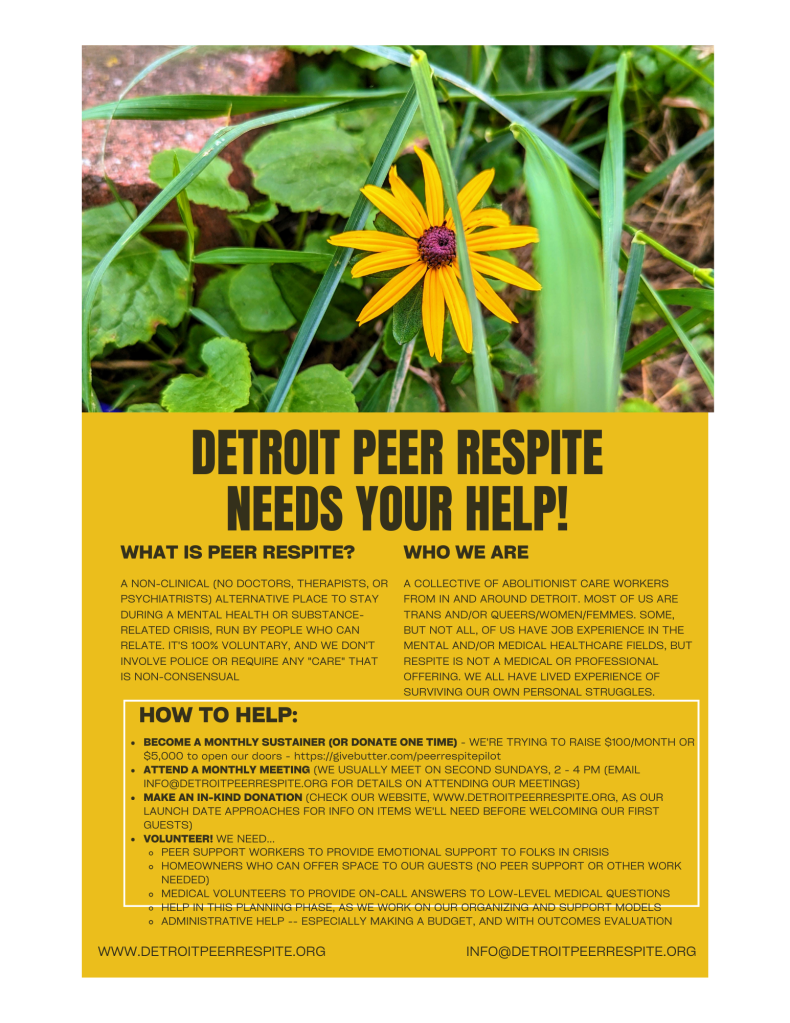
The first is the Detroit Peer Respite, an abolitionist alternative to mental health incarceration and coercive care for moments of acute crisis. We are working to pilot the ability to host a person in crisis in a local house for up to 10 days. In this non-medical and consent-based model, guests will be supported round the clock by another person who can listen, help find resources, work through problems, or whatever support is requested and helpful. The organizing and support comes from peers – people who are survivors of psychiatric incarceration or have other lived experiences with mental health struggles with ourselves and in our families. To make this happen, we need a lot of volunteers and a little bit of funding! I would love to talk to anyone local about how to get involved.

Donate to Detroit Peer Respite here: https://givebutter.com/peerrespitepilot#

The second project is the Abolitionist Book Club, a reading group that connects people inside and outside of prison for conversation and political education. This is a project started in collaboration with the Black Prisoners’ Caucus in WA as an act of material and emotional support with our imprisoned comrades. The club is currently reading Kaba and Richie’s No More Police. We’re fundraising to provide money for phone calls and messages to and from the prison (you can read more here about these exorbitant expenses).

Donate to Abolitionist Book Club here: https://chuffed.org/project/no-more-police-insideoutside

Big, big thanks in advance to anyone who can celebrate my birthday with me by supporting one of these projects. I would also love to chat with anyone who wants more info or is interested in getting involved, or doing something similar, or who’s already doing similar work, so as always, please reach out!

exciting updates

There is a little bit of news around my office that I haven’t yet posted about here. This spring, I started offering my own workshops directly. These workshops have been a goal of mine for a long time, and I’m really excited to have been able to figure out and set up all of the infrastructure to make them finally happen!

Book online

The workshops have been up and running now for a few months. It’s exciting to be facilitating and teaching adults (again) so regularly. The first cohort of my 4-session course “Create an Action to Defend Trans Life” has wrapped up. In this course I work with folks to think about their existing skills, networks, and preferences to support the design of an action that will in some way affirm trans life and/or support the struggle for trans liberation. An “action” is intentionally broad; there are so many more options for supporting social transformation than attending or organizing a protest. Fundraising is a critical action, for example! Or getting involved in your local library to help defend against book banning attacks. People taking this course get support from me in identifying ideas that will work for them as individuals, and also in designing and getting started with their plans. Everyone also gets plenty of support from the other folks taking the class (that’s why it’s a “cohort model”).

Multiple projects from the first cohort are now ongoing in the world, and I am so excited about it. It’s truly meaningful to support people to enact social change in tangible ways. Participants said they really appreciate the breadth of options I offered for getting involved, “besides throwing all of my time, energy, and safety on the line,” and that they were encouraged “to think in practical, concrete ways.”

Not to brag, but another participant said “Meg conveys a cool confidence—smart, well informed, friendly, kind. The course discussions were my favorite part of the workshops, listening to the questions from participants and Meg’s answers. I enjoyed getting to know the other members of the group. Meg was great about helping us to find projects that fit within our abilities and interests.” I hope to embody this compliment as well as I can!

I’m planning to offer this course a few more times, hopefully even regularly. The next session of this class is open for a few more days. We’ll meet once a month, on the second Saturdays, and scholarships are available. Just ask. I really hope this class will be a way for me to continue to engage people in activism and empower folks to get off the benches, because right now we need all hands on deck.

I’m also offering shorter workshops where people can practice using different gender pronouns and ask any other questions about gender identity that extends beyond male and female. The next session of this workshop is designed specifically for folks involved in supervising or hiring. It is two sessions: the second session will be about negotiating backlash for trans affirmative policies and is open to anyone interested, whether or not you are in a supervisory position.

As many of you may know, these are disastrous and very scary times for trans folks. My hope with these workshops is to encourage everyone to do all that they can right now in solidarity, and to make sure that trans life can be lived out loud in public. Please do what you can, and please tell your friends and family the same.

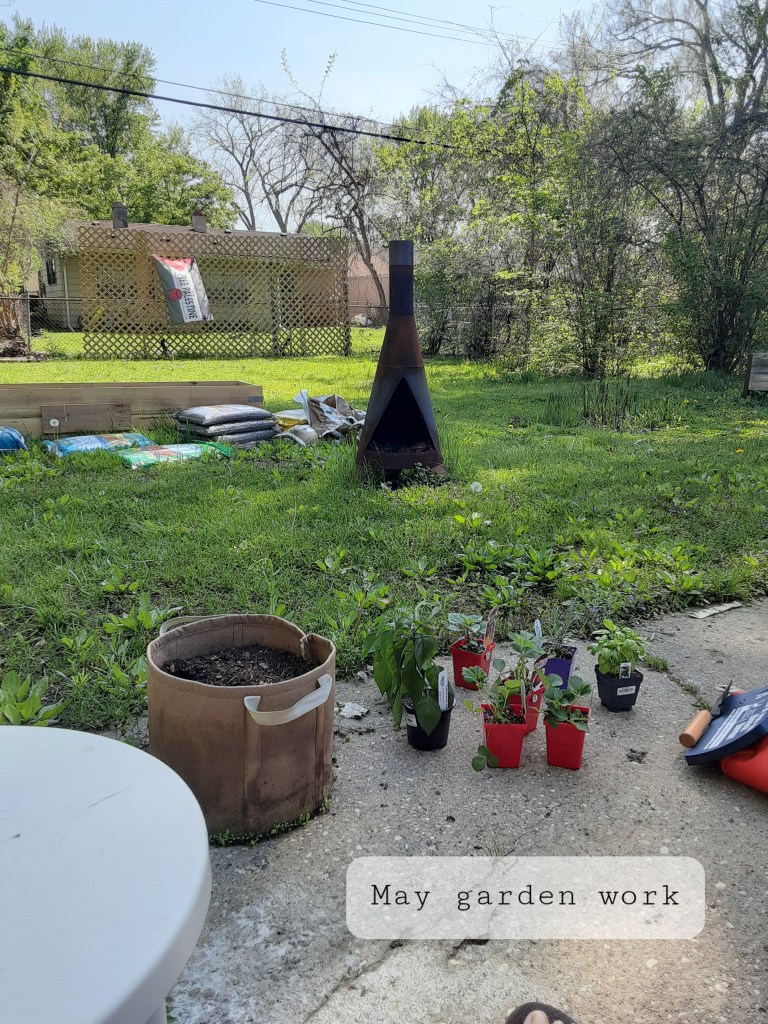
Picture of a messy yard in progress. In the foreground are a half dozen containers with basil, strawberry, and hot pepper plants. In the mid ground is a fire chimney and a raised bed with large bags of soil not yet opened nearby. In the background is a trellis with the Palestinian flag.
It is so healing to garden in late spring and turn my attention to the non-human world.

the police just keep murdering people

the last time I sat down to write, I was trying to write about the police killing Black people, and about the widespread harm the police do in general. it was last Wednesday, and Daunte Wright was still alive.

my poet friend really described this best in “Next Black Murder

in an effort to spread ideas, hope, and care for each other, and to fortify our abolitionist networks, here are some things folks can do about the violence that is inherent to policing:

a lot of us are struggling, but this is a social problem

Over the last few weeks governors in almost every state have called for a “reopening” after the spring COVID19 shelter-in-place orders. During this time, in response to debates about whether returning to circulation in public again en masse is safe or not, I have repeatedly heard the answer given as some variation of “everyone has to decide for themselves what they think is best.”

like everyone else Like many of us, I am not sure what to do and am just trying to figure it out. This is a terrifying time. I think often of another pandemic, another plague, where people died in hospital hallways. This plague also seemed concentrated in certain cities (the same ones that loom large today – New York and San Francisco) and to affect a specific segment of the population. Unlike the Spanish flu, the majority of the population alive today remembers that plague. And maybe in some ways this is the more relevant lesson, because the majority of the population alive today actually doesn’t recall that plague with much specificity, although in some communities whole networks of people were dying by the month and even the week.

During that plague, it seemed that it was easy for a majority of people in the United States to ignore or feel unaffected by what was going on because they believed it was only affecting specific groups of people to whom they already did not feel connected. And once they had done that, they could simply ignore the crisis, the tens of thousands of deaths, and even laugh at jokes about it.

M0001845 John Haygarth. Line engraving by W. Cooke, 1827, after J. H. Credit: Wellcome Library, London. Wellcome Images images@wellcome.ac.uk http://wellcomeimages.org John Haygarth. Line engraving by W. Cooke, 1827, after J. H. Bell. Line engraving Gent\’s magazine Published: 1827 Copyrighted work available under Creative Commons Attribution only licence CC BY 4.0 http://creativecommons.org/licenses/by/4.0/

Then too it was easy to fall into debates about what behavior was the right behavior to prevent oneself or one’s beloved community members from getting sick. But the real culprits, the villains, the murderers, were the politicians and institutions that refused to recognize the crisis or do anything to solve it, and the social structures that sustain systems of inequality making specific groups of people so much more vulnerable to illness.

In fact, it is the same communities who are still being affected. African Americans, imprisoned people, drug users, queer and trans people – these groups are all still dealing with the HIV epidemic that did not go away, and they are the same groups at much higher risk from COVID19.

And it was easier for the pandemic to keep raging when a majority of people felt no urge to apply pressure, when they did not feel personally affected, when they did not feel that their communities would continue to feel the reverberations forever.

Like many others, I am struggling to figure out how to negotiate this situation. I do not understand all the biological science involved. But I do understand that an inherently social problem is going to call for a social solution, and better yet, many of the aspects of the problems that we face here in the US with COVID19 are political problems that require collective action. We have much we can learn from previous struggles.

That means the answer, in an inherently social situation with a contagious disease, is ANYTHING BUT “everyone should do what they feel most comfortable with.”


Some ideas for collective action:

  • The Poor People’s Campaign has launched a “moral non-cooperation campaign” called Stay in Place! Stay Alive! Organize! with actions you can take coordinated with others to push for a healthier plan for your community.
  • Now is a great time to find or start an existing mutual aid network. Create and share the resources people need together in your community to be safe based on community members’ own assessments, instead of saying “some people will have to go to make the tough choice to go to work,” which is another way of saying some of us need to decide between dying from hunger or dying at work.
  • Find ways to support the many workers who are striking right now (e.g., respect their picket lines, donate to their strike funds, amplify their demands).

How We Can Help Each Other in a Pandemic

Like many other activists, I am not exactly sure how to organize in this moment. I like the phrase physical distance and social solidarity, but I find that I’m not totally sure how to put it into practice. This post is my imperfect attempt to share some ideas of what folks can do to help each other. I more than welcome suggestions, critiques, and additions. We are all learning how to do this together, and that is one example itself of social solidarity.

I first want to lay out that although we are all scared right now, we need to try to remain focused on centering the needs of the most vulnerable. We cannot get so wrapped up in our own needs, in securing ourselves and our families, that we leave behind everyone else. If we make sure our most vulnerable are secured, it’s pretty likely we will have created a network that can sustain everyone. Lead from generosity and love, not fear and scarcity. (Trust me, I know this is easier said than done; that’s why I think it has to actually be said. I am telling myself the same thing like a mantra as a way to work out of my own fear-based reactions.)

If your income has not been affected, PLEASE consider donating as much money as you can spare to one or more of the funds below. Even relatively small amounts of money will go a long way toward assisting extremely vulnerable folks, and donations are tight for everyone right now as unemployment is raging. These are fairly Detroit-centric, because I live here, but also because it looks like Detroit is going to be one of the hardest hit places.

  • We the People of Detroit is giving out water to the 5,000 homes in Detroit without running water (there have been severe delays in getting the water turned back on). They are facing more need, higher prices, and difficulties distributing this water:
    https://www.wethepeopleofdetroit.com/get-involved
  • ABISA – an org assisting Black/African immigrants and refugees in the Detroit area. Your donation will assist undocuBlack immigrants keep the lights on, put food on the table, fill the gas tank, turn on water, preserve a home:
  • Movimiento Cosecha – Undocumented Worker Fund – this fund will go directly to assist undocumented families in need. I have recently been organizing with Cosecha Detroit:
    https://secure.actblue.com/donate/cosechamutualaid
  • Witness for Peace Solidarity Collective – The Solidarity Collective has been extremely hard hit by the fact that we have needed to cancel delegations, speakers’ tours, and other aspects of our work on short notice. In fact, if we are not able to raise several thousand dollars quickly, we will not be able to continue our international solidarity work and accompaniment beyond April. Communities in Honduras, Cuba, and Colombia, and our partners specifically, are facing great risks from COVID-19 and our international solidarity and vigilance on US foreign policy remains critical.
  • Brightmoor Connection Food Pantry –Food pantry in Detroit that works with We the People, Detroit People’s Platform, and advocates a “shopper’s choice model”:  https://brightmoorconnection.org/
  • Forgotten Harvest – metro Detroit food bank that redistributes surplus food:
    https://forgottenharvest.giv.sh/03a6

Beyond Donations

The vast majority of suggestions I have seen are calls for donations. If you, like me, are person whose income has been affected or who cannot afford to spare (much), it seems a little harder to figure out how you can work in solidarity with others right now, but I made a short list. Most of you are probably doing some of these, but it’s worth reminding us that they are important examples of solidarity:

  • Check on your neighbors, regularly.  Check on your loved ones, family and friends, emotionally, and see if anyone needs anything.
  • Consider buying gift certificates to any local businesses you can’t patronize now to help them stay afloat.
  • If you have space, grow or make something that you can share with your neighborhood either from afar or in a safe way.
  • I am also working on putting together a central way to distribute action items such as phone calls (phone zaps) to make on a given day.

I hope I will hear suggestions and ideas from people, in any possible mode. 

Here’s what else I’m trying to focus on right now:

We are connected. We can listen to the wisdom of people who have survived terrible events. We can continue reach beyond our own household and beyond ourselves. We can prioritize the needs of the most vulnerable and marginalized. And that will still be the key to something better.

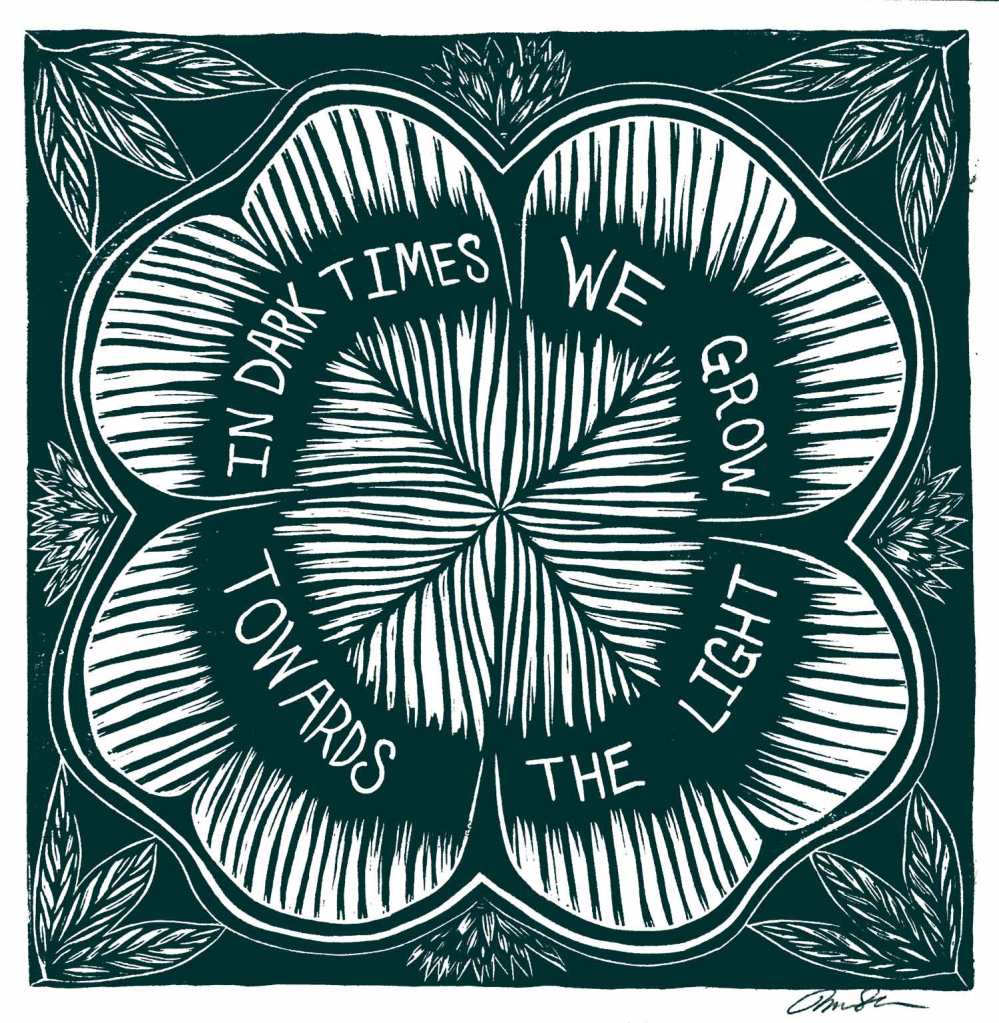
Consider supporting artist Meredith Stern of JustSeeds Collective here.

cite Black theorists

cite-black-women_3_orig

Cite Black Women t-shirt from the Cite Black Women Collective

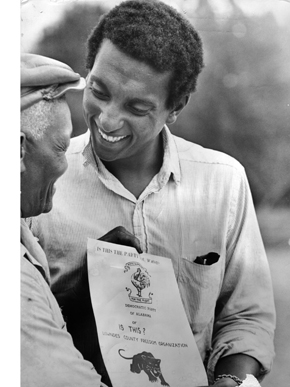
On page 8 of Keeanga-Yamahta Taylor’s book From #BlackLivesMatter to Black Liberation she says something that stopped me in my tracks: “Black revolutionary Stokely Carmichael and social scientist Charles Hamilton coined the phrase ‘institutional racism’ in their book Black Power.”

Although I understand the phrase institutional racism so well that I have actually taught its definition and usage regularly, this is the first time that I have ever heard its origin, and specifically that its origin is attributed to Stokely Carmichael. I am dumbfounded.  Of course, there can be no question that I am to blame for this. But there is also a much larger question here about sociology. I use and teach “institutional racism” in the ways

Stokely_Carmichael_in_Alabama_1966

Stokely Carmichael in Alabama in 1966

that sociologists around me use it, and the ways that I learned it. I have never before heard it attributed it to anyone specific, much less to Carmichael and Hamilton or the Black Power movement. We seem to have simply claimed it as something we do, as part of our larger systemic way of looking at the world. In fact it’s often used interchangeably with “systemic racism.” And that may well be a good and important thing. But it should not come at the cost of erasing the contribution of Black scholars, Black people, and Black movements to our theorizing and scholarship. While we can and do debate the ownership of any one person to a word, no one hesitates to cite Judith Butler when they use the phrase “gender trouble” though these words surely had other connotations and meanings before and after this scholar. We cite Marx when we simply refer to “capital” or the “means of production” and sometimes Foucault gets all of “power.”

This is a question of our citational practices and how they reify existing power structures. This is about how we continue to actively create a white academy. Sara Ahmed discusses this (and provides one alternative possibility) in her nourishing book Living a Feminist Life, which does not cite any white men:

Citations can be feminist bricks: they are the materials through which, from which, we create our dwellings. My citation policy has affected the kind of house I have built. I realized this is not simply through writing the book, through what I found about what came up, but also through giving presentations. As I have already noted, in previous work I have built a philosophical edifice by my engagement with the history of ideas. We cannot conflate the history of ideas with white men, though if doing one leads to the other then we are being taught where ideas are assumed to originate.

It is for this reason, among others, that the Cite Black Women campaign was created. As the Cite Black Women’s Collective says, “It’s simple. Cite Black Women.” But also: put in the work. Find the citations and place Black women in the center of your syllabus and your sociological research and even your informal political thinking. The collective has a praxis:

  1. Read Black women’s work
  2. Integrate Black women into the CORE of your syllabus (in life & in the classroom).
  3. Acknowledge Black women’s intellectual production.
  4. Make space for Black women to speak.
  5. ​Give Black women the space and time to breathe.

And a rad t-shirt (pictured above), which supports the Winnie Mandela School in a working class, Black neighborhood of Salvador de Bahia, Brazil. I’ve already briefly discussed how amazing Winnie Mandela was on this blog. The collective has also organized conference events (including ASA)  and #CiteBlackWomenSunday.

Look, this is not just about “you.” I certainly need to do better at this too. The fact is, unless a person has been making a conscious effort to do this for several years now, it’s likely that many of us need to be putting some work in to do better at this. The point is that we all need to do the work because it isn’t going to happen without it – no one is going to start getting the credit they deserve for their contributions to our discipline and to our thinking without all of us practicing the racial justice that we preach. Here is a short list of Black scholars who influenced sociology to get you started.