policing campus diversity: Somali Night

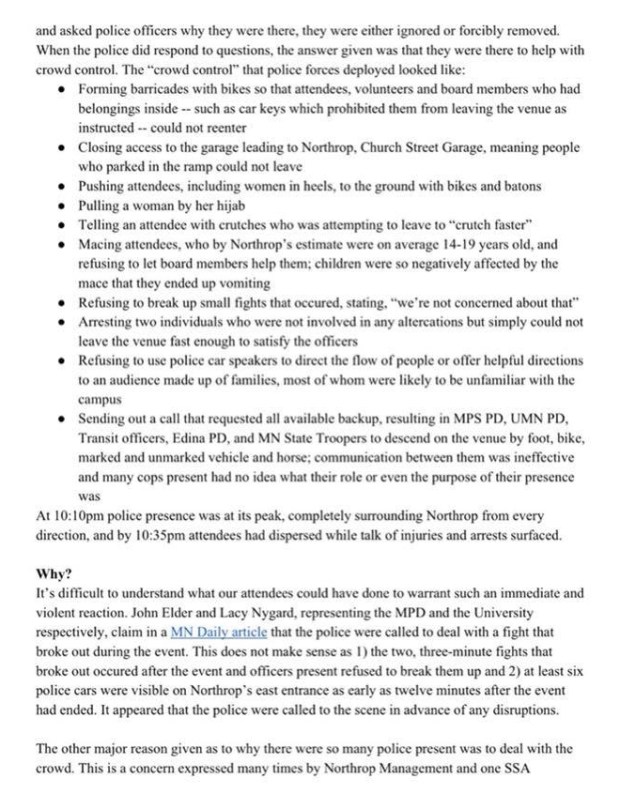
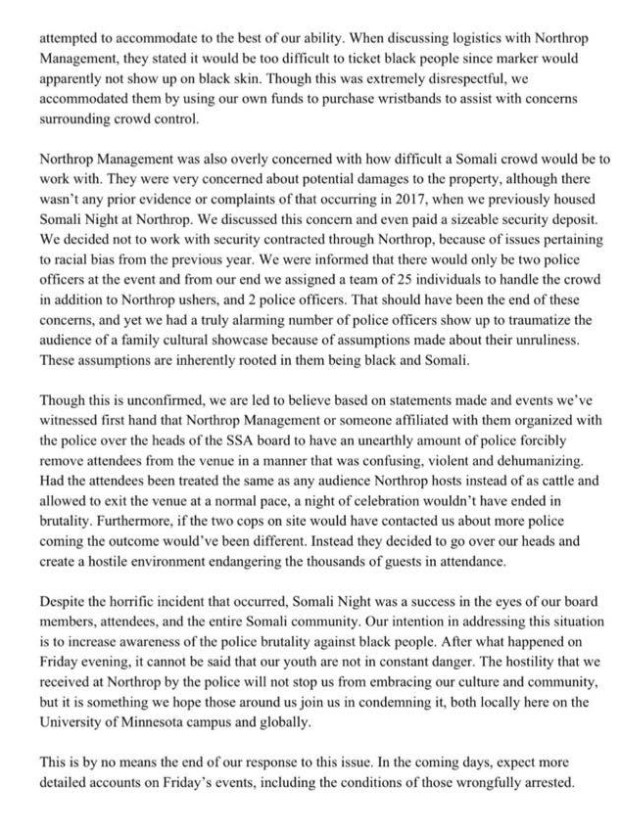
Yesterday I read the stomach turning account of how my alma mater, the University of Minnesota, treated the Somali Student Association at the end of its cultural week, last Friday. I’m presenting the Somali Student Association’s account here in its entirety, because the whole thing is worth the read. It is one of the most thorough, clear, and comprehensive accounts of a police riot I have ever read. It is an alarming picture of how subtle, purportedly nonviolent, and even micro-level forms of racism combine and become explicit, violent, and massive.

Somali Night Press Release Pg 1Somali Night Press Release Pg 2Somali Night Press Release Pg 3


Many things about this statement jump out immediately. One of them is the claim made by employees on a university campus that it would be impossible to use markers on Black skin. This indignity, which must have occurred in the context of so many others during the planning for this event, encapsulates clearly that the University of Minnesota is still unprepared in 2018 for the presence of Black people.

Something else I notice immediately is the calm, composed, and measured tone of this press release, written by a student organization.  So much can be learned just by reading what these students have to say about their experiences. I expect we will learn even more from them by watching how they challenge the university in its reaction.

Students on the University of Minnesota campus have already been reporting on their negative experiences with the cosmetic diversity initiatives embraced by their campus (which is similar to so many others). The Whose Diversity? campaign that began in Spring 2014 created a powerful set of testimonies of experiences of students of color on campus.

Perhaps most telling is that a quick Google search conducted 24 hours after the Somali Student Association’s press release and 3 days after the Somali Night incident itself reveals very little reporting on the event and its heavy policing. I suppose it comes as little surprise that the most cogent and knowledgeable source of information about these events comes from the affected students themselves.

Saturday Rec: I Am Not Your Negro

(On Saturdays, I’ll be posting recommendations for movies and books and other stuff. Here’s my first.)

I Am Not Your Negro

Best paired with: cigarettes and a typewriter

Not an incredibly unique documentary recommendation,  but if you haven’t yet seen it, see it now. Even if you already know a lot about race and racism, you will probably see something in a different way or appreciate something differently. The film is beautiful and well-made. The argument, which belongs almost entirely to James Baldwin, is interesting and deep. I re-watched it this week and was again amazed at how ahead of his time Baldwin was. Not because he’s saying things that have relevance in 2018 (although that’s true too), but because he seems to have anticipated the late 1960s and the 1970s well in advance: Notes of a Native Son was published in 1955.

Director Raoul Peck highlights the contemporary resonance in Baldwin’s words beautifully and devastatingly through images.

The flaws: the film is an intersectionality fail. There are almost no Black women in the movie, although Black women played an extremely large and critical role in the Civil Rights Movement of the 1960s. This is a problematic reflection of how history is told rather than how it was. And although Baldwin is well known to have been queer, it’s downplayed in the film.

But even so, see it. See it.

Here’s a teaser of Baldwin’s brilliance:

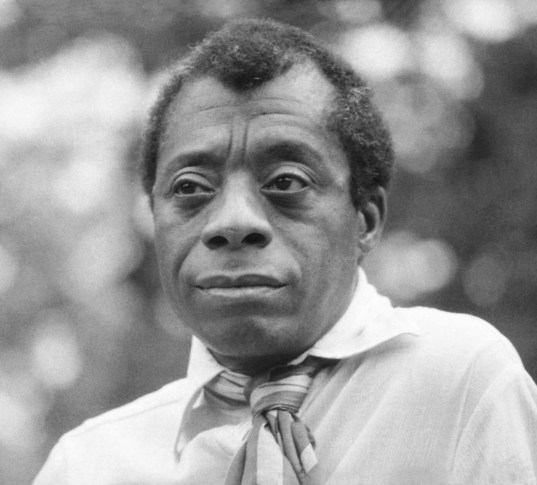
Photograph of James Baldwin

Click for video of Baldwin. (Photo by Allan Warren)


a meditation on tools

In the United States, the squeaky wheel gets the grease.

In Japan, the nail that sticks out gets hammered in.

Audre Lorde famously admonished white feminists at a conference in 1979 that “the master’s tools will never dismantle the master’s house.”

Black and white line image of a hammer, screwdriver, and wrench.

If you are neither the wheel or the nail, you might start to wonder about your commitments to justice.

It might not be an honor to be the last one standing.

Does that make you a tool?


memorializing the thankless work of revolution

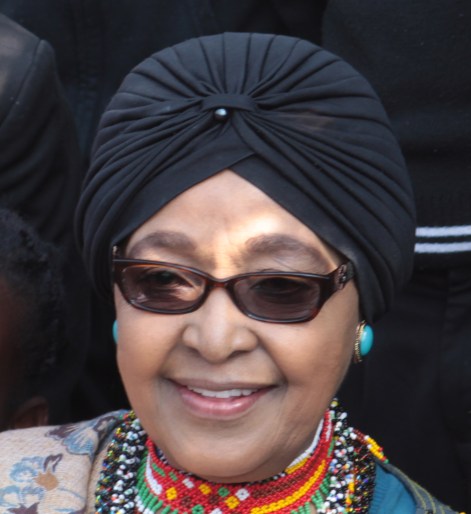
Winnie_Mandela_190814

Last weekend, just days before she died, I watched a documentary about Winnie Madikizela-Mandela. I wrote these words: “totally inspiring woman and many lessons to learn about how thankless the work of continuing the struggle and holding the line can really be, especially when done by women and women of color, or marginalized members of the group more generally. This woman was really sold out. One random key thing to remember: Nobel Peace Prize was also given to de Klerk when it was given to Nelson Mandela, in case you needed a reason to feel that prize was discredited.”

I am no expert on the South African freedom struggle, but the obituaries published in mainstream newspapers (to say nothing of the comment section! yikes!) only deepened my horror at how Winnie was treated. The NYT lead with a photo of this incredible woman with her ex-husband Nelson Mandela and the Washington Post was little better leading with the phrase, “Winnie Madikizela-Mandela, the former wife of Nelson Mandela and for decades one of South Africa’s most prominent and polarizing figures, died April 2 at a hospital in Johannesburg.”  She struggled to be her own person even in death.

Her story resonated with so many other Black women’s stories I’ve read and learned about over the years in particular. RIP Winnie, may we listen and learn something important from what you were here to tell us.


Anger

I am angry. In fact, I am really fucking angry. And one of the things that continually fuels my anger is the way that anger is a prohibited emotion. Socially unacceptable. I feel that each time I am openly angry, people around me wait quietly for me to finish my tirade. Or worse, try to calm me by telling me to see things another way, or to try to have sympathy for the other person or something like that. All of this sends me the message over and over, constantly, that being angry about the world is not OK.

But Black people are being murdered in the streets by police in the United States.

But I am a queer person who has lived my entire life in the closet because I wasn’t sure what else to do because heterosexuality is still that normative.

But femicide is still the norm not only through Latin America where the women are marching and yelling “Ni Una Menos” (not one woman less) but here in the US too where domestic violence continues to be a raging problem and I do not believe there is a person assigned female at birth, woman, or femme who has not experienced some form of sexual assault/harassment.

But almost no one gives a real shit about poor people or understands exactly why there are still poor people who lack access to stable food, water, and housing.

But having a disability makes a person dramatically more likely to be subject to the above problems and eugenics is still our normal way of thinking about bodies with differences.

I could go on.

Stencil of a woman posed to throw a brick.

Image by Nicolas Lampert, Josh MacPhee, and Colin Matthes (Justseeds Collective).

This world is an enraging place and it’s probably not a stretch to say that most of these problems are caused or at least perpetuated by indifference.

And without even going that far, why aren’t the whole range of human emotions permissible? Why do we want, and enforce on each other, an impoverished society where people are not allowed to express sadness and anger and joy? I don’t want to live in that sad little range of emotions either. I’m not advocating throwing a chair and breaking into sobs, necessarily but we not express verbally the way things do actually make us feel? I am at a loss for a rational argument against that.

But although I am a sociologist, and although I am a nonconformist with a lot of training in not giving many fucks what anyone thinks, it gets to you after a while when people just seem to think you are being too angry all the time. Maybe it is too exhausting. Maybe you are overreacting and getting angry at things that aren’t there. Maybe I have lost my ability to “look for the other side” as we did in the movement where I found the most meaning, and try to find community. Maybe I am alienating those I want around me.

And then I realized there is a name for this behavior, and this treatment. I am behaving like an angry feminist. I am being treated as such. How boring. How frustrating. I am scary enough that no person in my life would ever dare to literally tell me to calm down, but tacitly that’s what’s happening.

But I’ve snapped. Sara Ahmed describes this experience beautifully in Living a Feminist Life. Ahmed describes how when a feminist or a twig snaps, it can seem sudden because the pressure leading to the snap (what the twig or the feminist experiences) can’t always be observed from the outside. She writes:

“You might experience that pressure only when you are under it, rather like you encounter the wall when you come up against it. The weightiest of experiences are often those that are hardest to convey to those who do not share the experience. If a snap seems sharp or sudden, it might be because we do not experience the slower time of bearing or of holding up; the time in which we can bear the pressure, the time it has taken for things not to break. If the twig was a stronger twig, if the twig was more resilient, it would take more pressure before it snapped. … And then: violence is assumed to originate with her. A feminist politics might insist on renaming actions as reactions; we need to show how her snap is not the starting point.” (2017: 189)

This passage resonates very much with the anger I’ve experienced lately. When I express anger, it is regarded (and sometimes I am told directly) that it’s “distracting” from whatever I’m trying to explain or call attention. No one is interested any more in what lead to the anger—the pressure that lead to the snap. As if I were in perfect control, as if I were perfectly able to not be angry, as if I could avoid snapping. Can you bend a twig all the way back and then blame the twig for its lack of flexibility?

I love how her metaphor also makes me question the concept of resilience as a good thing. It doesn’t seem good to accept more pressure, to work harder to hold things together, especially when “things” are dysfunctional or especially sexist and racist institutional cultures that are harming human beings. The image that comes to mind is a woman with two feet on two different icebergs floating in different directions. She too will snap, sooner or later. Why not call attention to the problem sooner?