Ongoing assassinations and violence in Honduras: Carlos Hernández

A selfie of Carlos Hernandez wearing a white Oxford shirt.

Carlos Hernández, killed in his law office in Tela, Honduras, on April 10, 2018.

Last week, another person two degrees of separation from me was assassinated in Honduras. His name was Carlos Hernández, and he was killed in his law office in the municipality of Tela. He was the lawyer of one of five people who have been criminalized for defending the water in their community as part of an encampment they have sustained since May 2017 against intense persecution. I have met all five of them.


I have visited their encampment.

He is not the first person to die in relationship to their small community’s struggle.

It is unlikely we will ever know exactly who his killer is, and even less likely that person will face any judicial process because rates of impunity in Honduras for homicide are estimated at over 90%.

It is heavy to feel so surrounded by death. I cannot imagine how it would feel if I were actually living among it daily, breathing in its possibility at every turn. The violence is so frequent even among the people to whom I am directly connected that I fear that my friends and family are becoming tired of hearing about the deaths and death threats to my compañerxs in Honduras, and will stop being willing to act. I do not wish to center myself, but rather hope to connect myself personally as an act of solidarity, enabling others to also feel personally connected and invested in the lives of others.

Carlos Hernández was young. He was the lawyer for the mayor of Arizona, Arnoldo Chacón. Chacón is one of 5 members of the Broad Movement for Dignity and Justice (MADJ – Movimiento Amplio por Dignidad y Justicia) who have been formally accused of “usurpation” for stopping the state of Honduras and the company INGELSA from developing a hydroelectric dam on the Río Jilamito.

These community members have sustained “Camp Dignity in Defense of the Río Jilamito” since May 2017, defending their water and community from attack by a foreign company. All 5 of the accused, along with the many other members of the community who have participated in the encampment, have been subject to threats and attacks over this time period. Yet they persist. They arrive, daily, in shifts, making sure the camp is tended at all times. They make food for each other, take care of each other, make decisions together, and they confront the alliance of government and private capital which not only criminalizes this care-taking activity but dares to call it usurpation.

I first met these community members after they had completed just a few weeks of their encampment, at the end of May 2017. The camp is humble but cozy, and the reception they gave to our large Witness for Peace delegation of 22 U.S. citizens was deeply welcoming. We ate soup together, we chatted, we played games, and took pictures. They found enough chairs for all of us and hardly a chair for anyone else, and we could not manage to convince anyone to swap places and take a seat in our places. Of course. It would be rude to sit while an honored guest was standing.

Picture is of a banner, sign, and Honduran flag that cover barbed wire and make up a barricade

Barricade at Camp Dignity in Defense of Water and Life at Rio Jilamito

The people who spoke that day to us are the very same people who have been criminalized and whose lives have been threatened since then. I would like to use their names and to show their faces to humanize these every day rural people who have decided to take such enormous risks to protect the water in their community, but I am afraid that it may put them in more risk. I would like to humanize them, to counter the implicit suggestion that they are terrorists for impeding economic development – to which they did not consent and from which they will not benefit – but the very act of doing so may harm them further.

The assassination of Carlos Hernández can only be understood as part of a larger system of structural and political violence which runs deep. He was killed in a country which has recently inaugurated a fraudulent President, and this presidency and regime (and the support it receives from the United States) is inseparably related to the skyrocketing rates of violence. (I plan to write more about exactly how all of this is connected but have linked to some excellent existing analysis above by Radio Progreso, Jesse Freeston, Sandra Cuffe, and Ryan Morgan to get that conversation started here.)

Even in the face of incredible odds and almost unthinkable danger, the community at Jilamito continues to maintain their active resistance to INGELSA and its hydroelectric dam project. Their resistance shows us all that it is possible.


Click here for a list of concrete actions you can take in solidarity with people in Honduras.

How to Take Action in Solidarity with the Honduran People

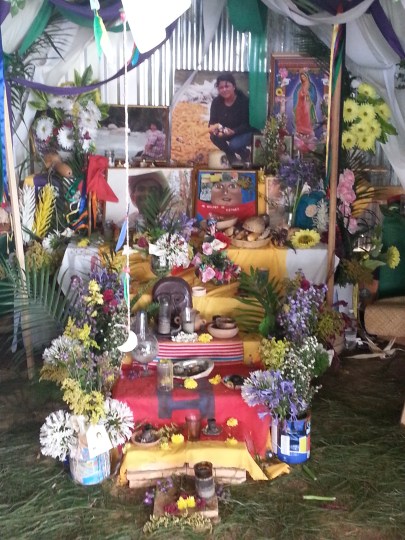
image is of the altar for Berta Caceres at Utopia in Honduras
  1. Ask your Congressional Representative to Co-sponsor the Berta Cáceres Act or thank them for already doing so. The bill asks that the United States suspend all “…security assistance to Honduran military and police until such time as human rights violations by Honduran state security forces cease and their perpetrators are brought to justice.” It is widely and strongly supported by Hondurans working for justice.
  2. Donate money or time (however small the amount) to an organization like Witness for Peace Solidarity Collective or Honduras Solidarity Network that works in solidarity with social movements on the ground so they can continue to do their work throughout this crisis, including accompaniment work. Avoid giving money to charity-focused organizations that do not seek to empower Hondurans to have autonomy over their own institutions.
  3. Organize a fundraiser for an organization like those above.
  4. Write an email to the US embassy telling them how disappointed you are in their position after informing yourself on the position of the US government in Honduras.
    US Embassy in Honduras Charges D’Affaires Heide Fulton: BronkeHM (at) state.gov
  5. Find and support local justice work in your community because these struggles are about more than just Honduras.
  6. Find ways to publicly let Hondurans know you support them in their struggles. This increases theur visibility by letting the Honduran government know there may be international pressure for certain humsn rughts abuses, and it is simply encouraging for people who have been marginalized to know that others are thinking of them and taking public actions (even pictures) on their behalf.
  7. Pay attention to what is happening in Honduras and tell people you know about it as well. Help others around you understand the connection between US foreign policy and the crisis in Honduras – this is a crisis created and perpetuated, in reality, on US soil, and we can change it by organizing on US soil as well. A few good resources are the Honduras Solidarity Network, Democracy Now!, NACLA, and the Upside Down World.

Last updated April 9, 2019.

Saturday Rec: I Am Not Your Negro

(On Saturdays, I’ll be posting recommendations for movies and books and other stuff. Here’s my first.)

I Am Not Your Negro

Best paired with: cigarettes and a typewriter

Not an incredibly unique documentary recommendation,  but if you haven’t yet seen it, see it now. Even if you already know a lot about race and racism, you will probably see something in a different way or appreciate something differently. The film is beautiful and well-made. The argument, which belongs almost entirely to James Baldwin, is interesting and deep. I re-watched it this week and was again amazed at how ahead of his time Baldwin was. Not because he’s saying things that have relevance in 2018 (although that’s true too), but because he seems to have anticipated the late 1960s and the 1970s well in advance: Notes of a Native Son was published in 1955.

Director Raoul Peck highlights the contemporary resonance in Baldwin’s words beautifully and devastatingly through images.

The flaws: the film is an intersectionality fail. There are almost no Black women in the movie, although Black women played an extremely large and critical role in the Civil Rights Movement of the 1960s. This is a problematic reflection of how history is told rather than how it was. And although Baldwin is well known to have been queer, it’s downplayed in the film.

But even so, see it. See it.

Here’s a teaser of Baldwin’s brilliance:

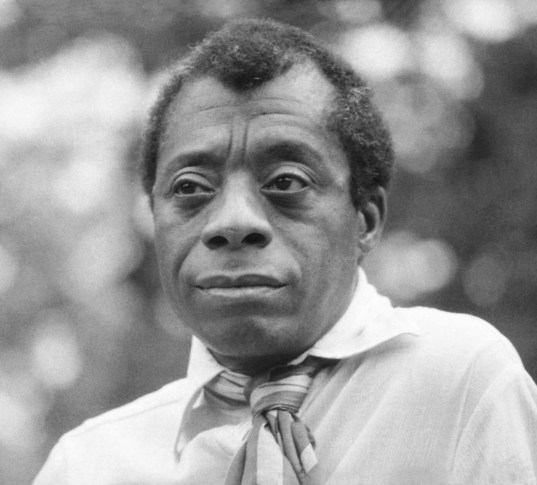
Photograph of James Baldwin

Click for video of Baldwin. (Photo by Allan Warren)


a meditation on tools

In the United States, the squeaky wheel gets the grease.

In Japan, the nail that sticks out gets hammered in.

Audre Lorde famously admonished white feminists at a conference in 1979 that “the master’s tools will never dismantle the master’s house.”

Black and white line image of a hammer, screwdriver, and wrench.

If you are neither the wheel or the nail, you might start to wonder about your commitments to justice.

It might not be an honor to be the last one standing.

Does that make you a tool?


lazy professor up at night

Last fall my university made the very sudden announcement to close the sociology program as well 24 others. Part of this experience as a faculty member is being told that it’s our fault, constantly. We are implicitly and explicitly blamed for not doing enough before this point. Chancellor Wachter has said over and over again that the “students voted with their feet,” which is just a way of saying if I/we had been offering worthwhile classes, I/we wouldn’t be in this situation (among other problematic implications of this phrase she loves so much). And yet here I am, literally awake at night, either still thinking (uselessly) about what I could do to try to stop these cuts from happening, or about what I could do make our program better, or about how I could recruit more students. The other night I lied in bed with a new idea for bringing back successful graduates (which is most) to meet our current students. I had pretty much fully developed the idea before I realized the entire thing is moot. There is no sociology program to recruit anybody in to. There is no reason to ease anybody’s fears about majoring or even minoring in sociology. In fact, perhaps students have good reason to be afraid of these majors and minors. Perhaps they should be afraid the administration will eliminate them, or the faculty time and resources need to sustain them. Working to recruit more students at this point would just be more time I’d spent on something that wouldn’t be valued, and if successful, I’m afraid it would ultimately place more students in the path of destruction.

But thinking about such solutions has become almost like a reflex for me, so that even six months later it’s still hard to stop. So I still haven’t been able to stop. And I don’t know when I will be able to, because ultimately I love(d) what I do. And I wasn’t coming up with ideas to recruit students to the major just to satisfy some bureaucrat or looking for ways to assuage student fears about what it would mean to major in sociology to bolster our numbers, but I was doing it because I wanted to teach. Because I thought that majoring in sociology would actually be meaningful for students, and because I know our graduates are actually out in the world happy with their work and I’d love to see more people doing that. It’s hard for me to turn that off, because it’s hard to accept the destruction of that possibility.

I see the same difficulty turning this impulse off in my colleagues too. We keep trying to do our jobs as if the old things mattered, although we have been pretty much told over and over again by our bosses that none of what we do matters, or at least not a lot of it. But old habits die hard, and it’s precisely because we believed passionately in those old habits. Because we weren’t and still aren’t the people we’re accused of being. And that’s one of the most painful bits. We’re accused of being these lazy arrogant out of touch people who don’t care at all for our students by people who actually seem to be all of those things.

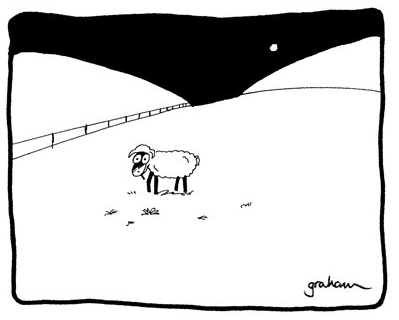
Sheep alone awake in a field at night.

Cartoon by Graham Licence

I’m left with a few hanging sociological questions for another day about the myth of the lazy professor: Who does the myth connect with? Who believes it? Anyone? Our students’ parents? Do the administrators and politicians who deploy it, or is it used totally cynically? (I don’t think the administrators believe it; I suspect they know it’s untrue and that’s why it will offend us so much.) Why does it hurt me so much if I’m not sure who believes it?

Losing the University

The university was never meant to be a place for liberation and social justice, but from its start was built for straight, white, able-bodied, cis-male elites. Rod Ferguson reminds us in his work We Demand that the fact that many of us associate universities with something else – with diversity, with the possibility for envisionining anticapitalist politics, with social justice movements – is in many ways the product of student struggles. Universities themselves have resisted these associations. Ferguson recalls for us that in 1970, four students were killed at Kent State University by the National Guard. Ten days later, police shot approximately 400 bullets into a women’s dorm at Jackson State University, killing two students. The reaction to these murders by dozens of college presidents was to “petition their state legislators not to curtail but to augment police powers on their campuses”(15-16).

The point is that I know the university is not nor has it ever been this romantic perfect place. I remind myself of that fact constantly. I was never planning on making a life here in academia in the first place; I didn’t feel like it was my life’s mission to teach undergraduate students and I have always felt like there are much better and more direct ways to make social change than education. This makes it easier to remember that the university has always been flawed, it wasn’t meant for anyone other than straight white male elites, and if some of the rest of us have managed to increasingly arrive in the past 100 years, especially the last 50 years, it has been for the most part, an anomaly. And it has been the fruits of our struggle. They didn’t want us here in the past and they don’t want us here now. They have never wanted us here. Ferguson says

For university and political elites, then, the social categories ‘tolerance’ and ‘diversity’ were never meant to inspire appreciation for the student movements, movements that might shed light on social inequalities and recommendations for transcending them. “Tolerance” and “diversity” were instead ways of saying “Society must be defended”—that is, protected from the student, who was understood to be a criminal from the start. (2017: 23)

In other words, it is not necessarily a tragedy to lose this place because there are and have always been other ways of doing this. Marginalized communities have always found ways to educate themselves, and those ways, being designed by and for liberation, have more liberatory potential than any institution which has always fought to keep us out.

But knowing all of that doesn’t seem to be helping me feel less sad right now. It doesn’t seem to be helping me much at all. The fact is that I feel I’ve benefitted enormously from my time in and around universities and it seems like many of my most marginalized students have done so as well. While these other forms of learning and education, free schools and free universities and popular educational models which I’ve been a part of, can be much more liberatory in the end, I’m afraid they will still be much more limited in their reach than the good ol’ public university in its heyday was. (Because was is really starting to seem like the operative concept here.)

Ironically, I mean, I wouldn’t even know about free schools without my exposure to the university… that’s certainly not true for everybody. And it needn’t be true. But I think it points to why I feel hope lacking in this moment. I feel a light going out. And sure, that light was really dysfunctional in the first place but it was granting wide access and possibility and acting as a funnel, at least for many students, to something much better, to much more critical ideas and action. How many of us were radicalized in the university? Of course there are other sites, other methods, other ways, but undeniably, this sucks.

The loss of access to critical thinking, to liberal arts, to social justice oriented classes throughout Wisconsin (and probably eventually elsewhere), is without a doubt, a loss of something, for some folks, who were in fact benefitting. Even if we do succeed in creating liberatory alternatives, it’s hard for me to imagine they will have the same reach and impact as the public university in its heyday. But I could be wrong. Perhaps I just need to dream bigger. I hope so. Perhaps I just need to get started on the experiment.

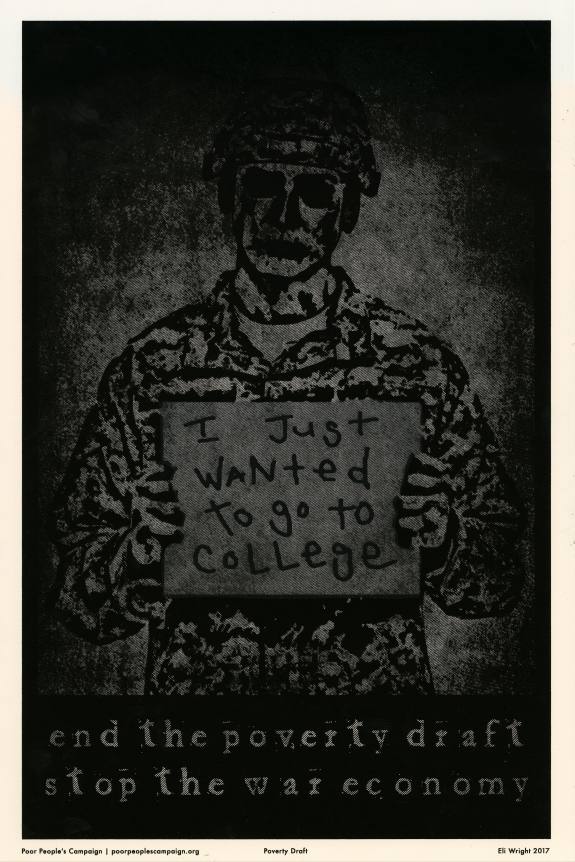
Black and white screenprinted poster of a soldier holding a sign that says "I just wanted to go to college." Text at bottom of poster says "End the poverty draft. Stop the war economy."

Image created by Eli Wright at Justseeds Collective for the new Poor People’s Campaign.

memorializing the thankless work of revolution

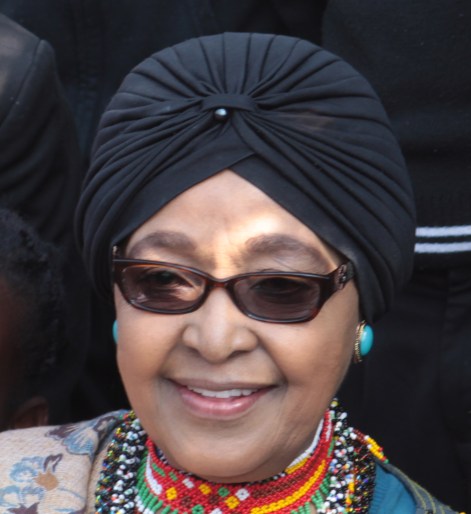
Winnie_Mandela_190814

Last weekend, just days before she died, I watched a documentary about Winnie Madikizela-Mandela. I wrote these words: “totally inspiring woman and many lessons to learn about how thankless the work of continuing the struggle and holding the line can really be, especially when done by women and women of color, or marginalized members of the group more generally. This woman was really sold out. One random key thing to remember: Nobel Peace Prize was also given to de Klerk when it was given to Nelson Mandela, in case you needed a reason to feel that prize was discredited.”

I am no expert on the South African freedom struggle, but the obituaries published in mainstream newspapers (to say nothing of the comment section! yikes!) only deepened my horror at how Winnie was treated. The NYT lead with a photo of this incredible woman with her ex-husband Nelson Mandela and the Washington Post was little better leading with the phrase, “Winnie Madikizela-Mandela, the former wife of Nelson Mandela and for decades one of South Africa’s most prominent and polarizing figures, died April 2 at a hospital in Johannesburg.”  She struggled to be her own person even in death.

Her story resonated with so many other Black women’s stories I’ve read and learned about over the years in particular. RIP Winnie, may we listen and learn something important from what you were here to tell us.


Anger

I am angry. In fact, I am really fucking angry. And one of the things that continually fuels my anger is the way that anger is a prohibited emotion. Socially unacceptable. I feel that each time I am openly angry, people around me wait quietly for me to finish my tirade. Or worse, try to calm me by telling me to see things another way, or to try to have sympathy for the other person or something like that. All of this sends me the message over and over, constantly, that being angry about the world is not OK.

But Black people are being murdered in the streets by police in the United States.

But I am a queer person who has lived my entire life in the closet because I wasn’t sure what else to do because heterosexuality is still that normative.

But femicide is still the norm not only through Latin America where the women are marching and yelling “Ni Una Menos” (not one woman less) but here in the US too where domestic violence continues to be a raging problem and I do not believe there is a person assigned female at birth, woman, or femme who has not experienced some form of sexual assault/harassment.

But almost no one gives a real shit about poor people or understands exactly why there are still poor people who lack access to stable food, water, and housing.

But having a disability makes a person dramatically more likely to be subject to the above problems and eugenics is still our normal way of thinking about bodies with differences.

I could go on.

Stencil of a woman posed to throw a brick.

Image by Nicolas Lampert, Josh MacPhee, and Colin Matthes (Justseeds Collective).

This world is an enraging place and it’s probably not a stretch to say that most of these problems are caused or at least perpetuated by indifference.

And without even going that far, why aren’t the whole range of human emotions permissible? Why do we want, and enforce on each other, an impoverished society where people are not allowed to express sadness and anger and joy? I don’t want to live in that sad little range of emotions either. I’m not advocating throwing a chair and breaking into sobs, necessarily but we not express verbally the way things do actually make us feel? I am at a loss for a rational argument against that.

But although I am a sociologist, and although I am a nonconformist with a lot of training in not giving many fucks what anyone thinks, it gets to you after a while when people just seem to think you are being too angry all the time. Maybe it is too exhausting. Maybe you are overreacting and getting angry at things that aren’t there. Maybe I have lost my ability to “look for the other side” as we did in the movement where I found the most meaning, and try to find community. Maybe I am alienating those I want around me.

And then I realized there is a name for this behavior, and this treatment. I am behaving like an angry feminist. I am being treated as such. How boring. How frustrating. I am scary enough that no person in my life would ever dare to literally tell me to calm down, but tacitly that’s what’s happening.

But I’ve snapped. Sara Ahmed describes this experience beautifully in Living a Feminist Life. Ahmed describes how when a feminist or a twig snaps, it can seem sudden because the pressure leading to the snap (what the twig or the feminist experiences) can’t always be observed from the outside. She writes:

“You might experience that pressure only when you are under it, rather like you encounter the wall when you come up against it. The weightiest of experiences are often those that are hardest to convey to those who do not share the experience. If a snap seems sharp or sudden, it might be because we do not experience the slower time of bearing or of holding up; the time in which we can bear the pressure, the time it has taken for things not to break. If the twig was a stronger twig, if the twig was more resilient, it would take more pressure before it snapped. … And then: violence is assumed to originate with her. A feminist politics might insist on renaming actions as reactions; we need to show how her snap is not the starting point.” (2017: 189)

This passage resonates very much with the anger I’ve experienced lately. When I express anger, it is regarded (and sometimes I am told directly) that it’s “distracting” from whatever I’m trying to explain or call attention. No one is interested any more in what lead to the anger—the pressure that lead to the snap. As if I were in perfect control, as if I were perfectly able to not be angry, as if I could avoid snapping. Can you bend a twig all the way back and then blame the twig for its lack of flexibility?

I love how her metaphor also makes me question the concept of resilience as a good thing. It doesn’t seem good to accept more pressure, to work harder to hold things together, especially when “things” are dysfunctional or especially sexist and racist institutional cultures that are harming human beings. The image that comes to mind is a woman with two feet on two different icebergs floating in different directions. She too will snap, sooner or later. Why not call attention to the problem sooner?

Stop Telling Me I’m Brave: On Courage and Being Set Apart

As feminists we know it’s important for us to have each other’s backs in a shitty heterosexist world. We have often done this by reassuring each other that we are strong and brave people. The thing is, after the year I’ve had, I’m not sure telling our friends over and over that they’re brave works the way it’s supposed to.

When you call someone brave you pretty much mean to say that they’re doing something that you’re not sure you would do in their situation. And that’s a compliment, but it also pushes that person away from you by making them different. When I spoke out openly about my experience as a stalking survivor and the incredible failures of the institutions that were supposed to protect me, it started to feel less like “brave” was about having my back and more like no one else was “brave” enough to have my back.

It started when I was doing things that did not feel like they even involved a choice, let alone courage. What I learned in surviving stalking is that even if you think you don’t want to go on, you pretty much do because there just aren’t that many other choices available. With the exception of suicidal depression (which I’m not minimizing, but I didn’t have), you will have to get out of bed sometime. I missed more days of work than ever before, but still I couldn’t just stop going altogether. I wasn’t so out of it that I couldn’t calculate those risks. I kept putting one foot in front of the other and showing up. Surviving.

My acts are not what I would characterize as “brave” necessarily. They are acts of resilience, like the acts that human beings who have survived worse things before me like intimate partner stalking, colonial wars, and daily racist police violence. Human beings are, at the end of the day, apparently pretty good at surviving some pretty terrible things, but that doesn’t make us all brave, and being called brave, when I was busy just surviving stalking, was almost like salt in the wound. Because all I felt, all the time, was fear.

I advocated, loudly, for my safety in my campus workplace. And, because I am a feminist activist, I did this in a way that I hoped would benefit future stalking victims and tried to point out how inevitable it is that this problem would happen again. I published my story with a major web outlet clarifying why I thought we needed better procedures on our campus not just for myself but for all of us, and called out my campus for their shameful disregard of the safety of my body and their refusal to “set a precedent.” I went forward with this story publicly even after I was issued an ultimatum insisting that it needed to be published anonymously or it could not be published. In each case, I was told by my friends and colleagues that my actions were very brave but in each case, I felt like I was simply doing the only right thing.

When my friends were calling me brave, it really felt like they were just letting themselves off the hook for not taking actions that were similar to mine or, worse, for not joining me in solidarity in the ways that they might have been implicated. I do not think my friends consciously meant anything negative when they told me I was brave. I think they really meant it. But what it usually means to say someone is brave is – what I heard–was, “oh wow, you have so much courage. I could never dare to do that.” What I needed to hear was: “man that situation sucks! Let me join you in this struggle.”

As a feminist method of support, bravery seems to work okay when we assign the label to ourselves. The women who wrote the groundbreaking All the Women Are White, All the Blacks Are Men, But Some of Us Are Brave obviously got a lot out of it. There were times when I liked the idea too, but only when I decided on my own to do something that I felt was brave. When the idea of bravery backfired, it was when someone else called me brave. Like a lot of terms, there’s a big difference between applying it to yourself and having it applied to you by someone else.

The concept of bravery though is one that always sets people apart. It’s an idea that’s usually associated with extraordinary individuals. Extra-ordinary. And maybe that’s why it hurt me so much, because I was already feeling so isolated. Bravery just seemed to set me even further apart from the pack.

But there are other reasons to avoid setting people apart, even when they haven’t necessarily survived something traumatic. If we want to build social movements that will change the world, we will need groups of people, not a few extraordinary individuals. I don’t dispute that to do this work we will have to be brave, but maybe we need to stop calling each other brave. Instead we have to find ways to be brave together. The first step to doing this will mean not holding each other up on pedestals too tall to reach but alternatively trying to learn how we can better support and understand each other’s necessary and chosen risks. Here in the United States the cliché is that one person can change the world but the reality is that it takes many people to change the world. Dr. Martin Luther King, Jr., did not boycott those buses on his own. Assata Shakur didn’t break herself out of jail. Although in the course of history we’ve exalted only these single individuals, their names would mean little without the movements full of other people around them. If they had been set apart in their own time as singularly brave individuals, as merely exceptional people, we wouldn’t even know who they were today because nothing would have been accomplished.

I know by telling me how brave my actions were that my feminist friends were trying to be nice and supportive. I can see that I was moving from surviving to advocating and that people wanted to pat me on the back for that forward movement. But what I want is to change the world, and for that I need my friends to join me, not laud me. I want my acts, just like my feminist ideals, to become ordinary, not extraordinary.

solidarity is our weapon

“Solidarity Is Our Weapon. International Women’s Strike.”