the fear of being out

I can remember that it all started when the ringleader boy looked at my legs and commented on their hairiness. The ringleader was a tall kid who was one of the first to pubescence, new to school and had a lesbian mother – none of this seems accidental in retrospect.

After that, he was able to engage almost every boy in the class with the exception of a few in giving me sexual nicknames, commenting on my body, checking my back for a bra strap, and, most damagingly, chasing me around and touching all over my body nonconsensually.  This lasted for most of the school year and was targeted at me individually.

When I was in sixth grade, I was the target of organized sexual harassment by a gang of boys in my public school.  At the first peak of awkward transition to adolescence almost every boy I knew touched my body in unwanted ways and made fun of me. I was not protected by anybody. I was effectively terrorized for being a girl, for not being enough of a girl, for not being the right kind of a girl.

silenceisnotprotection

Silence ≠ Protection by Crista Facciolla, Print. Organize. Protest.

I would now call this experience sexual violence. And yes, as an adult I can see that these boys probably participated more out of their own fear of being singled out and having their masculinity questioned than for any other reason. None of that makes it ok, however, or frankly matters very much to me, because if we didn’t live in a rape culture shot through with toxic masculinity in the first place, this wouldn’t have happened. And it was traumatic.

I felt like I had to hide what the boys were doing to me. I was made complicit in their terrorism. I’m still not sure I’ve disentangled why I didn’t feel like I could tell anyone. The simplest reason is shame. It was just so fucking embarrassing. If I was going to tell someone – an adult – I would have had to also tell them the insults and the things that the boys said. This would have meant discussing sex with that adult and relaying the insults that were said about me. I was way too embarrassed to do either thing.

If I told an adult what the boys were saying about me, I would have had to repeat the insults that were flung at me. In retrospect, it takes an awful lot of self-confidence to repeat the heinous thing someone else has said about you. Repeating it seems to just make it actually real.

After several months of this experience, something happened right in front of my teacher. I hoped that finally this would put a stop to the torment I was experiencing without me having to tattle, but the teacher did nothing. (There can also be no way he hadn’t observed anything before that because there were several incidents every single day.) It has taken me 25 years to tell this story to anyone, perhaps because when my teacher who I loved and trusted failed so completely to intervene, I decided that there was something wrong with me or that there would be no point in talking.

Instead I tried to find ways to resolve the problem myself.  Apparently I tried to fit into the kind of femininity that was suggested. If my back was going to be checked for bra straps, then I was going to wear a bra every day. No matter that I didn’t need one, that they were uncomfortable, that my mother was confused and that I was too embarrassed to even be seen looking at them in the store. I was going to be wearing one each time some boy checked my back and maybe they’d move along and not yell about it.

I went home and shaved my legs. I didn’t ask for any help with that either. I didn’t want to start a conversation or argue with my mom about whether I was too young, so I opted for stealing supplies in the shower and cutting the shit out of my legs instead. At least the cuts indicated that I had taken the hint and shaved. I was complying.

But something happened when I watched the Hannah Gadsby special Nanette. I wanted to tell this story for the first time. In the special, Gadsby tells the story of being beaten up by a man who thought she was hitting on his girlfriend, and the thought struck me like lightning: have I continued being just on the right side of feminine out of fear of exactly this kind of male violence?

Like Gadsby, I too was a raised in a household where there seemed to be anxiety about my sexuality and sometimes openly expressed fear about how difficult life would be if I turned out to be gay. It was clear that it would supposedly be ok but it would also make everyone somehow sad. Much of this fear was just that, fear, and it was well-meaning, but it transmitted to me as a message that only certain ways of being were OK. Simultaneously, no adults were protecting me from the risks at school of male violence and I was under constant pressure at home to be more feminine.

I don’t think I can draw a straight (hah) line to explain how or why anything happened, but as I grew up I adopted a style that would hide my feminine body to deflect attention and yet I think I made modifications to remain “female.” At least just female enough. I didn’t want to (re)create the possibility of violence by being too masculine, nor did I want to attract attention with my body.  I’ve never felt as if I “belonged” in most highly feminine clothes, but looking back now I see what has held me back from going full-on butch despite the attraction it has always held. I was receiving so many messages about the possibility of queer-bashing at home, in the media at large, and from my own experiences that it was much easier (but more damaging) to just pretend to be straight  in a heteronormative world.

It’s not just that women, or those of us assigned female at birth or gender non-conforming in various ways are subject to overwhelming rates of sexual harassment and violence. It’s also that we, along with our sisters, girlfriends, friends, cousins, and classmates, experience so much sexual harassment and sexual violence that the threat of male violence regulates us so completely, so thoroughly, that it actually creates who we are.

Unsurprisingly my silence did not, as Audre Lorde says, protect me. Not my silence about the sexual violence I experienced in sixth grade, nor my silence about my queer sexual and gender identities. Instead they left me with a legacy of confusion, pain, and fear.  I was, sometimes consciously and sometimes unconsciously, afraid that I would do “woman” wrong and that I would be found out. Living a non-normative life is not easy, just as my family and Hannah Gadsby’s family predicted. But neither is living a life full of silence and shame. Silence is fragile, and carries so much less power than I thought when I was only a small person. Coming out of our silence is terrifying, and it is very hard, and it subjects us to real risks. But it also allows us to write our own stories, to try to create our own lives, and most importantly, to find each other.

stop apologizing for other people

Recently I’ve noticed a disturbing trend so I’m going to suggest a simple rule: stop apologizing for other people.

Stop making excuses for power, for whiteness, for masculinity, for heterosexism, for ableism, for colonialism. When you apologize for someone else you become part of the problem. You are working to maintain those systems instead of actively working to dismantle them as you should always be trying to figure out ways to do.

If people were sorry for their behavior, they would apologize for themselves. If you want to change a system, support those who are challenging power. Always. When you jump in to make excuses for someone else, a few things happen:

  1. The person perpetrating the micro aggression or oppressive behavior does not have to account for their own behavior.
  2. The person who has actually been harmed is silenced and shamed by seeing that you and others stand against them, regardless of what you actually say as you are making excuses. You may think that you are seeking a compromise, harmony or some kind of middle ground, but the effect of what you are doing is actually further alienating a person who has actually been harmed by sending the message that you (and others in the group) will stand with power and make excuses for it.
  3. You cut off the ability for anyone to learn and grow from their mistakes. Learning is a painful struggle. We could all work on not letting our own fears get in the way of others’ learning process.

Race, gender, sexuality, social class, ability, and nationality are all attributes that exist within systems of power. They are not individual characteristics that we possess in a vacuum and it’s impossible for any of us to be unaffected by the larger unjust systematic power imbalances around us. Working to decolonize ourselves, dismantle patriarchy, unlearn racism, and just not enact bullshit on each other in activist and other daily spaces is an ongoing process, and we are all going to make mistakes. But it is essential in that process to not only allow people to make mistakes but to point them out and even more so to support the person who is brave enough to point out the mistake since likely they are the one who has been harmed by it. It is not piling on to simply agree with or support a marginalized person pointing out a problem. All you have to remember is this: do not make excuses for power.

a brick wall with a graffito that says just "sorry about your wall"

a spell to breathe through it collectively

I feel a familiar pit of anxiety rise up in my stomach. Nausea threatens to overwhelm me. I try to remember to breathe deeply. I remind myself that I can do this. I can do this, because I have already survived worse. I can do this, because so many have already survived so much worse than I can even imagine, and some of those people are my friends. If my friends can face threats of their own deaths and continue on every day, without losing their senses of humor, without giving up, then I can do this.

I let the feelings come, I let the fear in, but I try not to let it control me. I try instead to control it with my breath. And with my memories and thoughts of everyone I know who is braver than me. I’m afraid of the unknown, of the future, of what will hurt, but usually, it’s just about going through and then it will be over. I can do this. Breathe. I want to be able to do this, I can’t control it, but I can decide to do it. I can do this.

And with each repetition, it gets easier. And with each story we tell ourselves and each other, we get stronger. We get more resilient. We can do this. We don’t have to pretend not to be anxious, not to be scared. We just have to remember to breathe. And to do it anyway.

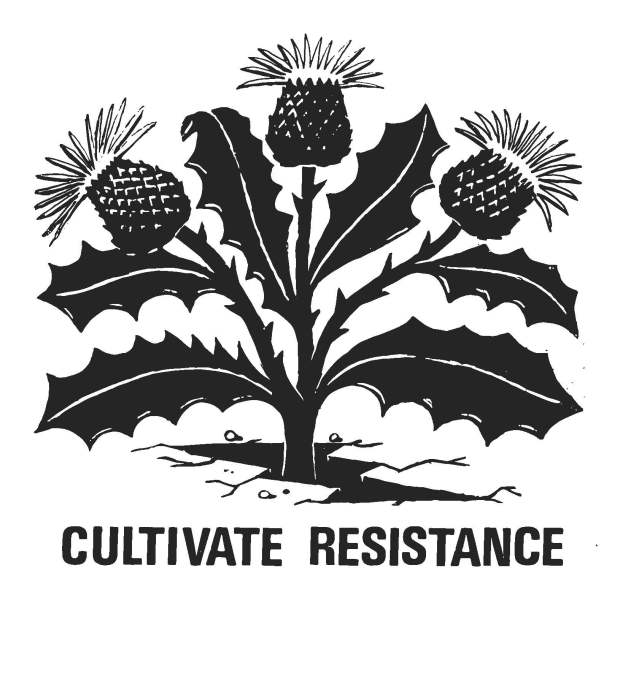
Dandelion growing out of concrete with words that say "Cultivate Resistance"

Graphic by Luke Thomas available at https://justseeds.org/graphic/cultivate-resistance/

sadness and struggle

I’ve been trying and failing to finish a lot of writing over the last few weeks. I have felt overwhelmed, with a lot to say, but at the same time not quite able to edit and polish and publish what I’ve got.

Today, after once again writing about 1,500 words without finishing a post, I finally picked up Cindy Milstein’s Rebellious Mourning and read the first essay, Benji Hart’s “Feeling Is Not Weakness.” In it, Hart talks about how sad and depressing it is to connect the dots on the systemic violent oppression of black and brown people. Hart says they feel guilty for being sad, because Hart knows one of the functions of the system is to create demoralization. Sadness makes it feel like this campaign of demoralization is working. In Hart’s words:

“I feel guilty for being demoralized. I should be angry. I should be fiery with unquenchable passion. I should be as relentless as the state. If I am sad, the state has won. If I am sad, the fight is over”(p. 20).

I too feel sad. And I had not realized until just at this moment that I have had writer’s block because I didn’t want to write anything out of my sadness. I didn’t want to let Husky, or city council, or Walker, or Trump, or whoever control my life and my successes and make me sad. I didn’t want the state or capital to win. But feeling sadness when confronted with tragic realities is what makes me human. It is what makes me strong. Hart puts it like this:

“Experiencing hurt around the realities my people and I face is more than understandable; it shows that I have not given in, not accepted the current, violent reality as inevitable, not forfeited belief in my own right to life.”(p. 21)

A compañera of mine put it another way:

“We’re in the heart of the Empire,” I said.
“You’re wrong,” she said, “the Empire has no heart.”

My sadness does not mean the battle is lost. It means I’ve refused to lose what’s at the core of struggle and what we struggle for: my dignity and humanity. My belief that better worlds are possible. My compassion for others. My willingness to see and face systemic injustice. My meaningful connections to people living precarious lives of all kinds. My hope that people can be better people, and that they can find the will and courage to stop enacting their power over others. It’s only when I become so cynical that I lose these things that the fight is over. Sadness is not the sign the battle is lost but the sign that it is still raging, and the sign that I am still willing to fight it.

a blue arm and a white arm hold hands across a paper background with foundation and charity names. the paper is torn to reveal the words "True Compassion is more than flinging a coin to a beggar; it comes to see that an edifice which produces beggars needs restructuring." - Martin Luther King, Jr

Art by Kevin Caplicki for the Poor People’s Campaign, available at Just Seeds Collective.

communication through bars is revolutionary

Today I was reading about Mutulu Shakur, who has spent over 30 years in prison, when I came across the following piece of information: Dr. Shakur was denied parole in one hearing solely because he participated in a phone call on speakerphone with a professor and their students. In essence, the act of speaking to people in an educational context became the reason that he was seen as a danger to society.

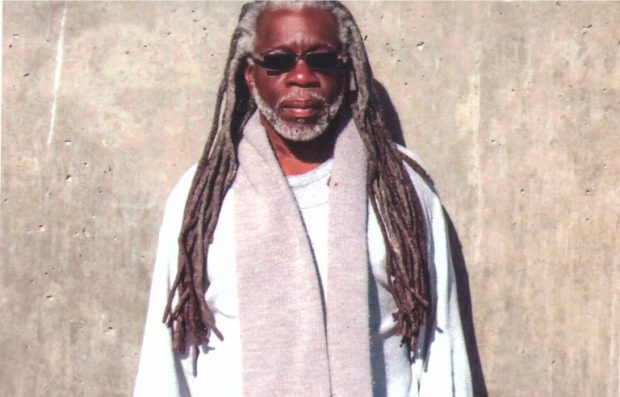
photograph of Dr. Mutulu Shakur in the sun against a concrete wall

Dr. Mutulu Shakur, August 2016

Dr. Shakur is the stepfather of Tupac Shakur and has served 32 years in federal prison for his involvement in a bank robbery which resulted in the deaths of 3 people and involvement in the escape of Assata Shakur. Shakur was denied mandatory parole in 2016 (after serving 30 years as a peaceful prisoner) and has currently initiated a lawsuit against the federal government.

For the last 3 years I have met with other local people twice a month to write letters to people in prison. This work has many critical aspects, some of which are immediately obvious, and others which are less so. Perhaps another day I can write more about the importance of writing a letter in the spirit of solidarity to a person who is literally living in a cage, and about the important and meaningful friendships that have grown from those letters. What I’m thinking about this afternoon is the way this work keeps me connected to the many shocking injustices of the prison system, and how much I continue to learn from it.

It’s worth reading the whole list of horrifying reasons Dr. Shakur was denied parole put together by his support committee. Apparently a prisoner cannot refer to themselves as a victim of COINTELPRO, although it is indisputably factually correct, if they want to ever be considered for parole, because referring to their victimization by the FBI makes them likely to reoffend.

Regarding the public phone call, no one disagrees that Mutulu called a professor who placed the call on speaker phone so that other faculty and students could listen to his comments. The problem is that the prison and parole board have not ever cited a rule that was violated by such a phone call, nor was anyone ever informed of such a rule (and how heinous is the idea of such a rule?). From the support committee summary:

“The February 2013 brief phone call, fully monitored, was the sole basis for rejecting the Parole Commission’s Hearing Examiner’s recommendation that Dr. Shakur be paroled in early 2015. No one has ever explained why any rule was violated or shown that Dr. Shakur or any other inmate has been informed that allowing someone to place his or her phone on a speaker is a rule violation.”

In this case, the mere act of speaking to others outside the prison walls becomes reason enough for continued loss of civil rights. Even the apparent involvement of Danny Glover at the event was not enough public pressure to turn the tide (or perhaps that’s exactly what irritated the parole board enough to cause the retaliation). The message is that prisoners can and will be punished for communicating with people outside of prison in public ways. But even so, it’s shocking to see that the prison has so much control that it does not need to provide any justification for this, even in such a high profile case.

This case and details are not only a good lesson on how the prison works, but they touch close to the local work we do, too. I sent Mutulu a birthday card last year, and received a nice note back. I’ve participated in similar phone calls myself at public talks given on campus, as an audience member, and have considered organizing these kinds of events as well. And another reason for Dr. Shakur’s parole denial is one that we deal with regularly: how to close a letter.

“Mutulu often signs off his letters with the words ‘Stiff Resistance’ and this indicates he may once again engage in violent crimes if released.”

The Hearing Examiner stated:

“The Commission not only finds these statements incompatible with the goals and conditions of parole supervision, but also concludes they are evidence that you have not disavowed yourself from the same set of beliefs you had when you were convicted …”

What is noticeable here is that the Commission looked past literally volumes of public statements and writing made by someone that would clarify and provide clear context on what they are thinking, in this case an explicit disavowal of violence as a means toward social change, and instead focused on a two word salutation and decided to interpret it in a vacuum. They will, it seems from their own statement, accept nothing less than a disavowal of all the political beliefs Dr. Shakur had when he was convicted. In other words, they are not looking for him (or other prisoners) to disavow violence or certain actions, but rather to disavow political resistance entirely. They are looking for complete submission, even in letter salutations.

But prisoners also demonstrate their refusal to submit and their continued meaningful political resistance precisely through communicating with us. It’s a way of maintaining their selves, their dignity, and their humanity inside of an institution that is specifically designed to strip them of all of that. Mutulu uses “stiff resistance;” another friend of our group, Sean Swain uses “stay dangerous” and has mounted three campaigns for governor while on the inside. Communication beyond bars is a radical tool or it would not be punished so radically. And if this is the punishment that occurs in a high profile case like Mutulu Shakur’s, with a website, support committee, and some connection to Danny Glover, one should imagine much more arbitrary denials and worse repression that occurs among the rest of the prison population.

Prisoners take enormous risks in simply communicating with us. As people who walk freely on the outside, it’s essential not to forget, underestimate, or waste these risks, and to understand that they are precisely how we know our work is revolutionary and meaningful.

prison_birds_hearts


Husky Refinery Is Not Our Mayor

Only today I noticed that the Superior Mayor’s office had posted an update on the section of the Douglas County website he had previously designated to be the single place for information on the refinery fire on May 7. The people of Superior are still waiting for a place where we can ask questions about the fire which is not a Facebook page (which leaves people open to being personally attacked) or run by Husky refinery, so I will continue to ask questions here, among other places. The Douglas County website is a one way transmission.

There are several things worth pointing out about this update. One is that it would seem very few people noticed it being posted and that there are reasons for that. For example no one I know who is active in gathering information about the refinery explosion mentioned it at all or had seen it before me. While a single source of information is indeed a very good idea, one has to wonder why new posts are not also announced on the other places the city uses to give information such as its “Jim Paine, Mayor of Superior” or “City of Superior” Facebook pages. While I hate the use of these privately owned sites in general for the dissemination of information, the fact remains that most people have already become reliant on using them since until last week they were the primary source of information. Why not post something that says, “hey I put something new up on the Douglas County website” if getting information to people was the goal?

The much more disturbing thing about this update however is that while on the Douglas County website the update says “Information from City of Superior Mayor’s Office: A summary of the week’s events has been compiled for your reference,” once you open the document it is clear that the entire update was written directly by the Husky Refinery itself and not by Jim Paine or the Mayor’s office at all. I find this to be totally unacceptable and even reprehensible when the role of our elected officials should be to advocate for our community. Sentences such as “we are beginning to clear areas within the facility so we can facilitate cleanup and the next phases of work,” are a pretty good indicator of the authorship of the document. The role, actions, or even name of the city of Superior is not mentioned even once in the document.

The document is also buried on a list of other updates on the Douglas County website, almost all of which are about air quality. As we now know from our own local scientific experts, the major risk is not from the air quality nor has it been since the immediate few days following the fire. What was in the air has traveled into our soil and potentially our water. It’s on the animals and perhaps on ourselves, and our children. It’s hard not to conclude that all of these updates about air quality are little more than a distraction from other more distressing information included even in a report written by Husky itself, which includes answers to some of the questions we asked on May 1.

The section on wildlife reads:

“Protections and deterrents for wildlife have been implemented as part of the facility response. To date there are two known impacts. One resident deer has been identified with oil staining on all four lower legs and one deceased common grackle has been found. The deer is being monitored. A decision has been made not to tranquilize the deer to remove the oil as it is not showing negative impacts. There has been no observed impacts to fish or other aquatic life in the onsite storm water ponds or Newton Creek as a result of the incident. Water monitoring continues.”

Surely we are not supposed to believe that the real concern is one single deer but rather that where there is one, there must be more? And how could a deer covered in oil not be showing negative impacts? This defies the imagination. And what of the bird?

I see here it’s also mentioned that:

“Water samples collected post incident to date are comparable to baseline samples pre-incident under normal refinery operating conditions, with the exception of trace amounts of Perfluoroalkyl Sulfonate (PFAS) – a chemical component found in firefighting foam.”

As we suggested previously, these are part of the same class of chemicals for which 3M just settled an $850 million dollar lawsuit because of the known health risks to humans and aquatic systems. How will the public be informed of the “treatment strategy” which is “being prepared”? Why didn’t Husky already have such a treatment strategy already in place since surely an asphalt fire in a refinery is not such an unlikely emergency? This is one of the questions we have already asked, and to which we received deflective answers from our mayor, leaving me more concerned than ever.

But how is the public ever supposed to trust any of the answers we receive if our mayor is reposting a summary produced by the corporation responsible for almost killing us, and passing it off as if the city and the refinery are one and the same voice?

Protect the Water.pdf

between words

I started this blog in part because the air around me was too thick with gaslighting. Because I needed to tell the story of what was happening at UWS and in the UW system not just to the world outside, but to myself. Because I needed to write down and tell so many stories. Writing makes things clearer and makes them make sense. When I don’t have the time to write I start to feel the walls close in and everything feels too quiet here. Up starts to feel like down. I hope I can be back to writing the world into sense again soon.

drawing of an anatomical heart with the text "This Machine Kills Fascists"

Graphic by Jonathan Byxbe of Flight 64 Studio in Portland, OR, via Justseeds Collective

Questions to and from the City of Superior

Public Comments to Superior City Council
May 1, 2018

As a social scientist I have been talking to people and taking notes on their questions and experiences for the last several days since the Husky Refinery explosion on Thursday April 26. This is a list of questions I have heard and compiled from community members who live and work in Superior, many of whom are UW-Superior students. It’s important to note that these are not rhetorical questions, but ones that we are hoping for answers to at some point in the future from the appropriate authority.

  1. Is the site still hot? Are there still fire concerns?
  2. What’s the role of independent scientists in all of this, for verifying tests and getting second opinions? As we know, this is good science.
  3. Where can people go to get their questions answered that isn’t a Facebook page (which leaves them open to being attacked and trolled) and isn’t run by Husky Refinery?
  4. What medical symptoms should people be on the lookout for?
  5. What are the instructions for people who grow food locally, including commercial growers? What compensation will be available for them for these losses?
  6. Where did the particulates end up – in the blast zone, in the plume, where exactly?
  7. How will the city work with UWS to improve their evacuation plan?
  8. Why was UWS ever considered a mustering point?
  9. Why doesn’t the city have a designated shelter and a designated helpline ready to go in the event of an emergency if we have a refinery located in our community?
  10. What about the deer right at the explosion site? And what about the people who eat the deer?
  11. What is the status of Lake Superior? Will it be safe to swim in? And how will we know?
  12. What are Husky’s plans for the future of hydrofluoric acid? What are the city’s plans regarding this risk?
  13. Why are there propane gas tanks located just across the street from the refinery in the first place?
  14. Exactly what tests are being run on the water and soil, and what is the time frame of those tests?
  15. What was the cause of the explosion?
  16. What do repair and reconstruction of the refinery actually look like? Will tanks be patched or replaced?
  17. Perfluorinated Chemicals (PFCs) are found in the foam used to fight the fire at the refinery, and are highly toxic to aquatic systems. In fact 3M recently lost a lawsuit to the state of Minnesota for $850 million dollars. for not disclosing the health risk around the use of these chemicals. What efforts are being used to contain the PFCs and clean it up?
  18. Why isn’t Husky’s own wastewater treatment plant designed to treat the Class B foams needed to put out a fire at Husky’s refinery?

One thing I have learned over the last several days is that lack of information also causes panic.

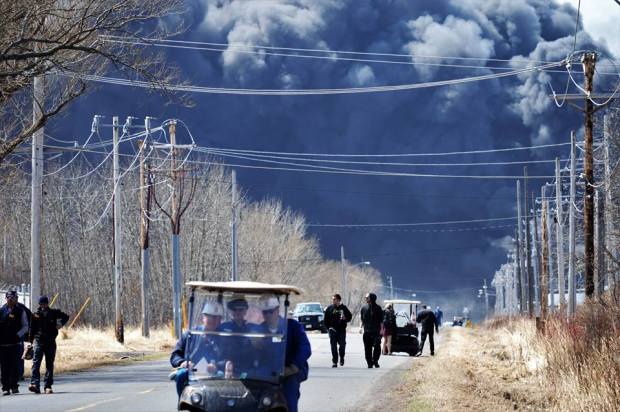
Photo shows black cloud of billowing smoke with workers walking away toward the camera, and many power lines.

Husky Refinery Explosion close up. Photo by Sheila Lamb.


the first few days

On Thursday morning I was in my upstairs office, writing. My house shook around 10 am. I called downstairs to my partner, who ran upstairs. We both thought the other would know what had happened. Had I dropped something really big on the floor? Had a really giant truck passed by? Neither of these seemed to explain why our windows and doors would shake, but we didn’t hear any sirens and nothing else happened, so mildly unsettled, we went back about our business.

I keep thinking about the part of Wormwood where Eric Olson describes Seymour Hirsch walking into the family’s house and announcing, “You must be the most uncurious family in America.”

At 11:30 I received an email from campus with a link to a news story with the first description of the explosion that had taken place at 10 am. The first news reports listed 20 “casualties,” (later revised to 16 injuries), and I immediately noticed that no one on the hours of news coverage or during the press conferences, was using the word Enbridge or mentioning the pipelines which lead to the plant. In fact, like many other people in town, I thought right up until Thursday that Enbridge owned that refinery, based on my impression from driving on the road next to the site. Apparently, Enbridge owns the tanks right across the street which somehow did not appear in any of the coverage.

I got ready to head to campus for my afternoon classes, simultaneously watching TV and checking social media for updates. I was already seeing several people commenting on the good news that no one had died, which seemed far too early to me. There had not yet been a report that they had accounted for all the workers, people had been taken to the hospital with an unknown severity of injuries, and the fire was still going. Soon after there were more explosions, and it was clear the fire was not out.

I arrived to campus a little after 12:30 and the mood was surreal. Apparently on campus the buildings had not shook and most people I talked to had the sense that it was not that serious. At 11:43 AM, the campus alert system sent the following message: “Explosion at the Husky Refinery. Law enforcement has stated that the fire is out. Campus will resume under normal operations,” which must have contributed to this mood.

I found myself wondering how people in Chernobyl had behaved (and also worrying that I was overreacting). I wondered why we weren’t a little more prepared for what to do. I worried that people were so quick to move on and not at all cautious about the air quality. Walking to my 1 pm class I received a text from my partner indicating that talk of evacuations had begun.

When I got to class, I did my job as a professor of sociology and cautioned my students about some of the dangers of happy talk. We discussed the fact that the refinery disaster perhaps concerned us more than we thought. An athlete told us that they had been asked to go in from the soccer field earlier that morning. I tried to find the line between pretending everything was hunky dory, and creating panic. I trusted that if we were evacuated we would certainly know it. We had just been in that classroom during a tornado drill a few weeks earlier, after all, and every device in the room began making alerts, not to mention that human monitors went room to room to make sure everyone had left. I thought if the computer was on in the room it would show an alert, and we all turned our phones face up. I was sure an evacuation of this level would be announced over the loud speaker as well, and I assured my students of this fact.

I cannot now say whether or not I am ashamed of this rather minimal trust I had in the institution to inform us of what was happening. I feel like a fool who should have known better, but on the other hand, these situations for good reason cannot be left up to individual faculty members to decide. We do not have all the information and should not need to gather it. We were put in an awful position. I heard from several faculty who said they held class because they were worried that if they didn’t their students wouldn’t have anywhere else to go. That’s the problem when institutions do not provide the support we need in an appropriate time frame — they leave us all to make decisions on our own and none of them seem like the right one.

We went on with our class business until about 1:45. Someone noticed they had a lot of messages on their phone first, and then we all looked down and saw that we had a lot of messages from family members and from the university alert system. Our family members wanted us to evacuate or to know if we were OK. The university alert system messages we had received since our class began said:

1:10 PM Info UWS Office of Public Safety has received is that the UWS campus is NOT under an evacuation order. Continuing to monitor and update as needed.

1:41 PM SAFE ALERT: UW-Superior is NOT within the evacuation zone. There has been some misinformation in the media about the evacuation zone.

Authorities state the evacuation zone is 10 miles south of the refinery, 3 miles east and west of the refinery and 1 mile north of the refinery, which is 28th street. We are closely monitoring the situation. If you do choose to leave campus, please use caution and avoid the impacted area.

These strangely defensive alerts were our only source of information for what to do on campus. Several of my students live in a dorm which was .3 mi outside the evacuation zone at that time, and they wondered where they should go instead of home. No one knew. Another student confirmed that WITC, a campus located spatially within our campus, had closed for the day. Still another student who shares caregiving responsibilities for small children began to worry. She checked her phone, and found that the schools had indeed closed and evacuated, but the children’s mother wasn’t sure at that point exactly where the kids were because the school had not activated their alert system. This was the point where the class began to collectively panic and feel that we were not being told what we needed to know and where to go. A resourceful student made a few phone calls and determined that unofficially students who were unable to go home were gathering in the student union. Here’s what the view was like from campus at that point:

Husky refinery smoke in the distance

Picture taken from UW-Superior campus while classes were still taking place during the Husky Refinery disaster, April 26, 2018.

If the plan was not to cancel classes in order to stop a traffic jam and to complete a more orderly evacuation, why not send email with more guidance for faculty letting us know to bring people to the student union as things escalated? Why not give us a few resources to help us keep things calm? Leaving us with no plans and suggesting that we somehow hold class while students are not sure if they can return home and their children are being evacuated to unknown locations does not make any sense. This was at 1:45. The next set of classes on Thursdays begin at 2:30 and classes were not officially canceled until 3:10. By 4:13, UWS was declaring itself to be in the evacuation zone as well.

I had no idea what to do or where to tell anyone to go. I did not know how to help the students evacuate, although we practice tornado drills every year (tornadoes are exceedingly rare in our region). Our university is located under 3 miles from a refinery; this is a known quantity. There is no reason not to practice or disseminate information about what to do in the event of this kind of disaster other than perhaps the desire to make us feel safe about some things (like pipelines and oil production, who are large donors to the university) and direct our focus on worrying about other things.

After my class dissolved early, I canceled my next class. Then I went home, packed my things, and evacuated myself to Duluth. On the way out of town I received the notice that classes had finally been canceled. Once in Duluth, I went to some stores and tried to do something relaxing for a while. I took this picture from the malt shop, as a sad comparison to so many beautiful pictures I’ve taken of the most amazing lake in the world:

Refinery smoke over the water

Picture of the Husky Refinery disaster from the Duluth shore of Lake Superior on the afternoon of April 26, 2018.

I got to my friends’ house and ate dinner. We watched the news on and off, but tired of the coverage. The last we had heard, the fire might rage for days, even weeks. Around 7 pm, someone came home and said, “Didn’t you hear? The fire’s out.” We turned on the news, and sure enough, we saw that the fire had been declared out, and Superior residents were told we could come home as early as 9 pm. An information number was given out, which we wrote down. We turned off the coverage again, since we’d been watching it for hours at that point, and we spent time with our friends.

At about 11:30 pm Thursday night we headed out the door to come home to Superior. At the door our friend said, “Oh! we never thought to double check if it was OK to go back.” “It’s OK,” we said, “we’ll call or something in the car.” We listened for news in the car but couldn’t find any local coverage on the radio. On the bridge I called the information line that had been given out only 5 hours before. It rang a bunch of times, then someone picked it up and hung up on me.

I do not know if I was just tired, or if wishful thinking got the best of me. But we went ahead and continued on home to Superior, since the phone call was just a double check and the evacuation seemed like it had already been called off. Imagine my horror when I was already in my house, checked the internet, and realized that the evacuation had been more or less called back on. This is the real risk of rushing to give people good news. It puts people in danger. It put me in danger.

That night and the next day I found that for some reason between 6:30 pm and 11:30 pm, some of the most critical hours for sharing information during the evacuation, when people like me were away from our homes and our usual sources of information and routines, the city and county announced two numbers for residents to call and then quickly closed these numbers. Instead, they directed people to call a hotline run by the Husky Refinery itself. They also announced that “The fire is extinguished. Residents in the evacuation area are asked to remain away from homes for at least another 2 hours (21:00 CST)” then announced at 21:20 CST that the evacuation order was still in place. It’s true that it doesn’t exactly say you can go back at 9 pm. But common sense dictates that an update was needed before 9 pm, not after, so I imagine that was an oversight that encouraged others to return too quickly as well. A press conference and update was announced for 10 am Friday, then it was announced that everyone could return at 6 am. I couldn’t figure out where everyone was even getting this news from. It turned out I was out of the loop in part because I wasn’t following the correct Facebook account. I follow the City of Superior on Facebook, not “Jim Paine, Mayor of Superior.” I only wish I were joking.

I spent the next day feeling as if I was in a freefall. It makes you feel insane when everyone is telling you everything is fine but there are clearly chemical gases being spilled nearby. When you are supposed to hold class with a giant black cloud looming on the horizon and the hospital is being evacuated, it’s hard to know what’s real. When most of the talk you hear is about what a good job everyone did but your experience was terrible (and dangerous), it is literally maddening. I heard a terrible story about what happened to the patients at the VA in Superior. I know other people who came home on Thursday night only to find out belatedly they shouldn’t have. Other people’s homes shook so violently that pilot lights went out, and it took them a few days to notice the gas leak in their empty homes. The air of finality of the pronouncements from the mayor’s office and the lack of questions on all sides contribute to my fear that none of these problems will be dealt with in due course. The last updates were Friday at noon, stating that the “I am in Superior and returning to the refinery site now, breathing the air myself. We will continue monitoring the air but the source of the danger has passed,” indicating no future investigation toward any of the long term health and environmental problems we face.

We know now that the major risk was hydrofluoric acid. We did not know that in my classroom at 1 pm while that fire was raging in the distance. Perhaps it is wise public policy to keep people where they are since we cannot all get out of town on two bridges fast enough when a toxic gas explodes; most of us would have died in our cars in traffic no matter what. Does that mean though that we should have so little plan and so little training that most of us run to our windows when we hear an explosion? Does that mean we should call people back to town before the fire is really out? There were many risks to be managed on Thursday and Friday in addition to all of the health and environmental risks that remain to be managed. Some of those were handled well. The HF tank did not explode. No workers died. These are, in fact, very good things. But some things were handled poorly and they were in fact foreseeable things. There’s no reason the city of Superior can’t operate its own helpline, or at least have a voicemail message giving the most current update and directing people to the proper information and emergency numbers.  These things should not be handled by the company, who does not have our community best interest at heart.

There’s no reason we can’t speak critically about what did and didn’t go well and work to keep doing better. We need to know what happened in order to be better prepared for the future. Perhaps people would not panic in emergencies if we were not lulled into complacency in the first place. For me the first step is no more HF in my community. I don’t want to live in a “kill zone” any longer.


policing campus diversity: Somali Night

Yesterday I read the stomach turning account of how my alma mater, the University of Minnesota, treated the Somali Student Association at the end of its cultural week, last Friday. I’m presenting the Somali Student Association’s account here in its entirety, because the whole thing is worth the read. It is one of the most thorough, clear, and comprehensive accounts of a police riot I have ever read. It is an alarming picture of how subtle, purportedly nonviolent, and even micro-level forms of racism combine and become explicit, violent, and massive.

Somali Night Press Release Pg 1Somali Night Press Release Pg 2Somali Night Press Release Pg 3


Many things about this statement jump out immediately. One of them is the claim made by employees on a university campus that it would be impossible to use markers on Black skin. This indignity, which must have occurred in the context of so many others during the planning for this event, encapsulates clearly that the University of Minnesota is still unprepared in 2018 for the presence of Black people.

Something else I notice immediately is the calm, composed, and measured tone of this press release, written by a student organization.  So much can be learned just by reading what these students have to say about their experiences. I expect we will learn even more from them by watching how they challenge the university in its reaction.

Students on the University of Minnesota campus have already been reporting on their negative experiences with the cosmetic diversity initiatives embraced by their campus (which is similar to so many others). The Whose Diversity? campaign that began in Spring 2014 created a powerful set of testimonies of experiences of students of color on campus.

Perhaps most telling is that a quick Google search conducted 24 hours after the Somali Student Association’s press release and 3 days after the Somali Night incident itself reveals very little reporting on the event and its heavy policing. I suppose it comes as little surprise that the most cogent and knowledgeable source of information about these events comes from the affected students themselves.