the first few days

On Thursday morning I was in my upstairs office, writing. My house shook around 10 am. I called downstairs to my partner, who ran upstairs. We both thought the other would know what had happened. Had I dropped something really big on the floor? Had a really giant truck passed by? Neither of these seemed to explain why our windows and doors would shake, but we didn’t hear any sirens and nothing else happened, so mildly unsettled, we went back about our business.

I keep thinking about the part of Wormwood where Eric Olson describes Seymour Hirsch walking into the family’s house and announcing, “You must be the most uncurious family in America.”

At 11:30 I received an email from campus with a link to a news story with the first description of the explosion that had taken place at 10 am. The first news reports listed 20 “casualties,” (later revised to 16 injuries), and I immediately noticed that no one on the hours of news coverage or during the press conferences, was using the word Enbridge or mentioning the pipelines which lead to the plant. In fact, like many other people in town, I thought right up until Thursday that Enbridge owned that refinery, based on my impression from driving on the road next to the site. Apparently, Enbridge owns the tanks right across the street which somehow did not appear in any of the coverage.

I got ready to head to campus for my afternoon classes, simultaneously watching TV and checking social media for updates. I was already seeing several people commenting on the good news that no one had died, which seemed far too early to me. There had not yet been a report that they had accounted for all the workers, people had been taken to the hospital with an unknown severity of injuries, and the fire was still going. Soon after there were more explosions, and it was clear the fire was not out.

I arrived to campus a little after 12:30 and the mood was surreal. Apparently on campus the buildings had not shook and most people I talked to had the sense that it was not that serious. At 11:43 AM, the campus alert system sent the following message: “Explosion at the Husky Refinery. Law enforcement has stated that the fire is out. Campus will resume under normal operations,” which must have contributed to this mood.

I found myself wondering how people in Chernobyl had behaved (and also worrying that I was overreacting). I wondered why we weren’t a little more prepared for what to do. I worried that people were so quick to move on and not at all cautious about the air quality. Walking to my 1 pm class I received a text from my partner indicating that talk of evacuations had begun.

When I got to class, I did my job as a professor of sociology and cautioned my students about some of the dangers of happy talk. We discussed the fact that the refinery disaster perhaps concerned us more than we thought. An athlete told us that they had been asked to go in from the soccer field earlier that morning. I tried to find the line between pretending everything was hunky dory, and creating panic. I trusted that if we were evacuated we would certainly know it. We had just been in that classroom during a tornado drill a few weeks earlier, after all, and every device in the room began making alerts, not to mention that human monitors went room to room to make sure everyone had left. I thought if the computer was on in the room it would show an alert, and we all turned our phones face up. I was sure an evacuation of this level would be announced over the loud speaker as well, and I assured my students of this fact.

I cannot now say whether or not I am ashamed of this rather minimal trust I had in the institution to inform us of what was happening. I feel like a fool who should have known better, but on the other hand, these situations for good reason cannot be left up to individual faculty members to decide. We do not have all the information and should not need to gather it. We were put in an awful position. I heard from several faculty who said they held class because they were worried that if they didn’t their students wouldn’t have anywhere else to go. That’s the problem when institutions do not provide the support we need in an appropriate time frame — they leave us all to make decisions on our own and none of them seem like the right one.

We went on with our class business until about 1:45. Someone noticed they had a lot of messages on their phone first, and then we all looked down and saw that we had a lot of messages from family members and from the university alert system. Our family members wanted us to evacuate or to know if we were OK. The university alert system messages we had received since our class began said:

1:10 PM Info UWS Office of Public Safety has received is that the UWS campus is NOT under an evacuation order. Continuing to monitor and update as needed.

1:41 PM SAFE ALERT: UW-Superior is NOT within the evacuation zone. There has been some misinformation in the media about the evacuation zone.

Authorities state the evacuation zone is 10 miles south of the refinery, 3 miles east and west of the refinery and 1 mile north of the refinery, which is 28th street. We are closely monitoring the situation. If you do choose to leave campus, please use caution and avoid the impacted area.

These strangely defensive alerts were our only source of information for what to do on campus. Several of my students live in a dorm which was .3 mi outside the evacuation zone at that time, and they wondered where they should go instead of home. No one knew. Another student confirmed that WITC, a campus located spatially within our campus, had closed for the day. Still another student who shares caregiving responsibilities for small children began to worry. She checked her phone, and found that the schools had indeed closed and evacuated, but the children’s mother wasn’t sure at that point exactly where the kids were because the school had not activated their alert system. This was the point where the class began to collectively panic and feel that we were not being told what we needed to know and where to go. A resourceful student made a few phone calls and determined that unofficially students who were unable to go home were gathering in the student union. Here’s what the view was like from campus at that point:

Husky refinery smoke in the distance

Picture taken from UW-Superior campus while classes were still taking place during the Husky Refinery disaster, April 26, 2018.

If the plan was not to cancel classes in order to stop a traffic jam and to complete a more orderly evacuation, why not send email with more guidance for faculty letting us know to bring people to the student union as things escalated? Why not give us a few resources to help us keep things calm? Leaving us with no plans and suggesting that we somehow hold class while students are not sure if they can return home and their children are being evacuated to unknown locations does not make any sense. This was at 1:45. The next set of classes on Thursdays begin at 2:30 and classes were not officially canceled until 3:10. By 4:13, UWS was declaring itself to be in the evacuation zone as well.

I had no idea what to do or where to tell anyone to go. I did not know how to help the students evacuate, although we practice tornado drills every year (tornadoes are exceedingly rare in our region). Our university is located under 3 miles from a refinery; this is a known quantity. There is no reason not to practice or disseminate information about what to do in the event of this kind of disaster other than perhaps the desire to make us feel safe about some things (like pipelines and oil production, who are large donors to the university) and direct our focus on worrying about other things.

After my class dissolved early, I canceled my next class. Then I went home, packed my things, and evacuated myself to Duluth. On the way out of town I received the notice that classes had finally been canceled. Once in Duluth, I went to some stores and tried to do something relaxing for a while. I took this picture from the malt shop, as a sad comparison to so many beautiful pictures I’ve taken of the most amazing lake in the world:
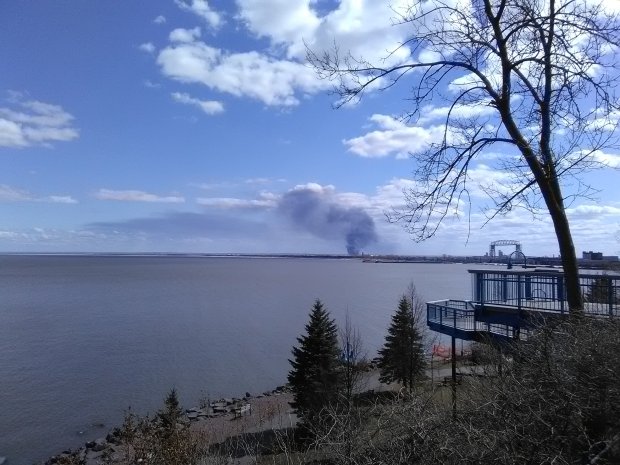
Refinery smoke over the water

Picture of the Husky Refinery disaster from the Duluth shore of Lake Superior on the afternoon of April 26, 2018.

I got to my friends’ house and ate dinner. We watched the news on and off, but tired of the coverage. The last we had heard, the fire might rage for days, even weeks. Around 7 pm, someone came home and said, “Didn’t you hear? The fire’s out.” We turned on the news, and sure enough, we saw that the fire had been declared out, and Superior residents were told we could come home as early as 9 pm. An information number was given out, which we wrote down. We turned off the coverage again, since we’d been watching it for hours at that point, and we spent time with our friends.

At about 11:30 pm Thursday night we headed out the door to come home to Superior. At the door our friend said, “Oh! we never thought to double check if it was OK to go back.” “It’s OK,” we said, “we’ll call or something in the car.” We listened for news in the car but couldn’t find any local coverage on the radio. On the bridge I called the information line that had been given out only 5 hours before. It rang a bunch of times, then someone picked it up and hung up on me.

I do not know if I was just tired, or if wishful thinking got the best of me. But we went ahead and continued on home to Superior, since the phone call was just a double check and the evacuation seemed like it had already been called off. Imagine my horror when I was already in my house, checked the internet, and realized that the evacuation had been more or less called back on. This is the real risk of rushing to give people good news. It puts people in danger. It put me in danger.

That night and the next day I found that for some reason between 6:30 pm and 11:30 pm, some of the most critical hours for sharing information during the evacuation, when people like me were away from our homes and our usual sources of information and routines, the city and county announced two numbers for residents to call and then quickly closed these numbers. Instead, they directed people to call a hotline run by the Husky Refinery itself. They also announced that “The fire is extinguished. Residents in the evacuation area are asked to remain away from homes for at least another 2 hours (21:00 CST)” then announced at 21:20 CST that the evacuation order was still in place. It’s true that it doesn’t exactly say you can go back at 9 pm. But common sense dictates that an update was needed before 9 pm, not after, so I imagine that was an oversight that encouraged others to return too quickly as well. A press conference and update was announced for 10 am Friday, then it was announced that everyone could return at 6 am. I couldn’t figure out where everyone was even getting this news from. It turned out I was out of the loop in part because I wasn’t following the correct Facebook account. I follow the City of Superior on Facebook, not “Jim Paine, Mayor of Superior.” I only wish I were joking.

I spent the next day feeling as if I was in a freefall. It makes you feel insane when everyone is telling you everything is fine but there are clearly chemical gases being spilled nearby. When you are supposed to hold class with a giant black cloud looming on the horizon and the hospital is being evacuated, it’s hard to know what’s real. When most of the talk you hear is about what a good job everyone did but your experience was terrible (and dangerous), it is literally maddening. I heard a terrible story about what happened to the patients at the VA in Superior. I know other people who came home on Thursday night only to find out belatedly they shouldn’t have. Other people’s homes shook so violently that pilot lights went out, and it took them a few days to notice the gas leak in their empty homes. The air of finality of the pronouncements from the mayor’s office and the lack of questions on all sides contribute to my fear that none of these problems will be dealt with in due course. The last updates were Friday at noon, stating that the “I am in Superior and returning to the refinery site now, breathing the air myself. We will continue monitoring the air but the source of the danger has passed,” indicating no future investigation toward any of the long term health and environmental problems we face.

We know now that the major risk was hydrofluoric acid. We did not know that in my classroom at 1 pm while that fire was raging in the distance. Perhaps it is wise public policy to keep people where they are since we cannot all get out of town on two bridges fast enough when a toxic gas explodes; most of us would have died in our cars in traffic no matter what. Does that mean though that we should have so little plan and so little training that most of us run to our windows when we hear an explosion? Does that mean we should call people back to town before the fire is really out? There were many risks to be managed on Thursday and Friday in addition to all of the health and environmental risks that remain to be managed. Some of those were handled well. The HF tank did not explode. No workers died. These are, in fact, very good things. But some things were handled poorly and they were in fact foreseeable things. There’s no reason the city of Superior can’t operate its own helpline, or at least have a voicemail message giving the most current update and directing people to the proper information and emergency numbers.  These things should not be handled by the company, who does not have our community best interest at heart.

There’s no reason we can’t speak critically about what did and didn’t go well and work to keep doing better. We need to know what happened in order to be better prepared for the future. Perhaps people would not panic in emergencies if we were not lulled into complacency in the first place. For me the first step is no more HF in my community. I don’t want to live in a “kill zone” any longer.



policing campus diversity: Somali Night

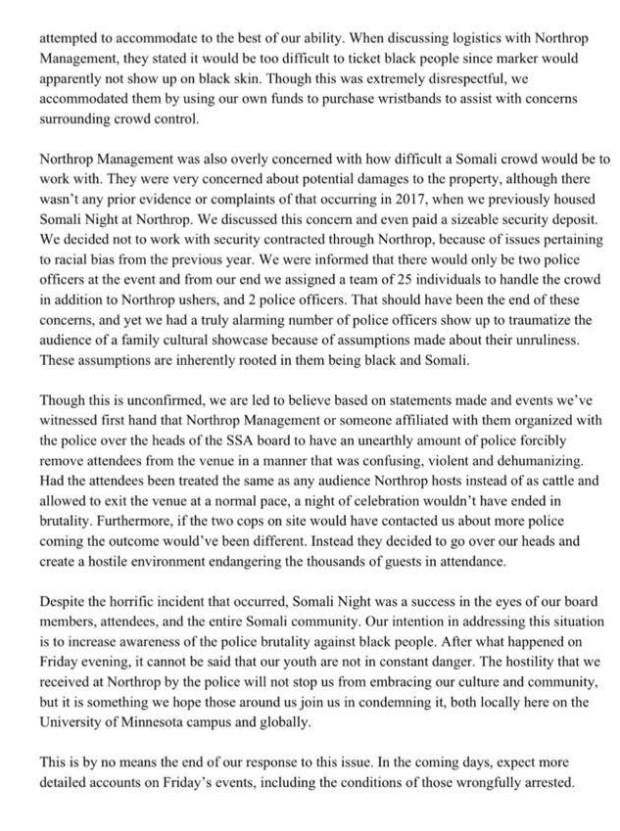
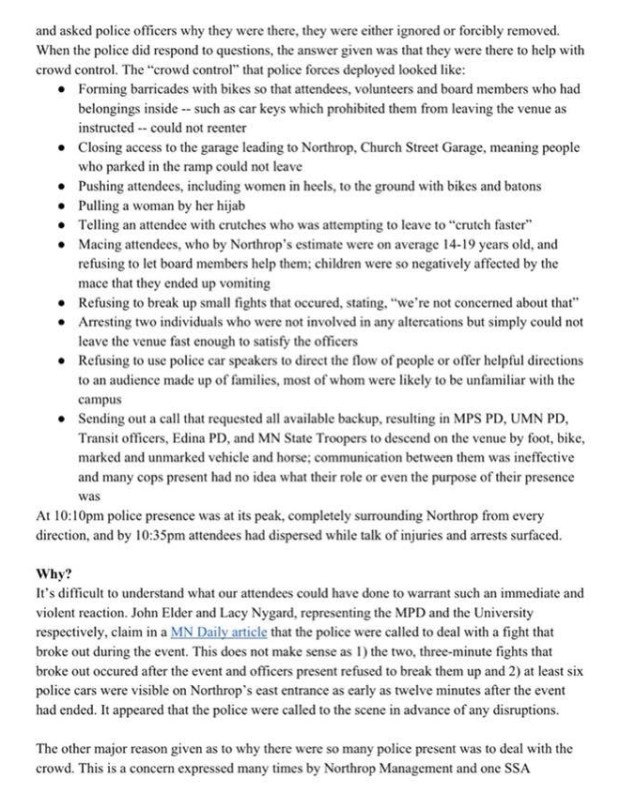
Yesterday I read the stomach turning account of how my alma mater, the University of Minnesota, treated the Somali Student Association at the end of its cultural week, last Friday. I’m presenting the Somali Student Association’s account here in its entirety, because the whole thing is worth the read. It is one of the most thorough, clear, and comprehensive accounts of a police riot I have ever read. It is an alarming picture of how subtle, purportedly nonviolent, and even micro-level forms of racism combine and become explicit, violent, and massive.

Somali Night Press Release Pg 1Somali Night Press Release Pg 2Somali Night Press Release Pg 3


Many things about this statement jump out immediately. One of them is the claim made by employees on a university campus that it would be impossible to use markers on Black skin. This indignity, which must have occurred in the context of so many others during the planning for this event, encapsulates clearly that the University of Minnesota is still unprepared in 2018 for the presence of Black people.

Something else I notice immediately is the calm, composed, and measured tone of this press release, written by a student organization.  So much can be learned just by reading what these students have to say about their experiences. I expect we will learn even more from them by watching how they challenge the university in its reaction.

Students on the University of Minnesota campus have already been reporting on their negative experiences with the cosmetic diversity initiatives embraced by their campus (which is similar to so many others). The Whose Diversity? campaign that began in Spring 2014 created a powerful set of testimonies of experiences of students of color on campus.

Perhaps most telling is that a quick Google search conducted 24 hours after the Somali Student Association’s press release and 3 days after the Somali Night incident itself reveals very little reporting on the event and its heavy policing. I suppose it comes as little surprise that the most cogent and knowledgeable source of information about these events comes from the affected students themselves.

Reading on the Chaos in the UW system

Today I’m presenting a master list of high quality commentary and analysis on what has been going on in the University of Wisconsin system over the last several months, particularly around the merger of the UW Colleges and the extensive program cuts at UW-Superior and UW-Stevens Point.

I am a sociologist, and we are fond of saying that our discipline does not give us the tools to read the future. That being said, if I was the kind of person who made bets, I would be willing to place money on the fact that we will soon see another announcement of deep program cuts to another UW campus, made in the absence of faculty, student, and community input. Too much groundwork has already been laid for this to be the end of it. I think it will be important to be informed about what the situation is in Superior, at Stevens Point, at the Colleges, and throughout the UW system, as these cuts continue to roll forward.

Clenched blue fist in the shape of the state of Wisconsin with the text Stand with Wisconsin at bottom.

Eulogy for UWS

I did not plan to be a college professor when I entered my PhD program in sociology. I was interested in more directly community engaged work and writing. I fell in love with teaching during my fieldwork at a movement run high school for adults in Buenos Aires, where I co-taught social sciences in a classroom populated primarily by young women who lived in the neighboring shantytown. But even so, I was highly suspicious that this experience could be replicated inside of a bureaucratic institution of higher education in any meaningful way.

It was only toward the end of my tenure as a graduate student when I saw one particular job listing that I decided to look for jobs teaching at the university level. The job was at the University of Michigan-Flint, a regional comprehensive university where my mom had graduated when I was a kid.

Looking at the posting brought back a flood of memories of attending classes the few times she didn’t have childcare, and had to take me to classes with her. These days are burned into my memory, because the visual inspection, behavior talk, and overall prep was intense! I must have been in about second grade, and I can remember my mom talking me into wearing my best clothes by telling me this is what all the “college girls” would be wearing. I know I was much more dressed up than I usually got just to go to my own school. Now I can see that my mom was worried about being embarrassed by having me or us look too poor, since having to bring your kid to class is already a bad way to stick out at college. Once I can remember getting a new toy doll just in order to go to class to be sure that I wouldn’t become restless during the lecture. Although I was generally a pretty good kid, I still remember the very serious talk I got before going to those classes about how essential it was that I be absolutely good.

I have told this story to more than one student at UWS, because I wanted these students to feel welcome in my classes and on our campus. And I always tell them their kids are welcome in my classes, because I know they will behave. After all, I know exactly the serious talk they got before coming to the class. I have wanted to be part of expanding these students’ access to education, their access to big ideas, and part of expanding their world. My mom’s life circumstance forced her to leave high school but her child is a college professor, in no small part because of my exposure to the importance of College, capital C, through her and her persistence in completing it.

I didn’t get the job at U of M-Flint, but after I saw that listing I knew that I wanted to teach students like my mom. Not just students with kids, but nontraditional students; students who never thought they’d find themselves in a university for a variety of reasons including race and social class; students who are afraid that if something goes wrong, someone will figure this out, and they won’t be let back in. UW-Superior has provided a tremendous environment for doing this, because it is open enrollment, has small class sizes, has a public liberal arts college mission, and my department is very supportive of deeper methods of teaching and learning. All of this is unsustainable with the loss of any faculty voice in the running of the campus, the partnership with for-profit companies who will put pressure on the campus to develop easier curricula for faster degrees regardless of what is being learned (if they haven’t already started), and the elimination of nearly all the liberal arts disciplines on campus. There is no longer any institutional support for these experiences.

I have been able to be a part of amazing transformations in my few short years at UWS that are considered impossible in most educational environments, and I will be grateful for that experience. But I will mourn the tremendous loss for all of us in the region at the abandonment of that mission, and I will not participate in the charade that it has not been abandoned. This is no longer the UWS where I hoped to spend the next twenty five years teaching.

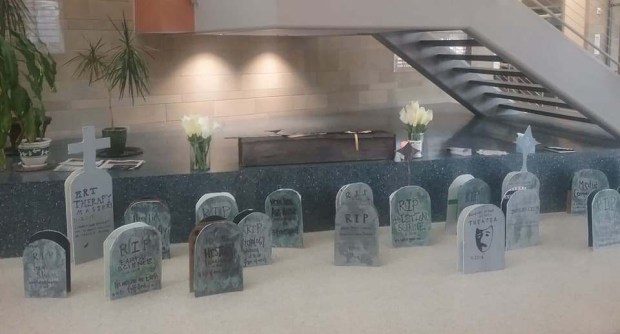
picture is of 25 handmade headstones with the names of academic programs set out in a univeristy building. in the background is a cardboard casket flanked by paper flowers.

Headstones for each cut major and minor program and a casket for the University of Wisconsin-Superior we knew and loved. The funeral was held Saturday, April 14, 2018. Photo Credit: Trudy Fredericks.

Ongoing assassinations and violence in Honduras: Carlos Hernández

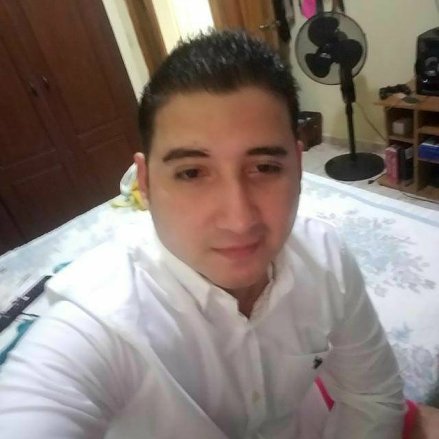
A selfie of Carlos Hernandez wearing a white Oxford shirt.

Carlos Hernández, killed in his law office in Tela, Honduras, on April 10, 2018.

Last week, another person two degrees of separation from me was assassinated in Honduras. His name was Carlos Hernández, and he was killed in his law office in the municipality of Tela. He was the lawyer of one of five people who have been criminalized for defending the water in their community as part of an encampment they have sustained since May 2017 against intense persecution. I have met all five of them.


I have visited their encampment.

He is not the first person to die in relationship to their small community’s struggle.

It is unlikely we will ever know exactly who his killer is, and even less likely that person will face any judicial process because rates of impunity in Honduras for homicide are estimated at over 90%.

It is heavy to feel so surrounded by death. I cannot imagine how it would feel if I were actually living among it daily, breathing in its possibility at every turn. The violence is so frequent even among the people to whom I am directly connected that I fear that my friends and family are becoming tired of hearing about the deaths and death threats to my compañerxs in Honduras, and will stop being willing to act. I do not wish to center myself, but rather hope to connect myself personally as an act of solidarity, enabling others to also feel personally connected and invested in the lives of others.

Carlos Hernández was young. He was the lawyer for the mayor of Arizona, Arnoldo Chacón. Chacón is one of 5 members of the Broad Movement for Dignity and Justice (MADJ – Movimiento Amplio por Dignidad y Justicia) who have been formally accused of “usurpation” for stopping the state of Honduras and the company INGELSA from developing a hydroelectric dam on the Río Jilamito.

These community members have sustained “Camp Dignity in Defense of the Río Jilamito” since May 2017, defending their water and community from attack by a foreign company. All 5 of the accused, along with the many other members of the community who have participated in the encampment, have been subject to threats and attacks over this time period. Yet they persist. They arrive, daily, in shifts, making sure the camp is tended at all times. They make food for each other, take care of each other, make decisions together, and they confront the alliance of government and private capital which not only criminalizes this care-taking activity but dares to call it usurpation.

I first met these community members after they had completed just a few weeks of their encampment, at the end of May 2017. The camp is humble but cozy, and the reception they gave to our large Witness for Peace delegation of 22 U.S. citizens was deeply welcoming. We ate soup together, we chatted, we played games, and took pictures. They found enough chairs for all of us and hardly a chair for anyone else, and we could not manage to convince anyone to swap places and take a seat in our places. Of course. It would be rude to sit while an honored guest was standing.

Picture is of a banner, sign, and Honduran flag that cover barbed wire and make up a barricade

Barricade at Camp Dignity in Defense of Water and Life at Rio Jilamito

The people who spoke that day to us are the very same people who have been criminalized and whose lives have been threatened since then. I would like to use their names and to show their faces to humanize these every day rural people who have decided to take such enormous risks to protect the water in their community, but I am afraid that it may put them in more risk. I would like to humanize them, to counter the implicit suggestion that they are terrorists for impeding economic development – to which they did not consent and from which they will not benefit – but the very act of doing so may harm them further.

The assassination of Carlos Hernández can only be understood as part of a larger system of structural and political violence which runs deep. He was killed in a country which has recently inaugurated a fraudulent President, and this presidency and regime (and the support it receives from the United States) is inseparably related to the skyrocketing rates of violence. (I plan to write more about exactly how all of this is connected but have linked to some excellent existing analysis above by Radio Progreso, Jesse Freeston, Sandra Cuffe, and Ryan Morgan to get that conversation started here.)

Even in the face of incredible odds and almost unthinkable danger, the community at Jilamito continues to maintain their active resistance to INGELSA and its hydroelectric dam project. Their resistance shows us all that it is possible.


Click here for a list of concrete actions you can take in solidarity with people in Honduras.

a meditation on tools

In the United States, the squeaky wheel gets the grease.

In Japan, the nail that sticks out gets hammered in.

Audre Lorde famously admonished white feminists at a conference in 1979 that “the master’s tools will never dismantle the master’s house.”

Black and white line image of a hammer, screwdriver, and wrench.

If you are neither the wheel or the nail, you might start to wonder about your commitments to justice.

It might not be an honor to be the last one standing.

Does that make you a tool?


lazy professor up at night

Last fall my university made the very sudden announcement to close the sociology program as well 24 others. Part of this experience as a faculty member is being told that it’s our fault, constantly. We are implicitly and explicitly blamed for not doing enough before this point. Chancellor Wachter has said over and over again that the “students voted with their feet,” which is just a way of saying if I/we had been offering worthwhile classes, I/we wouldn’t be in this situation (among other problematic implications of this phrase she loves so much). And yet here I am, literally awake at night, either still thinking (uselessly) about what I could do to try to stop these cuts from happening, or about what I could do make our program better, or about how I could recruit more students. The other night I lied in bed with a new idea for bringing back successful graduates (which is most) to meet our current students. I had pretty much fully developed the idea before I realized the entire thing is moot. There is no sociology program to recruit anybody in to. There is no reason to ease anybody’s fears about majoring or even minoring in sociology. In fact, perhaps students have good reason to be afraid of these majors and minors. Perhaps they should be afraid the administration will eliminate them, or the faculty time and resources need to sustain them. Working to recruit more students at this point would just be more time I’d spent on something that wouldn’t be valued, and if successful, I’m afraid it would ultimately place more students in the path of destruction.

But thinking about such solutions has become almost like a reflex for me, so that even six months later it’s still hard to stop. So I still haven’t been able to stop. And I don’t know when I will be able to, because ultimately I love(d) what I do. And I wasn’t coming up with ideas to recruit students to the major just to satisfy some bureaucrat or looking for ways to assuage student fears about what it would mean to major in sociology to bolster our numbers, but I was doing it because I wanted to teach. Because I thought that majoring in sociology would actually be meaningful for students, and because I know our graduates are actually out in the world happy with their work and I’d love to see more people doing that. It’s hard for me to turn that off, because it’s hard to accept the destruction of that possibility.

I see the same difficulty turning this impulse off in my colleagues too. We keep trying to do our jobs as if the old things mattered, although we have been pretty much told over and over again by our bosses that none of what we do matters, or at least not a lot of it. But old habits die hard, and it’s precisely because we believed passionately in those old habits. Because we weren’t and still aren’t the people we’re accused of being. And that’s one of the most painful bits. We’re accused of being these lazy arrogant out of touch people who don’t care at all for our students by people who actually seem to be all of those things.

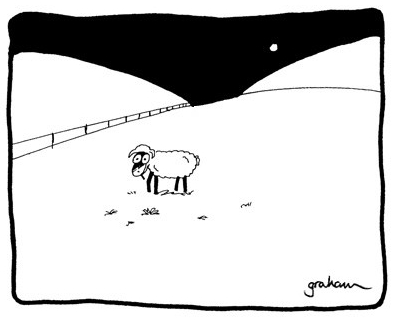
Sheep alone awake in a field at night.

Cartoon by Graham Licence

I’m left with a few hanging sociological questions for another day about the myth of the lazy professor: Who does the myth connect with? Who believes it? Anyone? Our students’ parents? Do the administrators and politicians who deploy it, or is it used totally cynically? (I don’t think the administrators believe it; I suspect they know it’s untrue and that’s why it will offend us so much.) Why does it hurt me so much if I’m not sure who believes it?

Losing the University

The university was never meant to be a place for liberation and social justice, but from its start was built for straight, white, able-bodied, cis-male elites. Rod Ferguson reminds us in his work We Demand that the fact that many of us associate universities with something else – with diversity, with the possibility for envisionining anticapitalist politics, with social justice movements – is in many ways the product of student struggles. Universities themselves have resisted these associations. Ferguson recalls for us that in 1970, four students were killed at Kent State University by the National Guard. Ten days later, police shot approximately 400 bullets into a women’s dorm at Jackson State University, killing two students. The reaction to these murders by dozens of college presidents was to “petition their state legislators not to curtail but to augment police powers on their campuses”(15-16).

The point is that I know the university is not nor has it ever been this romantic perfect place. I remind myself of that fact constantly. I was never planning on making a life here in academia in the first place; I didn’t feel like it was my life’s mission to teach undergraduate students and I have always felt like there are much better and more direct ways to make social change than education. This makes it easier to remember that the university has always been flawed, it wasn’t meant for anyone other than straight white male elites, and if some of the rest of us have managed to increasingly arrive in the past 100 years, especially the last 50 years, it has been for the most part, an anomaly. And it has been the fruits of our struggle. They didn’t want us here in the past and they don’t want us here now. They have never wanted us here. Ferguson says

For university and political elites, then, the social categories ‘tolerance’ and ‘diversity’ were never meant to inspire appreciation for the student movements, movements that might shed light on social inequalities and recommendations for transcending them. “Tolerance” and “diversity” were instead ways of saying “Society must be defended”—that is, protected from the student, who was understood to be a criminal from the start. (2017: 23)

In other words, it is not necessarily a tragedy to lose this place because there are and have always been other ways of doing this. Marginalized communities have always found ways to educate themselves, and those ways, being designed by and for liberation, have more liberatory potential than any institution which has always fought to keep us out.

But knowing all of that doesn’t seem to be helping me feel less sad right now. It doesn’t seem to be helping me much at all. The fact is that I feel I’ve benefitted enormously from my time in and around universities and it seems like many of my most marginalized students have done so as well. While these other forms of learning and education, free schools and free universities and popular educational models which I’ve been a part of, can be much more liberatory in the end, I’m afraid they will still be much more limited in their reach than the good ol’ public university in its heyday was. (Because was is really starting to seem like the operative concept here.)

Ironically, I mean, I wouldn’t even know about free schools without my exposure to the university… that’s certainly not true for everybody. And it needn’t be true. But I think it points to why I feel hope lacking in this moment. I feel a light going out. And sure, that light was really dysfunctional in the first place but it was granting wide access and possibility and acting as a funnel, at least for many students, to something much better, to much more critical ideas and action. How many of us were radicalized in the university? Of course there are other sites, other methods, other ways, but undeniably, this sucks.

The loss of access to critical thinking, to liberal arts, to social justice oriented classes throughout Wisconsin (and probably eventually elsewhere), is without a doubt, a loss of something, for some folks, who were in fact benefitting. Even if we do succeed in creating liberatory alternatives, it’s hard for me to imagine they will have the same reach and impact as the public university in its heyday. But I could be wrong. Perhaps I just need to dream bigger. I hope so. Perhaps I just need to get started on the experiment.

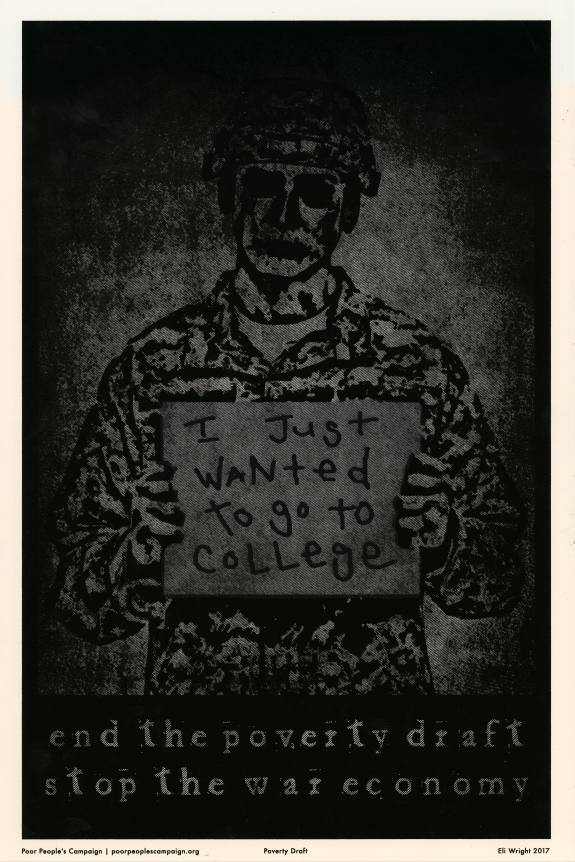
Black and white screenprinted poster of a soldier holding a sign that says "I just wanted to go to college." Text at bottom of poster says "End the poverty draft. Stop the war economy."

Image created by Eli Wright at Justseeds Collective for the new Poor People’s Campaign.

memorializing the thankless work of revolution

Winnie_Mandela_190814

Last weekend, just days before she died, I watched a documentary about Winnie Madikizela-Mandela. I wrote these words: “totally inspiring woman and many lessons to learn about how thankless the work of continuing the struggle and holding the line can really be, especially when done by women and women of color, or marginalized members of the group more generally. This woman was really sold out. One random key thing to remember: Nobel Peace Prize was also given to de Klerk when it was given to Nelson Mandela, in case you needed a reason to feel that prize was discredited.”

I am no expert on the South African freedom struggle, but the obituaries published in mainstream newspapers (to say nothing of the comment section! yikes!) only deepened my horror at how Winnie was treated. The NYT lead with a photo of this incredible woman with her ex-husband Nelson Mandela and the Washington Post was little better leading with the phrase, “Winnie Madikizela-Mandela, the former wife of Nelson Mandela and for decades one of South Africa’s most prominent and polarizing figures, died April 2 at a hospital in Johannesburg.”  She struggled to be her own person even in death.

Her story resonated with so many other Black women’s stories I’ve read and learned about over the years in particular. RIP Winnie, may we listen and learn something important from what you were here to tell us.


Anger

I am angry. In fact, I am really fucking angry. And one of the things that continually fuels my anger is the way that anger is a prohibited emotion. Socially unacceptable. I feel that each time I am openly angry, people around me wait quietly for me to finish my tirade. Or worse, try to calm me by telling me to see things another way, or to try to have sympathy for the other person or something like that. All of this sends me the message over and over, constantly, that being angry about the world is not OK.

But Black people are being murdered in the streets by police in the United States.

But I am a queer person who has lived my entire life in the closet because I wasn’t sure what else to do because heterosexuality is still that normative.

But femicide is still the norm not only through Latin America where the women are marching and yelling “Ni Una Menos” (not one woman less) but here in the US too where domestic violence continues to be a raging problem and I do not believe there is a person assigned female at birth, woman, or femme who has not experienced some form of sexual assault/harassment.

But almost no one gives a real shit about poor people or understands exactly why there are still poor people who lack access to stable food, water, and housing.

But having a disability makes a person dramatically more likely to be subject to the above problems and eugenics is still our normal way of thinking about bodies with differences.

I could go on.

Stencil of a woman posed to throw a brick.

Image by Nicolas Lampert, Josh MacPhee, and Colin Matthes (Justseeds Collective).

This world is an enraging place and it’s probably not a stretch to say that most of these problems are caused or at least perpetuated by indifference.

And without even going that far, why aren’t the whole range of human emotions permissible? Why do we want, and enforce on each other, an impoverished society where people are not allowed to express sadness and anger and joy? I don’t want to live in that sad little range of emotions either. I’m not advocating throwing a chair and breaking into sobs, necessarily but we not express verbally the way things do actually make us feel? I am at a loss for a rational argument against that.

But although I am a sociologist, and although I am a nonconformist with a lot of training in not giving many fucks what anyone thinks, it gets to you after a while when people just seem to think you are being too angry all the time. Maybe it is too exhausting. Maybe you are overreacting and getting angry at things that aren’t there. Maybe I have lost my ability to “look for the other side” as we did in the movement where I found the most meaning, and try to find community. Maybe I am alienating those I want around me.

And then I realized there is a name for this behavior, and this treatment. I am behaving like an angry feminist. I am being treated as such. How boring. How frustrating. I am scary enough that no person in my life would ever dare to literally tell me to calm down, but tacitly that’s what’s happening.

But I’ve snapped. Sara Ahmed describes this experience beautifully in Living a Feminist Life. Ahmed describes how when a feminist or a twig snaps, it can seem sudden because the pressure leading to the snap (what the twig or the feminist experiences) can’t always be observed from the outside. She writes:

“You might experience that pressure only when you are under it, rather like you encounter the wall when you come up against it. The weightiest of experiences are often those that are hardest to convey to those who do not share the experience. If a snap seems sharp or sudden, it might be because we do not experience the slower time of bearing or of holding up; the time in which we can bear the pressure, the time it has taken for things not to break. If the twig was a stronger twig, if the twig was more resilient, it would take more pressure before it snapped. … And then: violence is assumed to originate with her. A feminist politics might insist on renaming actions as reactions; we need to show how her snap is not the starting point.” (2017: 189)

This passage resonates very much with the anger I’ve experienced lately. When I express anger, it is regarded (and sometimes I am told directly) that it’s “distracting” from whatever I’m trying to explain or call attention. No one is interested any more in what lead to the anger—the pressure that lead to the snap. As if I were in perfect control, as if I were perfectly able to not be angry, as if I could avoid snapping. Can you bend a twig all the way back and then blame the twig for its lack of flexibility?

I love how her metaphor also makes me question the concept of resilience as a good thing. It doesn’t seem good to accept more pressure, to work harder to hold things together, especially when “things” are dysfunctional or especially sexist and racist institutional cultures that are harming human beings. The image that comes to mind is a woman with two feet on two different icebergs floating in different directions. She too will snap, sooner or later. Why not call attention to the problem sooner?